Sunday, May 17, 2015

Back in the Saddle!

This Pack of Gnolls has finally begun a new Dungeons and Dragons game! I was gifted a Fifth Edition Player’s Handbook and Monster Manual for Christmas this past year by my father-in-law, and promptly picked up a Dungeon Master’s Guide soon after. I was impressed with what I read, to be sure, and was quite eager to get a game started with my kids.

Unfortunately, that proved difficult. At the time I was working at the Iowa Fertilizer Plant in Southeast Iowa, some 200 hundred miles from home. The money was good, a lot of overtime, but it was damn hard being away from my family. A month ago, there was a massive lay-off at the plant (even though construction wasn’t even close to complete) which sent some 1500 construction workers packing.

Fortunately, it didn’t take long for my union hall to find me new employment close to home, and an actual 40-hour work week has given me time for an actual life. It wasn’t long before a good friend asked if I’d be interested in some D&D; he and his buddies hadn’t played in several years. I was eager to give 5th Edition a spin, so characters were made and a game begun!

We have four players; a Halfling thief, a Drow ranger, a Dwarf paladin, and a Tiefling druid. The setting is about as straightforward as it gets for D&D. A big bad red dragon has taken over the peak of a mountain and has started demanding tribute from the city at the base of the mountain. Of course, a long time ago, the mountain was home to a Dwarven kingdom. Now, those ancient halls are filling with monsters answering the dragon’s call for minions and treasure.

We’ve had two sessions so far. With the first we only got as far as a roadway encounter with some goblins as the team made their way to the mountain. With the second they found their way into the mountain, did battle with a couple of bears and a group of orcs. Both sessions resulted in enough experience points for all the characters to level up at the end of each.

I certainly made the critical mistake of really only skimming through the rules before getting started with the game. I’ve read through so many different editions of D&D, including retro-clones, that a lot of the rulesets tend to run together. So the first couple of sessions certainly suffered from a lot of looking-up the rules timeouts, but we are starting to get the hang of it.

I know I didn’t expect the characters to level up quite so quickly, although I did certainly throw some challenging encounters their way, so they earned it.

So far, the only complaint I really have about 5E is that the monsters seem to have just too damn many hit points. For the time being, I feel like I should trust the playtesters before changing very much, and see how it plays out as we progress. I imagine that the rate of progression for the PCs will slow after another session or two, especially as they get deeper into the mountain and the challenges become more cerebral and less combat-oriented.


It is very good to be rolling the dice again, and having a creative outlet. Hopefully, I will be able to start up a game for my kids as well, but that depends on their behavior around the house to get that up and running. I do have some good ideas written up for them, if they can get their acts together! 

Thursday, November 28, 2013

Thanks

I have hardly even thought about D&D or any other types of RPGs in months. It's pretty much been all Magic: the Gathering here, which has done an excellent job of sating my fantasy gaming needs of late. 

Now, on this National Day of Mourning, I'm enjoying the rare day off work and randomly just popped onto my old blog here to see what was going on, and after clicking on a few other links in the OSR-osphere, found myself sucked into post after post at the Dungeon Dozen

Every single post there just oozes so much possibility. The randomness, the hilarity, the devious plots and the gory endings. Of course I couldn't help but wonder just what a campaign would look like, determined by these random charts. 

Seems fun. Not sure if it'll happen. 

Anyway, thanks for the inspiration, Dungeon Dozen!

Sunday, March 24, 2013

Castle Ravenloft Adventures and Conversion Thoughts


Let’s take a look at the adventures that come with the Castle Ravenloft game, and see what we can pull from them for this mash-up.

Adventure 1: Escape the Tomb
The basic premise is that a single character, having been plucked off the street by a vampire, finds him/herself in an underground crypt. They somehow know that it is daylight, and have until nightfall to escape, lest Strahd awaken and come for them!
This I can work with, and it presents a pretty good way to give a character just enough experience points to go from zero to first level. Will probably have to take a little extra time sculpting this adventure to make sure it’s not too deadly for 0-levels… but maybe it should be. Of course, Strahd will be changed to one of the Innistrad vampires. Assume as much moving forward with the rest of the adventures.

Adventure 2: Find the Icon of Ravenloft
Here, the idea is that somewhere under Strahd’s castle, lies a chapel which is untouched by the evil darkness of the place. Inside is an artifact called the Icon of Ravenloft, which a local priest believes can be used to defend the town and possibly destroy the vampire lord.
This kind of thing I would prefer to run later on, perhaps at level 3 or 4. The Icon of Ravenloft I would simply change to the Witchbane Orb.

Adventure 3: Klak’s Infernal Artifact
This adventure features a kobold sorcerer, Klak, who has conjured up some infernal magic into an infernal artifact. All manner of chaotic magic has been swirling around Barovia, which has prompted the town elders to ask our heroes to investigate. Klak has a mad-scientist laboratory and everything!
There are a couple of interesting special rules to this adventure. First, when the heroes use XP to cancel out an Encounter Card, the active hero takes 1HP damage. Also, when certain dungeon tiles are drawn (the ones with white arrows), the active hero gets a random power card from among those they didn’t start with.
Not sure how exactly to manifest these things within my system. Gonna leave this one on simmer for a bit.

Adventure 4: Daylight Assault
This one’s pretty basic. The heroes decide to sneak into Strahd’s castle during the day, while he’s sleeping, and steal a bunch of his stuff. Sounds like a recipe for disaster to me. But it can pretty much be run straight, just have to have a decent way to track the time. The board game uses a “time track” which progresses when certain board tiles are placed. Not sure if that’s ideal for this or not. Probably not, but maybe.

Adventure 5: The Final Transformation
Okay, now this one is a bit more interesting. A villager/friend/lover/family member of someone has been bitten by Strahd and is being turned into a vampire. The only way to save him is to venture into the dungeon with him in tow, find a Dark Fountain, and let him drink from it. Unfortunately, he starts acting crazy when monsters are around.
This one is a bit more difficult, just because of the flavor in the Innistrad “Planeswalker’s Guide” articles of how vampirism works there.
Also, it would be way more fun if it was one of the player characters.

Adventure 6: Destroy the Dracolich
There’s a big nasty Dracolich rampaging across the countryside, destroying everything in its path. It is apparently Strahd’s new pet.
I would change this to fit with the flavor of Stensia. Specifically, instead of a Dracolich, it would be the Scourge of Geier Reach.
So that should be fun.
Also, that adventure is not going to be in the dungeon.
However, I do like the part about the phylactery in this adventure, as it fits perfectly with the Dracolich concept. Probably have to do something similar with the Scourge.

Adventure 7: Impossible
This one is nuts. Individual heroes, for some magical reason, assaulting the dungeon alone, and must defeat three out of six possible major villains (not including Strahd).
Perhaps this is a good time to examine the more unique villains from the game. There are six.
The Howling Hag: the Morkrut Banshee is a card from the set that jumps out to me immediately for the Howling Hag. Unfortunately, it’s effect in Magic doesn’t translate all that well to tabletop D&D, so we’ll have to come up with something else. Fortunately, we have Monster Manuals.
The Young Vampire: Didn’t we already save him in adventure 5?
The Werewolf: Werewolves were a major part of the Innistrad block, bringing with them a new mechanic (flip cards), so this fits right in. Picking the right one is going to be the biggest issue, I think. It’ll probably be someone the PC’s know and love and would never suspect of being a werewolf. The only other problem I can think of is that the vampires and werewolves of Innistrad don’t exactly get along very well (though I’m sure there are outliers).
Klak, Kobold Sorcerer: uhh, pretty sure we took care of the little bastard earlier, too.
Zombie Dragon: Yes.
Flesh Golem (uhh, can we just call him Frankenstein?): Extra yes.
And as for using this as an adventure in the game… probably not. It’s a suicide mission. In fact, it’s kind of written that way in the guidebook. When one of the heroes die, you just pick up with the next one who shows up.

Adventure 8: Horror of the Howling Hag
This is one of the more interesting adventures in the booklet, mostly because of the way it’s set up. You prearrange the board in a 5x5 tile square, with a Hero starting on each of the four corners, and the center tile, an Arcane Circle, revealed in the center. The heroes must make their way to the arcane circle in the center to disrupt the hag’s magic ritual.
I think this adventure can probably be run almost straight out of the book, with appropriate modifications for M74 rules, of course. I would add some build-up to the whole thing, of course, but overall it’s fun adventure. Really, the only problem is that it involves multiple characters who are isolated, and the nature of the board means the players would have easy access to information the characters wouldn’t have.

Adventure 9: Gauntlet of Terror
This adventure is quite literally a “hold the gates” type of scenario. The heroes are supposed to prevent 5 monsters from leaving the dungeon and heading for town, and “win” once they have killed 20 such monsters.
This one would probably be quite good every once in a while as something simple to run that doesn’t require much in the way of set-up or even organization. This one also has the added bonus of being easily adjustable to any number of locations, the most important part is keeping the monsters from getting past the heroes. Pretty straightforward.

Adventure 10: Blood and Fog
For this adventure, the situation is one where the heroes become trapped in the dungeon and must find an alternative exit (which is the Secret Stairway tile, hidden some ways down the stack).
This is really the kind of thing that could be sprung on a hero or heroes during any adventure, and really may be better that way.

Adventure 11: Rampaging Golem
Frankenstein’s monster is on the loose! This one is fun because instead of actually fighting the rampaging Golem, the heroes can attempt to find certain items and attempt to calm the monster. Of course, they could just fight the monster. Granted, some of the items enrage the golem, while others calm him down, and there’s no rhyme or reason to which ones do what.
Definitely going to be included as a possible adventure, except in Innistrad these monsters are apparently called “Skaabs”. Or something. (Probably because the previous block, Scars of Mirrodin, featured Golems extensively, and there would be too much overlap in potentially broken mechanics).

Adventures 12 & 13: The Hunt for Strahd
I do like that there are two parts to this adventure, and that the heroes have to defeat Strahd not once but twice to be ultimately victorious. Defeating him at the end of Adventure 12 just causes him to turn to a mist, and lead in to Adventure 13. There are numerous items to collect to help defeat Strahd, and his “bodyguard” needs to be defeated first, which is one of the minor villains already encountered in the previous adventures.
Now, obviously, Strahd is the wrong villain for our world, but this could just as easily be Olivia Voldaren or Edgar Markov instead. As for the items to be collected, I would prefer to have them all being collected over time in several different adventures, as opposed to all at once. So really, this adventure is kind of a little outline for the overall storyline. That I can work with. 

Friday, March 22, 2013

The Nature of Magic on Innistrad


Innistrad, being part of the Magic: the Gathering multiverse, is inundated with magic. In MtG, there is no difference between arcane and divine magics like we are accustomed to in D&D. Instead, magic is flavored by its mana source, of which there are five options: white, blue, black, red and green, the mana of which is garnered from lands like plains, islands, swamps, mountains and forests, respectively. Priests of Avacyn, on Innistrad, would naturally believe their healing and protective magic is granted to them by the angel Avacyn herself. Rather, they just simply do not fully understand the source of the magic. 

This line of thought naturally will cause a change in the way I described magic in my last post, but this is more a thought experiment to see what I can conjure up for this game. 

So, by eliminating the clerical options, and instead expanding with the five different colors of Magic, we are offering the players significantly more choices with their character progression. We'll retain the "have to have used it to acquire it when you level" rule. What this means is that any magical item found in the game will have to have a color identity of some sort. 

I would also propose that when a wizard gains a level, they have to physically make a connection with the land that is the source of their particular color of magic. They cannot cast their spell on their own until they do this! Mana flows from the land, and they must be bonded with it to use it. 

This is the kind of thing that will require a ritual of some sort, of course, each of which would be different depending on the type of mana. 

So, the basics of each of the five types of magic. 

White magic comes from the plains, and is often protective or healing in nature. White magic all about justice and law. D&D's clerics would use white magic. 

Blue magic comes from islands and the sea. It often works on the mind, with illusions and deception. D&D's illusionists would use blue magic. 

Black magic, from swamplands, is as bad as it sounds. It is the magic of death, decay, selfishness and raw power. Black magic is the province of necromancers. 

Red magic, of the mountains and highlands, is chaotic and full of unfettered emotions. It is often manifest in flames. 

Green magic, from the forests and woods, is the magic of nature. The druids of D&D would use green magic. 

Choosing a color of magic at one level does not preclude a mage from choosing a different color at another level (as long as they have experience using magic of the particular color). It does, however, mean they will have to forge another bond with a different type of land. Gaining a level in a second color will not be difficult. However, the third, fourth, and fifth will be. There is a chance the land will reject a mage, and the ritual fail. 

Thursday, March 21, 2013

Microlite74/D&D Adventure System Mashup: Innistrad


Okay, we got a lot going on here, and a lot of it is subject to change as I move forward with tweaking and gameplay, but here are the basics we'll be working with for the M74/D&D Adventure System Mashup set in the Magic: the Gathering plane of Innistrad. *Really, really need a better name for this project!*

We are using the basic Microlite74 rules for this game, with some tweaks to fit the setting.

Players start as 0-level townsfolk in the province of Stensia, on the plane of Innistrad, under the rule of bloodthirsty vampire families. The game is set on the Magic: the Gathering plane of Innistrad. The characters all begin as townsfolk in the dark province of Stensia, a province ruled by vampires.

http://www.wizards.com/magic/magazine/article.aspx?x=mtg/daily/stf/167


The Voldaren Estate, home to Olivia Voldaren, is the primary location for adventure in this game. The haunted dungeons beneath the estate are in a magical state of flux, and only vampires and their servants can navigate them without getting lost or trapped inside. There are two other major vampire strongholds in Stensia: Markov Manor and Castle Falkenrath. Adventures can certainly take place in these locations as well.


Player Characters
0-Level characters require 10 experience points (experience points, or XP, are explained below) to advance to 1st level, whereupon they gain a class.

0-Level Characters begin the game with the four basic attributes, determined by rolling 3d6 and arranged to taste. The four basic stats are Strength, Dexterity, Charisma, and Mind. Each stat has an ability modifier equal to the score, minus ten and divided by 2, rounded down. For example, a score of 15 would have an ability modifier of 2 (15 minus 10 is 5, which divided by 2 is 2.5, rounded down is 2). The roll bonus for each attribute is used for skill rolls of different sorts.

There are two other basic stats every character has. These are Armor Class and Hit Points.

Armor Class is a measure of how difficult it is to hit a character. Armor Class is equal to 10 plus the Dexterity Modifier plus the Armor Bonus. If a character wants to hit a monster, they must roll a number on a D20 that is greater than their foe’s Armor Class. That particular roll can be modified by a character’s ability modifier, explained above, for different stats depending on the action undertaken.

Hit Points are a measure of how much “damage” a character can take before they are knocked out. A character has hit points equal to their Strength attribute. We prefer to think of it more as how many “near misses” you get before a brutal, mighty (or lucky) blow knocks you out. After all, you only get so many close calls.

What class a character becomes depends on the actions they take. There are four different basic classes from which characters can acquire skills. 

Warrior. To become a warrior, a character must bash monsters!
Rogue. To become a rogue, a character must be sneaky and demonstrate fine motor skills.
Cleric. To become a cleric, a character must find an item that allows them to channel their faith, typically a holy symbol of some sort, and successfully use it in the name of their god.
Wizard. To become a wizard, a character must find an item that allows them to cast spells, be it a spellbook, a magic wand, ring, or staff, etc.

There are further variants on the basic classes that can be acquired as the game progresses. Specialty wizards, paladins, rangers, bards, etc are all options if the player wishes to pursue them. For the most part, it simply requires walking the walk. If a warrior or cleric, for example, decides their fate is to be a paladin, it is up to them to become a paladin, to acquire the armor and weapons and pronounce their faith.

These variants are limited only by the player’s imagination. Special abilities of classes can be discussed with the DM and should be based on D&D sourcebook material.

Most of the action will take place in the dungeons below the vampire strongholds of Stensia. The tile-placing dungeon-building method from the D&D Adventure System is ideal for this, as it allows the DM to focus on creatures and goals, rather than endlessly drawing out maps.

Each newly placed tile will present a potential problem for the adventurers. There is a chance of monsters rushing them from the darkness, traps being set off, and a variety of other environmental hazards to navigate.


Leveling Up and Experience Points

We will use the standard M74 rules for leveling, with a few tweaks of course.

All characters begin as Level 0 townsfolk. Experience Points are gained for defeating monsters, completing quests, and spending gold. Typically, a monster will be worth a number of experience points equal to its Hit Dice. A character earns experience points from spending gold in town to help others in some manner, with no other gain for themselves. A character earns 1 experience point for every 100 gold spent in this manner. This can be anything from simply being a very generous tipper at the pub, to throwing a party for the whole town. A character shouldn’t be offered true quests until 3rd or 4th level, which is about when people will start to see them as heroes, based on their deeds.

Level.     XP required
1.              10
2.             30
3.             60
4.             100
5.             150
6.             210
7.             280
8.             360
9.             450
10.            550

When gaining a level, a character may choose to gain a level from any class in which they have experience. That is to say, if a character has physically fought with weapons, disarmed traps, cast spells in some manner and used a holy relic of some sort in a display of faith, they are free to choose any of the four basic classes to level-up as. They are free to choose a different class at each level.

The physically-focused classes, Warriors and Rogues, earn Feats when they gain a level. Spellcasting classes, Clerics and Wizards, earn Spells upon gaining a level. Characters also get more hit points when when they go up a level. Finally, PCs have the relevant ability score of their class (for this particular level) raised by one.

Hit Points gained per level
Warrior: 1d8 plus Strength modifier
Cleric: 1d6 plus Charisma modifier
Rogue: 1d6 plus Dexterity modifier
Wizard: 1d4 plus Mind modifier

Because leveling is based on actions taken during the course of the game, players have a good bit of freedom to build their characters, albeit slowly. If all a player wants to do is bash monster heads, they can go right for it, taking warrior every level and kicking a lot of butt. If a player wants a more well-rounded character, they can take warrior at 1st level, gaining a warrior feat, 1d8 plus Strength modifier hit points, and getting a plus 1 to their Strength score, then at 2nd level, after having acquired a couple magic spell scrolls in a dungeon, take a level of Wizard. They’ll then gain 1d4 plus Mind modifier hit points, learn one of the spells they were exposed to, and get a plus 1 to their Mind score.

Basically, no character is locked in to their first chosen class.

Warrior Feats
Combat Training: plus 1 to hit, plus 1 to damage with melee weapons
Archery: plus 1 to hit, plus 1 to damage with bows and crossbows
Thrown Weapons: plus 1 to hit, plus 1 to damage with thrown weapons (daggers, axes, hammers)
Cleave: when an opponent is knocked out, get an extra attack against another nearby foe.
Push: on a successful hit, push an opponent away from you one square.
Weapon Specialization: plus 3 to hit, plus 3 to damage with one unique weapon.

Rogue Feats
Quick Feet: you don’t provoke opportunity attacks for movement when adjacent to enemies.
Sneak Attack: if you can sneak up on your target unnoticed, double damage on a successful attack.
Move Silently: plus 2 to any attempt at moving silently.
Pick Locks: plus 2 to any attempt to pick a lock with appropriate tools.
Disarm Traps: plus 2 to any attempt to disarm a trap.
Reflexes: plus 2 to Armor Class while wearing light armor.

Spellcasting

Magic is difficult to learn and even more so to control. However, there are magical items scattered throughout the world from which those aspiring to wizardry or the priesthood can learn from.

Wizards can learn magic from a variety of different sources: magical wands, staffs, rods, and rings, for example, or from casting spells inscribed on scrolls. When a wizard gains a level, he or she can gain the ability to cast any single spell that they have cast over the course of gaining experience for that level. It is up to the player to keep track of these spells. So, if character has used a scroll to cast a Fireball, a wand to cast a Lightning Bolt, and a ring to cast Feather Fall over the course of gaining their most recent level, they can choose one of those spells to permanently remember and cast at will.

Priestly magic works differently. The character must have a holy symbol of their deity. At any time, they can beseech their god through a prayer, be it to put a blessing on something, or repel undead, to heal wounds or purify something. The DM must roll for the success or failure of this prayer in secret! The character will not know immediately if their deity has granted their request (however, it depends on what exactly the request is). 

Also of note, is the current state of priestly magic on Innistrad. The only "deity" the humans of Innistrad worship is the archangel Avacyn. However, she has disappeared of late, and priestly magic has grown weak. Her disappearance is a mystery, although the recent rise in the frequency and ferocity of monster attacks that has coincided with her vanishing is not lost on the people of Innistrad, and many wonder what they have done wrong to cause their angelic leader to abandon them. 

Adventuring

Most adventures will take place in the tombs, crypts, and dungeons below the vampire strongholds of Stensia. Time permitting, the DM can prepare other sites for adventure, but the tile-placing method of the D&D Adventure System is ideal for quick dungeon delves.

Every time a tile is placed, there is a roll on a chart to see what happens. Often there will be a monster coming out of the darkness, other times a different event will occur.

The Event Die

The DM shall have a D12, set to 1, at the beginning of the dungeon adventure. At the end of each round, one PC must roll their own D12 and roll higher than the current number on the DM's event die. After each round, the DM ticks the event die up one. If a PC rolls below the current number on the event die, an additional random encounter occurs (these are significant and more dangerous than what happens with each placing of a tile). Certain actions in game can cause the event die to tick up further. 

Also, the DM can rule that a player must roll a smaller size die if they have been particularly foolhardy.

Combat

Combat is fairly straightforward. Characters get one attack type action per turn. To do this, they declare who or what they want to attack (or some other action they wish to take), and roll a 20-sided die. The higher the roll, the better. If making an attack, they must roll higher than their opponent’s Armor Class. On a successful hit, roll for damage, according to the weapon being used, and subtract that amount from the hit points of who or whatever was hit. If a PC has zero hit points, they fall unconscious. An unconscious character loses 1 Hit Point per round until their wounds are bound. If they reach a negative number of Hit Points equal to their Strength, they will die.

Monsters simply die when they get to zero hit points, although PCs may declare their desire to subdue monsters instead of killing them. This must be done ahead of time.

There are squares on the board. Each one is about five feet across. You can only make a melee attack against something in a square next to you. You can only make ranged attacks against something that is more than one square away from you, that you can also see.

Opportunity Attacks occur when you are adjacent to an opponent, and then attempt to move away from them. Basically, they get a free shot at you when you try to get away. If they hit, you take damage and fail to get away.

Saving Throws

Sometimes, something dangerous happens, and there’s a chance you can dodge disaster. In these circumstances, the DM will often call for a “Saving Throw” to see if you dodge the fireball, or resist the mind control spell, or what-have-you. Saving Throws are simple: roll a D20, add the relevant ability modifier (the DM will tell you which to use), and hope you score a 20 or higher in total to make your save. 


Tuesday, March 19, 2013

Back in the Game!


Hey, it’s only been about six months since last I posted anything here. After spending all of my available nerd energy playing Magic: the Gathering over most of that time, I’ve gotten the itch to run some D&D again, but it has to be in a way that works for our very large and busy family. Magic: the Gathering has been perfect for us, as it satisfies the fantasy cravings while being quick to just pick up and play when I have even a little bit of time with one of the kids.


D&D, on the other hand, required me to spend a good deal of time during the week preparing for the weekend session. These sessions often devolved into contests amongst the children of “who can be the silliest and garner the most attention at the table” to the endless frustration of myself and my father-in-law.

So, something different is in order. We need something that I can just pick up and run when I have a spare hour or two with a couple of the kids, because that seems to be about all I ever get. Basically, it’ll be a blend of the D&D Adventure System Games (Castle Ravenloft, Wrath of Ashardalon, Legend of Drizz’t) and Microlite74.

The system will build on what I started with Hyrulian Adventures (see my last half-dozen or so posts). Hyrulian Adventures, by the way, went well, but our increasingly busy family schedule kept us from having a free Sunday afternoon for a while, and then it became harder and harder for me to get refocused on it enough to start it up again… along with the aforementioned behavioral issues with the children at the gaming table.

I’m currently working on putting it all together. The basic idea is that I’ll be able to use the tile based dungeon-building mechanics from the D&D Adventure System for a good number of quick, short adventures when I don’t have something bigger ready to go.


The setting is going to be something the children are already quite familiar with: the plane of Innistrad, from the recent Magic: the Gathering set. Particularly, the province of Stensia, which is ruled over by powerful vampire clans. This, of course, works pretty well with a lot of what already comes in Castle Ravenloft. It also provides a decent amount of pre-built setting that the children know well; well enough they will be excited when they find certain artifacts they recognize from the cards they play with, or likewise meet certain characters, many of which I will be sure to weave into the story. 


All in all, I think it's a good start. I've got a good bit written up to get it all started, and I'll have it posted up here in the next couple of days. It's been a while since I've even cracked open the old D&D tomes, and it feels good perusing these old books for inspiration once again. 

Tuesday, September 18, 2012

Hyrulian Adventures: Alignment in Legend of Zelda

Alignment in the Legend of Zelda games is an interesting beast. There is clearly an old school D&D, Law vs Chaos thing going on, right?

Kinda.

Sorta.

But there’s more to it than that. When we look at the mythology of the world, it centers around the power of the Triforce, of which there are three (four?*) parts: Wisdom, Power, and Courage. Each of these parts is personified in Zelda, Ganon, and Link, respectively.

*That fourth part would be the upside-down triangle there in the middle. The Triforce of Shadow? Not going there in this post, but it’s worth mentioning.

So, we have alignment working along these three axes. We have a Triforce of Courage that needs reassembling, and then someone to wield it. Who should that be?

Obviously, the person who has been the most Courageous! This will mean a great deal more bookkeeping for myself, as I will need to keep track of the PCs actions every game and make judgment calls (quite frankly, more than I’m really comfortable doing, but I think it will be worth it in the end) on whether their actions have been Wise, Courageous, or Power-hungry. In the end, only one of them can raise the Triforce of Courage and fight Ganon. Of course, I’m not going to tell them I’m keeping track of this kind of thing.
Side-note: what happens if someone who is not pure of heart or truly courageous enough to wield it gets his or her hands on the Triforce of Courage? Something exciting I’m sure… Because I'm not going to just come out and tell them who is supposed to wield the Triforce of Courage! 

Right now, I have it set up with a kind-of points system. Basically, each character will get a point in the appropriate column whenever they do something in-game that is especially Wise, Courageous, or Power-Hungry. I wish there was a good way to make Wisdom, Power, and Courage each PC's stats, but I'm not sure how to make it work. They feel more like personality attributes than physical statistics to me, which is why I'm keeping them separate. I do have plans to use these scores in a couple of different ways down the line, which I'll explain when we get there (eventually). 

But also, what happens to the character who has been the most Wise?

Or the most Power-hungry?

Any ideas? Sound off in the comments below! 

Monday, September 17, 2012

Hyrulian Adventures: Session 1


I was a little stressed out leading up to getting started yesterday; I haven’t run a D&D game in several months, and running a game for the kids can always be a challenge. On top of that, I didn't have as much prepared as I would have liked, and knew I would be winging some of the session. We started with character generation. We had five characters fully done up within an hour and a half. Microlite characters are pretty straightforward, of course, and most of the time was taken up buying supplies.

I explained it in an earlier post, but I’ll recap here. PCs start basically as level-0 townsfolk with three stats: Strength, Dexterity, and Mind. Stats are calculated using 12d6, dropping the three lowest rolls, and assembling three scores with what remains and assigning as the player sees fit. Ability modifiers are calculated by taking the score, minus ten, and divided by 2, rounded down. They all get 12 HP plus a Strength bonus. They all rolled on my Character (Family) Background Generator, which gave us the children of a barber, a forester, a farmer, an arrowsmith, and explorers. There are no levels. Character improvement happens through acquiring items in-game, training with NPCs, and success with certain tasks in the field. I’m still ironing out some of the details, but I have plenty of time and some good ideas, I think.

Regardless, things got off to a start with some combat. I’ve learned that with the kids, they need some action to start things off. So I explained the situation, plopped down a battle map, and we got to rolling dice.
They nearly died.

It was fantastic.

So, having successfully fended off the bokoblin attack and defended their fellow villagers and the refugees, they set off to help the town by acquiring more weapons and armor. They upgraded their “weapons” (really just hunting tools) by having the town blacksmith do a little work on some of the swords that were dropped by the bokoblins from the attack in town.

They have a general map of the area (which belongs to the daughter of the explorers), and they were faced with a few options. First, Lon Lon Ranch is some five or six miles from Kakariko Village, and there was some concern if the ranch would be okay. Also, Ordon Village, some twenty miles to the south, could also be in need of assistance. Finally, there was an area on the map clearly marked “Ruins” to the Northwest (the remains of the original Hyrule Castle, perhaps…?). They eventually settled on heading to the Ranch.

A random encounter happened first. Currently, as it is always dark and Hyrule is crawling with monsters, I’m rolling for every mile travelled. I roll 2d6, and if either face pops up a 1, bam, random encounter. Snake Eyes would be the discovery of something fairly major.

They came across a ruined tower, though it still had a second floor at least. It also had a pair of bokoblins guarding the entrance. An ambush took the guards out and they set up to move in. My father-in-law directed their movements, and they made quick progress with good cover, and the encounter with another four or five bokoblins inside didn’t last very long.

They did, however, fail to investigate upstairs. Not sure why, as bokoblins were coming at them from upstairs, but I wasn’t about to remind them. The tower’s not going anywhere, and whatever was up there will still be there, right? Maybe? Who knows.

They made it the rest of the way to Lon Lon Ranch, where they met Malon and her father Talon. Malon is the twelve year old girl who really runs the Ranch, and Talon does what he can to help out. When they come up, she is armed with a shortbow and certainly not thrilled to have strangers, but is willing to let them stay the night in the barn if they help out repairing the ranch.

Oh, and there’s a cave nearby where all these monsters seem to keep coming from, and little Malon just hasn’t been able to get over there and clear it out. Could you guys investigate?

In they went. Numerous encounters with Deku Baba plants later (the little bastards kept popping back up out of the ground after they killed them, wonder why...) and they were face to face with some robed evil dudes creating bokoblins in some kind of foul ritual involving rupees. The robed guys went down fairly quickly, but not before one of them toasted our heroes pretty good with a fireball attack of some sort.

Of course, the two youngest adventurers took the bait of the evil-looking daggers dropped by the robed fellows. And as they were trying to leave the dungeon, fighting their way through the Deku Baba plants that had grown back, one of the plants grabbed the boy as he tried to stab it with said evil dagger and chewed him up good. The rest of the group took the plants out and hauled the boy out, but he would need a few days to recover, and that only with the aid of some famous Lon-Lon Milk. Needless to say, they’re not really sure what to do with those daggers now…

And that’s where we left things. The plan is for some of the adventurers to borrow horses from Lon-Lon Ranch, leaving the injured boy there for a few days while they head back to Kakariko to deliver some of the weapons they’ve acquired, and then head back to Lon-Lon and then down to Ordon Village. We’ll see how things go, of course.

Overall, a good first session for the campaign, I think. If there’s anything that’s going to kill the kids, though, it’s greed. They all suffer from “Gimme Gimme” syndrome; they all want the shiniest new thing to show up, and it’s always a competition amongst all of them to see who can get it. They were going after fallen rupees in the middle of combat. Seriously. It nearly killed a couple of them on a couple of occasions. Once that nonsense started, any thoughts of taking it easy on them vanished. Not that I was fudging any die rolls (everything gets rolled right out in front of God and everyone), but I certainly wasn’t going to bring my B-game as far as tactics with the monsters was concerned. After all, they had been warned before the game started that their characters were fragile and could easily be killed if they weren't careful...

The kids had a good time, though. There was certainly some frustrations from every seat at the table at some point, be it from a string of poor die rolls or lamenting bad decisions, but all their characters (barely) survived to see another session, so we’ll continue on!

Sunday, September 16, 2012

Hyrulian Adventures Begin


Hyrule has known peace for a thousand years at least, under the strong but caring leadership of the Royal Family.

All that changed last Thursday morning, when the earthquakes began. While rare, earthquakes are perfectly natural events, and certainly no cause for alarm. Until they continued. For three days. Much of Kakariko lay in ruins, only the sturdiest buildings surviving.

The next day, a boy, carrying a shield and a sword and wearing a green tunic, rode into town, and sought out the elder Sahasrahla. Within a couple hours, he was gone again. Apparently, he was the “Hero of Legend”, but you had never heard of this legend before.

Then the monsters came.

And then the darkness followed. The sun has not been seen in days. You can hear the howling of the monsters in the wilds.

A few hours ago, refugees arrived from Hyrule Castle Town. Hundreds of people, many of them injured, all of them terrified of what they had seen at the castle. Monsters had descended upon the town, undead rising up from the cobblestones, and the castle torn up from the very ground itself, and by some magic remains suspended there, transformed into a twisted, evil, Forbidden Fortress.

The refugees and other survivors have been gathered in the village temple. There are a few soldiers with them, and their primary concern is building up defenses for the village and its people. No one knows what has happened to the Royal Family. None of the survivors knows anything about the “Hero of Legend”. The Elder Sahasrahla pulls the five of you aside. He fears the worst; the Hero has fallen, and the Triforce of Courage is shattered and scattered across Hyrule. This evil, these monsters, can only come from someone wielding the Triforce of Power, and if what the refugees say is true, there is a good chance that someone has taken captive Princess Zelda, the bearer of the Triforce of Wisdom.

The Triforce of Courage must be recovered, reassembled, and wielded by someone pure of heart if there is any hope at all of returning the light to Hyrule! 

But first, Kakariko Village must be defended from attack...

Monday, September 10, 2012

Out of Hibernation and In Search of the Unknown!

Out of Hibernation and Into the Unknown!

It's been a good bit of time since we last checked in! This is due in part to a general lack of D&D-type gaming over the last few months, as our gaming focus has been primarily on Magic: the Gathering of late. 

However, the little gnolls have begun a journey In Search of the Unknown! A family friend, Jans, wanted to run a regular game of D&D for his ten-year-old (I think) daughter, which now includes my four minions and another of her friends. They are using the D&D Next playtest rules (the most recent one) for this adventure, and I'll probably have some thoughts on the playtest rules in a future post. 

My father-in-law and I stayed to watch events unfold and help keep the kids kind of on-track. The characters include a trio of elves (rogue, wizard, cleric), a pair of dwarves (cleric and fighter), and a human sorcerer. 

They made it to the Keep, and the silliness ensued in short order. The boys decided their dwarves would go over to the tavern, and the girls (the elves), whose characters were apparently abolitionists, promptly followed them, smacked them, and tried to take their ale away. 

Calmer heads prevailed, as Jans made it clear the local townsfolk were aghast at their behavior. I think sometimes my kids just have to cause drama with each other, as they all like to boss each other around. They also all like being the center of attention, and the younger ones especially will say and do silly things for that express purpose. 

Regardless, they did eventually make it to the dungeon. They didn't have too many problems with the monsters they encountered, and were doing fairly well at examining their surroundings and treading carefully...

Until they got to the room with all the various pools of liquid. By the time we called it a day, the dwarf fighter was fast asleep and unable to be awaken, the dwarf cleric was covered in neon green goo and completely intoxicated with the elf wizard and human sorcerer, the elf rogue was glowing blue and had a hand badly burned by acid, and the elf cleric was glowing orange, I believe. 

It may be a bit late to tell them how to use a ten-foot-pole...

Regardless, they all had a lot of fun, so I think this may be a once-a-month type of thing. It did light a bit of a fire under my butt to run some D&D again, though! If I work at it, we should be able to start Hyrulian Adventures in the next couple of weeks (possibly this weekend if I really bust my ass!). Hopefully I'll have some more material ready for that shortly. 

It's good to be back :)

Friday, May 4, 2012

Of Miracles and Soulbonds

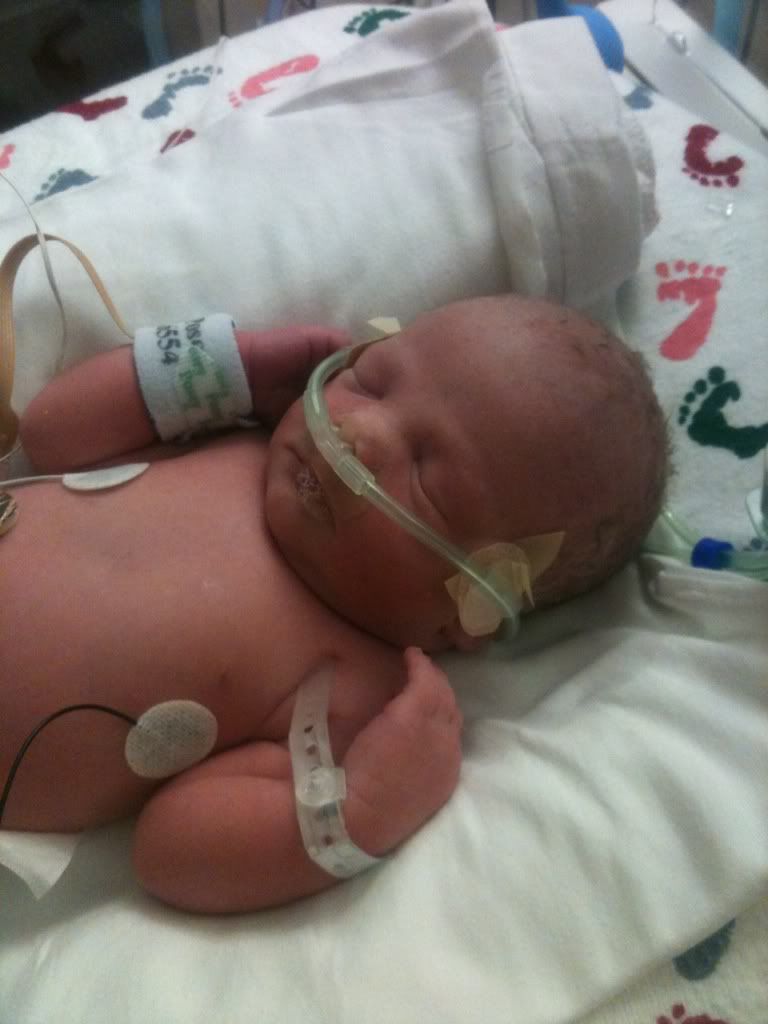
So we had our little miracle of life occur on Tuesday, May 1st, at 6:46 pm Central time. Avery Timothy Linn Sullivan entered the world via c-section delivery, due to suspected (though non-existent) placental abruption. At 33 weeks gestation, he weighed five pounds, six ounces and was eighteen inches long. As I type this, he is still in the NICU, but doing better every day.


Being that early, his lungs weren't quite as developed as they ought to be, so his oxygen and CO2 levels were a bit off, and he still needs to get the hang of sucking milk, but he's making progress.

This is my second child, my wife's fifth, and the sixth child in our household. Hers, mine, and now ours. Three boys and three girls, so we're a regular geeky Brady Bunch. Both of my offspring have had to spend some time after birth in the NICU; this trip is significantly less stressful than the first. When my daughter was born two and a half years ago, her biological mother (not my beautiful amazing wife) was, unbeknownst to me, a junkie, and she was born addicted to heroin (the junkie tested positive for heroin, amphetamines, and PCP, the baby tested positive for heroin). Needless to say, I have full custody of the child. But that time in the NICU was awful, because we didn't know what was going on (the addict wasn't exactly forthcoming about her drug use), and as it was slowly figured out... well, it's a pretty awful feeling, seeing your baby go through that. All in all, it was a sixth-month process to ween her off of a regular oral liquid morphine dosage.

So, I guess if my first kid pulled through after dealing with that big mess of terrible, this kid has it easy! By the way, my daughter is doing great now. There are some concerns that she may fall somewhere on the mild end of the autistic spectrum, but she's incredibly bright and clever and I'm sure she's going to do just fine.

We haven't played D&D in months at this point. Once things normalize, and Mama and Avery come home from the hospital, we'll be in a better spot to continue the campaign. The kids and I have continued to play plenty of Magic: the Gathering, and if any of you keep current on Magic trends, you'll have noticed the title of this article is a bit trendy.

"Miracle" and "Soulbond" are the names of two new mechanics introduced in the most recent Magic expansion set, Avacyn Restored. I just thought it was quite appropriate that this new set would be released this week, just a few days after I've experienced a miracle and soulbonding of my own!

Avacyn Restored also marks the first time I attended an in-store pre-release event, on Saturday, April 28th. It was $25, and you got six packs from the new set to open up and use to build a "sealed deck" for the little tournament they had going on there. There were maybe twenty people playing at the shop I went to (the Fantasy Shop in Florissant, MO), and I brought my oldest daughter, Alex. She's 11, and was by far the youngest person there, but she had a blast and was making everyone laugh because she's damn witty. She likes Magic but hasn't gotten terribly into it (although she is more excited about it now, after having such a good time at the pre-release).

Personal side-note about Alex: She's the oldest, and she's been through a lot. She was old enough to really remember (and still has a lot of pain from) her mom and dad getting divorced, and the roller-coaster of moves and everything else that happened before I came along. While my wife's three younger kids took to me pretty quickly, she has been reluctant to really be able to trust that I'm actually going to stick around and be a real dad. Taking her (and only her) to this Magic event (that all the other kids would have loved to go to) really meant a lot to her and was an awesome little bonding experience, even though we didn't spend a lot of time together while there. Just the fact that I took her, and she was able to have fun and be herself and talk to all kinds of different people, meant the world to her.

Anyways, I really like "Limited" Magic. There's a lot to be said about a player's skill when they have to make the best of what they wind up with in the packs they open. Randomization is the great equalizer.

It's kinda like rolling your stats 3d6 in order, when you think about it. You gotta take what you get, and make the best character (deck) you can with what you've been given. Sometimes it makes a lot more sense to run a fighter (aggro deck) instead of a wizard (control deck) purely because of the roll of the dice (draw of the cards), even if you prefer one over the other.

In fact, I liked the idea of the "sealed deck" format so much I decided we'd explore it even further in-house here. Alex and I both kept our cards from the pre-release separate, and today, upon full release, I purchased 18 fresh booster packs, six each for Kanaan, Chloe, and Aiden to crack open and start building their deck for a little league play. Each of us will play each other twice (to start, we may keep it going for a while after we finish the first set of matches) (and I have a full schedule written up, due to OCD). Every time a player earns two match wins, they get a fresh booster pack to open and add to their collection to draw on for their sealed deck. I'm also going to make it interesting, by allowing the kids to "trade out" cards from their sealed pools to the general collection at a rate of two-to-one; for example, they can trade in two of their uncommons for a single uncommon from the household's general collection (Whenever we decide to end the league, all the cards they've opened up will wind up in the "general collection" anyway... Magic cards are pretty strictly supervised in this house, purely because of the terrifying amount of Pokemon and Yu-Gi-Oh! cards I find laying around the house all the time; I would have a come-apart if I found Magic cards under the sofa). Also, whenever they've earned a fresh booster pack, they can instead choose five commons and two uncommon cards from the general collection (so they have control, but get half the amount of cards and no rares, like they would from a booster pack). And finally, they can select a booster pack from any set currently on sale at the Florissant Fantasy Shop (which is pretty much limited to Innistrad, Dark Ascension, Avacyn Restored, and the 2012 Core Set).

So, all in all, it should be interesting. I'm really hoping I can help them build up some deck-building skills with this little league exercise, and also introduce them to the concept of the "metagame". I know "metagaming" is a bad word in D&D-speak, but in competitive Magic, it refers to the local "scene", i.e., what types of decks are likely to show up at any given constructed tournament, which ones are strongest, and, most importantly, how to build your deck to compete against those other ones. Often, it's as simple as knowing to sideboard certain cards against certain styles of deck. In this case, they'll get a taste of it because they'll be able to see every match (if they want to), so they'll be able to see each other's strategies as the season progresses and potentially make changes as they see fit (and have access to the cards they need!).

This has been a fairly lengthy post. If you made it this far, thanks! I'm not sure how much time I'll have moving forward to post D&D material, but as soon as we get a session in, you'll get a play-report. If anyone is interested in how our little in-house Limited Magic league progresses, leave a comment and I'll start posting about it as it happens!

Tuesday, April 3, 2012

Still Alive!

Whew, it's been a minute since last I had anything of value to say here, and that doesn't look like it's going to change anytime soon. My wife is quite pregnant and high-risk and has been in the hospital for the past two weeks. The baby's not due until early June, and we don't anticipate her being able to come home until little Avery arrives. This means I've jumped headfirst into the role of SuperDad for the five kids at home, getting them ready for school in the morning, getting the two-year-old to her babysitter each day; off to work and then back home, pick up the two-year-old, make sure kids are getting their homework done, cook dinner, shuttle one or several of them to whatever activity might be scheduled for that night, do laundry, clean the house, take care of yard work, pay bills, get the kids ready for the next day... and try to find some time in there to actually go visit my lovely wife in the hospital.

Needless to say, there hasn't been much time for gaming lately. I've been scratching my fantasy-gaming itch with some Magic: the Gathering (I try to sneak at least one game in per night with one of the kids before bedtime).

Hopefully, we'll get to play some D&D with the kids on Easter. That's gonna require me to get ready, but I bet I can wing it. We'll see. We've got a ton of board games and card games and such to fall back on if I'm not prepared by Sunday. I've got a lot of work to do around here and my brain is not currently functioning well on D&D levels due to everything else that has to run through it, so it's kind of a crap-shoot.

And that's all the news that's fit for digital ink!

Wednesday, March 7, 2012

I'm Tumbling Now

In an effort to keep A Pack of Gnolls focused on D&D and other RPGs, and not sully its good reputation with all that CCG silliness, I've started a little blog over on Tumblr that will be specifically about Magic: the Gathering.

You can follow me there at Mana Burns.

I'm regularly getting distracted by deck-building, but I am also still working on Hyrulian Adventures, more Microlite material, and more stuff from my kids' game to post as well.

Sunday, March 4, 2012

Sentimental Sunday

I was in a fairly nostalgic mood this morning, and started flipping through my recently acquired Palladium Games Heroes Unlimited 2nd Edition. I picked it up for super cheap, along with Ninjas and Superspies, at the Fantasy Shop's Used Gaming Auction in January. 

Looking through it, I am confronted with the same thoughts I have every time I look through a Megaversal book: how the crap did we ever figure this out, or run it, or have any fun with it? Maybe these books only make sense when you're in middle school and high school. I have so many issues with lots of the system, from skills to combat, SDC vs Hit Points, that I don't even know where to begin. 

I do remember having some completely ridiculous fun with the system though. Perhaps it had more to do with the company I was keeping than the game, though. We always went completely over the top with our Supers games. 

I used to have a nice little collection of Palladium stuff: Palladium Fantasy, Systems Failure, Nightbane, and a couple other Heroes/Rifts items. I put them in the Fantasy Shop's Used Gaming Auction a couple years ago and only got ten lousy bucks for all of it; I didn't think I'd ever use any of it. I'm still pretty sure I won't ever use it, but a Microlite-type Heroes game could be pretty fun, especially with my goofball kids. 

So I'll have to ponder some kind of conversion. Yeah, I think I've got a bad case of gamer ADD at the moment, but that's par for the course. Hey, at least I'm never bored! 

Saturday, March 3, 2012

My Gateway to D&D: Magic the Gathering

I've been working overtime through most of this week, including today, and along with a hectic schedule for the gnollpack, I haven't been able to make much progress on much of anything gaming related, but I have had some thoughts brewing. And hey, look at that, I didn't post for a week and just jumped up to over 100 followers here! Thanks people! 

To make up for lack of posting this week, here's a fairly rambling and long-winded one about Magic: the Gathering and D&D, with a little personal introspection to boot. 

I have been playing a little Magic: the Gathering every night lately, a couple games before bedtime with one of the minions. I find myself going further down the Magic rabbit hole these days. Don't worry, A Pack of Gnolls isn't going to morph into a Magic blog; I won't bore you with decklists or strategies or synergies here. 

However, Magic served as my gateway to fantasy gaming. Sure, I'd been playing Star Wars D6 and Palladium's Heroes Unlimited and Robotech with my buddies, but when Padre showed us Magic, my imagination really came alive. The old Dragonquest RPG was introduced to our little group soon after, and we were all hooked. 

I find Magic to be a loving homage to D&D. It is clearly drawing a lot of inspiration from its D&D roots, even to this day. There are dwarves and orcs, goblins and paladins, rogues and knights, devils, demons, skeletons, zombies, necromancers, fireballs, druids... The list goes on. If it appeared in D&D, more than likely it shows up in Magic, too. I've written about this before, but the current expansion, Innistrad, is quite clearly an homage to Ravenloft; its full of vampires and werewolves and zombies and ghosts, and is all about humanity on the brink of destruction at the hands of merciless undead and demonic overlords. And it's a lot of fun to play. A lot of the cards are awesome plays on horror tropes; one of my favorites, purely for its creepiness factor, is Village Cannibals. 

Magic was my gateway to fantasy gaming, so it will always have a place in my heart. I didn't play it for a long time; my original collection contains cards from 1994-1998. I only recently started picking up Magic cards again, when my in-laws gave the minions each a starter deck from the recent New Phyrexia and Innistrad sets. That's a good twelve years! The more I've played with the kids, the more I've gotten into it, and I started picking up boosters, deck-builder kits (220 or so cards for $20!), and Fat Packs. Now we've got a halfway decent collection going. Each of the kids has their own deck, and there are a few others I've put together that they all play with. What's really important is that we're all spending good quality time together. The kids are all pretty sharp and have challenged me on several occasions with their decks. 

I'm not a great Magic player; I'm about as good at Magic as I am at video games. I can do pretty well, but not great. I'm never going to be a pro Magic player; I'm not going to shell out ten or twenty bucks for a single card to perfect a deck. I love opening booster packs, and I'm really liking booster draft-type games. 

What's really ironic is that the things that I love about Magic are basically the same things that drove me away from 4E D&D. Character Generation for 4E is incredibly similar to building a Magic deck. You choose your role and power source, you find synergies within the various available options, and you put it all together in one package. I got sick of all that with 4E, but I'll happily spend hours doing the exact same thing for Magic, looking over the cards in our collection, finding synergies and combos and marveling at the art. 

It's weird, I know. There's just something viscerally satisfying about handling the cards. The same activity in 4E is a major chore on the computer screen with the Character Builder, and even more so with a hand-written sheet with the books open! 

Anyways, I know a lot of grognards out there can't stand Wizards of the Coast for what they've done with the modern incarnations of the D&D brand, and with the way they've treated their D&D customers through the years. I find myself in a funny position here. I thoroughly enjoy Magic, and I thoroughly enjoy old-school D&D. So I'm a bit of a contradiction in terms here, as far as my gaming is concerned. 

Actually, now that I think about it, that's how I've been my whole life. I was a gifted athlete who played at the top local levels in my chosen sports, but eschewed jock culture for sci-fi and fantasy geekiness. I was a liberal working-class kid who went to high school with a bunch of upper-class conservatives. Now I'm a union construction worker, and the people I work with all have hobbies that primarily include either firearms or automobiles, while I'm playing D&D and Magic with my kids. 

Yeah, I never made much sense to me either.