or, Randomness vs The Curve
As I get deeper into working on my card-based fantasy RPG, tentatively titled "The Deck of Many Heroes", I continually find myself debating dice in my head. My Dragonquest days (read: percentile rolls) and my love for the D20 trend me toward that type of random roll. However, I also can very much appreciate a proper curve when adding die rolls together. My last post, which was character backgrounds for 4E, utilized both, and I think it works well. The first roll is 2d10 added together to determine which chart you proceed to roll on, which are all random die rolls.
I am forever torn between the law of averages and the chaos of randomness! Hmm, maybe I'm truly neutral...
Any thoughts, oh D&D blogosphere?

New-School Rules, Old-School Style
Showing posts with label DnD the CCG. Show all posts
Showing posts with label DnD the CCG. Show all posts
Tuesday, July 19, 2011


Friday, July 15, 2011
D&D the CCG: The Deck of Many Heroes
D&D the CCG: Progress and the Magic System
Progress has moved along pretty well here with my D&D the CCG project, which I am thinking of renaming "The Deck of Many Heroes". For readers new to the blog, here's the basics. I am working on a card-based fantasy role-playing game. The idea is to have no big rulebooks, and instead all rules and character information will be on cards. A PC will be defined by a simple character record card and a number of other cards with feats, skills, boons, and powers.
(For the record, I am aware of the Miniature Heroes project on Kickstarter, thank you. I have not yet seen the card system for that, but I am planning to pick it up as soon as I can.)
There are a lot of things I like about 4e D&D, and a number of those things make appearances in my card-based system. First, the Core Skills. I have stolen these whole-cloth from 4e and I am perfectly okay with it. I think they work very well for resolving just about any non-combat action, and even many actions in-combat.
I have also stolen the concept of "Power Sources" for PCs. For those not familiar, in 4e D&D, fighters, rogues, and rangers have the "martial" power source, clerics and paladins have the "divine" power source, wizards and sorcerers and bards are "arcane", and druids and shamans are "primal". There are also the "psionic" and "shadow" power sources. My system uses Martial, Arcane, Divine, and Primal as the core "classes" for PCs, and a player can use the options available through cards to build the type of character they want to play.
I've included a number of Old-School nods in the system. The first being a random attribute generation system. The standard attributes are all there: Strength, Constitution, Dexterity, Intelligence, Wisdom, and Charisma. Instead of the familiar 3-18 (3d6) range, I have opted for a 1-6 scale (1d6), and the attribute's score is also the modifier that applies to D20 rolls for skill checks, attack rolls, etc. Character generation is 1d6 in order. Each of the four class types have minimum attribute requirements. So far I have yet to roll up a character that was unable to be at least a Martial class (requires at least a 4 in either STR, CON, or DEX) though if you had all 6 attribute rolls of 3 and under, you would not qualify for any class. That being said, it should be fairly easy to select a race that gives you a bonus to one of your attributes that would allow you to qualify for something.
In the Old-School style, the races are limited to the originals: human, dwarf, halfling, elf, half-elf, half-orc, and gnome. No dragonborn or tieflings or shardminds or wilden here. This is classic fantasy.
I am also planning on using Hit Dice for determining monster hit points and general toughness.
I have also included a number of things I've taken from my Dragonquest days. Chief among these is the use of experience points to purchase ranks in different skills, as opposed to a flat level-based system in which all of a characters abilities improve at the threshold of a certain number of experience points. While I am sure that the point-buy system will encourage a certain degree of munchkinism and min-maxing, I think it also enables, in this case, the capacity to develop a player's ideal fantasy archetype, or a Jack of all Trades, or whatever else.
Also included from my Dragonquest days is random background generation, which determines starting wealth and (spendable) experience points, and Ye Olde Bogey Table, which is also part of character generation to give a character a number of random quirks. The best part of being human is getting four rolls on the bogey table. Often those rolls alone could do a lot to determine what type of character you would wind up creating.
I have established the basics for combat: weapons and armor. Martial characters have access to skills that grant bonuses to hit and to damage, Arcane characters have spells, etc. It's a fairly straightforward system: roll d20, add relevant modifiers (from your character's cards) and try to beat opponent's Armor Class. Damage on a hit is a dice roll based on weapon (d4 for daggers, d8 for longswords, etc). The system does not require a battlemat and minis but could support that style if preferred.
I have finally come to the biggest road-block of them all: the magic system. I suspect that this is the most difficult part of developing most fantasy RPGs. Keeping things balanced is a big part of it, of course. Coming up with enough spells to satisfy player demands for variety is another. What I want is to come up with several spells that have old-school flavor, can become stronger as they are ranked up through the expenditure of experience points, and are also modular enough to be used creatively by players while covering numerous bases. For example, there are several spells that are basically deviations of levitate object (mage hand, unseen servant, etc), that could all be covered by a single spell, cleverly used.
I want to avoid the Vancian nonsense of a strict limit per day on number of spells, but I also am not a huge fan of Dragonquest's life-draining magic system, either. I do like the Dragon Age RPG "dragon dice" stunt mechanic system, but it doesn't mesh at all with my d20 Core Mechanic. So, what I am going with at the moment consists of arcane spellcasters being able to cast basic spells at will, and other spells have a limit per day that increases with Ranks. It's all a pretty big enigma to wrap my brain around, and I'll be perusing numerous old-school tomes for some magical inspiration. If anybody has any suggestions or comments, I'd love to hear them.
Progress has moved along pretty well here with my D&D the CCG project, which I am thinking of renaming "The Deck of Many Heroes". For readers new to the blog, here's the basics. I am working on a card-based fantasy role-playing game. The idea is to have no big rulebooks, and instead all rules and character information will be on cards. A PC will be defined by a simple character record card and a number of other cards with feats, skills, boons, and powers.
(For the record, I am aware of the Miniature Heroes project on Kickstarter, thank you. I have not yet seen the card system for that, but I am planning to pick it up as soon as I can.)
There are a lot of things I like about 4e D&D, and a number of those things make appearances in my card-based system. First, the Core Skills. I have stolen these whole-cloth from 4e and I am perfectly okay with it. I think they work very well for resolving just about any non-combat action, and even many actions in-combat.
I have also stolen the concept of "Power Sources" for PCs. For those not familiar, in 4e D&D, fighters, rogues, and rangers have the "martial" power source, clerics and paladins have the "divine" power source, wizards and sorcerers and bards are "arcane", and druids and shamans are "primal". There are also the "psionic" and "shadow" power sources. My system uses Martial, Arcane, Divine, and Primal as the core "classes" for PCs, and a player can use the options available through cards to build the type of character they want to play.
I've included a number of Old-School nods in the system. The first being a random attribute generation system. The standard attributes are all there: Strength, Constitution, Dexterity, Intelligence, Wisdom, and Charisma. Instead of the familiar 3-18 (3d6) range, I have opted for a 1-6 scale (1d6), and the attribute's score is also the modifier that applies to D20 rolls for skill checks, attack rolls, etc. Character generation is 1d6 in order. Each of the four class types have minimum attribute requirements. So far I have yet to roll up a character that was unable to be at least a Martial class (requires at least a 4 in either STR, CON, or DEX) though if you had all 6 attribute rolls of 3 and under, you would not qualify for any class. That being said, it should be fairly easy to select a race that gives you a bonus to one of your attributes that would allow you to qualify for something.
In the Old-School style, the races are limited to the originals: human, dwarf, halfling, elf, half-elf, half-orc, and gnome. No dragonborn or tieflings or shardminds or wilden here. This is classic fantasy.
I am also planning on using Hit Dice for determining monster hit points and general toughness.
I have also included a number of things I've taken from my Dragonquest days. Chief among these is the use of experience points to purchase ranks in different skills, as opposed to a flat level-based system in which all of a characters abilities improve at the threshold of a certain number of experience points. While I am sure that the point-buy system will encourage a certain degree of munchkinism and min-maxing, I think it also enables, in this case, the capacity to develop a player's ideal fantasy archetype, or a Jack of all Trades, or whatever else.
Also included from my Dragonquest days is random background generation, which determines starting wealth and (spendable) experience points, and Ye Olde Bogey Table, which is also part of character generation to give a character a number of random quirks. The best part of being human is getting four rolls on the bogey table. Often those rolls alone could do a lot to determine what type of character you would wind up creating.
I have established the basics for combat: weapons and armor. Martial characters have access to skills that grant bonuses to hit and to damage, Arcane characters have spells, etc. It's a fairly straightforward system: roll d20, add relevant modifiers (from your character's cards) and try to beat opponent's Armor Class. Damage on a hit is a dice roll based on weapon (d4 for daggers, d8 for longswords, etc). The system does not require a battlemat and minis but could support that style if preferred.
I have finally come to the biggest road-block of them all: the magic system. I suspect that this is the most difficult part of developing most fantasy RPGs. Keeping things balanced is a big part of it, of course. Coming up with enough spells to satisfy player demands for variety is another. What I want is to come up with several spells that have old-school flavor, can become stronger as they are ranked up through the expenditure of experience points, and are also modular enough to be used creatively by players while covering numerous bases. For example, there are several spells that are basically deviations of levitate object (mage hand, unseen servant, etc), that could all be covered by a single spell, cleverly used.
I want to avoid the Vancian nonsense of a strict limit per day on number of spells, but I also am not a huge fan of Dragonquest's life-draining magic system, either. I do like the Dragon Age RPG "dragon dice" stunt mechanic system, but it doesn't mesh at all with my d20 Core Mechanic. So, what I am going with at the moment consists of arcane spellcasters being able to cast basic spells at will, and other spells have a limit per day that increases with Ranks. It's all a pretty big enigma to wrap my brain around, and I'll be perusing numerous old-school tomes for some magical inspiration. If anybody has any suggestions or comments, I'd love to hear them.
Sunday, June 5, 2011
D&D the CCG: Refigured
I'll have another couple posts concerning 4E meets AD&D over the course of the next week, but this afternoon I wanted to give an update on my little D&D the CCG project that I've been pondering for the last few months.
Epiphany!
Yup, I had a bit of an epiphany the other day, and realized that I was generally going about things all wrong. Attempting to fit WotC's 4E ruleset onto cards works in certain situations, as part of a 4E game, but you can't do it all.
See, the whole point, really, of having the cards is ease of use. No more lugging around a ton of books, no more looking up rules in said books, etc. It wants to be easily portable, so you can sit down with some friends for an hour (like at lunch, perhaps?) and have a good bit of D&D right there. So you want a simple core mechanic, with simple rules right there on the cards for everything your character can do. I've take a liberal amount of inspiration from both 4E and the OSR as I have cobbled this all together, and have made significant progress over the past 5 days or so on how it should all work. Hopefully I'll be able to begin some playtesting on my family pretty soon.
Basics
It's basically a D10 system. Characters have your standard D&D stats (STR DEX CON INT WIS CHA), each of which is rolled for randomly on a D10. Choice of race from among human, half elf, elf, dwarf, halfling, gnome, and half-orc, and all of them except humans and half-elves get choices for a boost and a penalty to their stats (example: Elf +2 Dex or Int, -2 Con or Str). Any action a character takes in a game boils down to a D10 roll, plus the relevant Statistic, plus any conditional modifiers (based on cards in hand), and attempting to beat a target number. For example, my big dumb fighter with a STR of 9 and an INT of 2 wants to hit the orc. Roll d10, add 9 for STR, add 2 for training with his sword, and try to beat the Orcs AC of 14. In this example, he'll score a hit 80% of the time. However, if he's trying use his wits, he's pretty much going to have to roll a 10 to accomplish anything of even average difficulty.
I will not include a whole ton of tactical combat rules. We're going old-school, abstract, use your words and your mind to visualize the situation here. Cinematic descriptions are way better than counting squares.
Playtest, Anyone?
I should have some basic play-test cards ready by this evening, as I have already gotten most of my chores done for the day. If anyone is interested in playtesting this, I would be more than happy to make available what I have.
Also, just as a little note, I've started using Springpadit.com to get this whole thing organized and OH MY GOD IT'S AWESOME. I've only used it for taking notes so far and it's been a huge help for tracking thoughts and putting things together.
Epiphany!
Yup, I had a bit of an epiphany the other day, and realized that I was generally going about things all wrong. Attempting to fit WotC's 4E ruleset onto cards works in certain situations, as part of a 4E game, but you can't do it all.
See, the whole point, really, of having the cards is ease of use. No more lugging around a ton of books, no more looking up rules in said books, etc. It wants to be easily portable, so you can sit down with some friends for an hour (like at lunch, perhaps?) and have a good bit of D&D right there. So you want a simple core mechanic, with simple rules right there on the cards for everything your character can do. I've take a liberal amount of inspiration from both 4E and the OSR as I have cobbled this all together, and have made significant progress over the past 5 days or so on how it should all work. Hopefully I'll be able to begin some playtesting on my family pretty soon.
Basics
It's basically a D10 system. Characters have your standard D&D stats (STR DEX CON INT WIS CHA), each of which is rolled for randomly on a D10. Choice of race from among human, half elf, elf, dwarf, halfling, gnome, and half-orc, and all of them except humans and half-elves get choices for a boost and a penalty to their stats (example: Elf +2 Dex or Int, -2 Con or Str). Any action a character takes in a game boils down to a D10 roll, plus the relevant Statistic, plus any conditional modifiers (based on cards in hand), and attempting to beat a target number. For example, my big dumb fighter with a STR of 9 and an INT of 2 wants to hit the orc. Roll d10, add 9 for STR, add 2 for training with his sword, and try to beat the Orcs AC of 14. In this example, he'll score a hit 80% of the time. However, if he's trying use his wits, he's pretty much going to have to roll a 10 to accomplish anything of even average difficulty.
I will not include a whole ton of tactical combat rules. We're going old-school, abstract, use your words and your mind to visualize the situation here. Cinematic descriptions are way better than counting squares.
Playtest, Anyone?
I should have some basic play-test cards ready by this evening, as I have already gotten most of my chores done for the day. If anyone is interested in playtesting this, I would be more than happy to make available what I have.
Also, just as a little note, I've started using Springpadit.com to get this whole thing organized and OH MY GOD IT'S AWESOME. I've only used it for taking notes so far and it's been a huge help for tracking thoughts and putting things together.
Sunday, May 29, 2011
4E meets AD&D (pt 1)
Over at Saveversusdeath.com, Sersa has a very cool webcast going all about his whole Fourthcore design philosophy, and the one thing that has really piqued my interest is his 4E/Whitebox game, which he was tweeting about last night. From what he has made available on his website (scroll down on linked page above for player handout PDFs), this game seems to be based on 4th Edition D&D, with some OSR-inspired modifications; specifically, the elimination of Non-Armor Defenses and the return of the saving throws vs wands, breath weapon, gaze attacks, poison, etc, and a limiting of player options to the four basic classes of fighter, rogue, wizard and cleric. From our short conversation via Twitter, it's pretty clear Sersa is bringing his Fourthcore design style to play in that game, which of course only further intrigues me.
This stuff really got me gears rolling, and I was forced to crack open my old-school books again, and the perusal got me thinking about just how the game has changed, mechanically, through the years. Now, I'm not trying to start an edition flame-war here. Instead, I want to take a look at the best parts of the New School and Old School are and figure out how to make it all work together. This can be done, it's just gonna take some clever thinking.
Both 4E and AD&D have things they do very well, and things that are a bit clunky. Let's start by breaking these things down.
What I Like About 4E
The Core Mechanic: anytime you want to do something, roll d20, add the relevant modifiers, and try to hit the target difficulty number. Regardless of whether you're attacking a gnoll, attempting to swing on a chandelier, picking a lock or negotiating with terrorists, your actions can always boil down to a d20 roll. Some people might argue that the negotiations should be part of role-playing and not subject to the roll of a die; I would be one of those people, but the fact of the matter is there are people who aren't interested in that type of character immersion, and that's okay. No, really, it's okay. We're not all playing this game so we can talk with funny voices.
Powers/Exploits/Spells/Prayers: The statblocks for your powers, generally how you attack in combat, work very well. I don't care if you think they are the "WoWification" of D&D. They help make combat a lot more interesting than "I hit it with my axe" or "I shoot it with my bow".
Codified Combat Modifiers: yes, there is a difference between "stunned" and "dazed". Having a limited set of options for status ailments in combat, with set rules for each, is a good thing. Knowing how those rules work is an even better thing. If you have to keep looking these up, you haven't done your homework. Shame on you.
Balance: Balance between different types of characters is a good thing. Simple as that. Everybody gets a chance to shine.
Power Sources: Martial, Arcane, Primal, Psionic, Shadow.
Options: Some people might call 4E's abundance of options for character generation (races, classes, feats, etc) "bloat" or "power creep". I like to call it "color". If you build a genasi swordmage because you want a magic and sword-wielding warrior-sorcerer with a fiery temper and fiery abilities, cool, play it to the hilt. If you build that swordmage just looking at the stats and concerned only with how much damage you can put out, get the fuck away from my table.
What I Don't Like About 4E
Options: Wait, what? Wasn't that up in the things I like? Well, yeah, but it also drives me nuts. Honestly, there are too many options and yes, they do contribute to power creep within the system. Certain feats become "must-haves" to be a competitive character and "keep up with the math" and therefore are deemed "feat taxes" (go search the WotC CharOp forums if you don't know what I'm talking about). There are way too many options to even begin to understand how they all work and how to make things fit together. My players are casual gamers and don't own the books. Character creation can take well over an hour of just sifting through Players Handbooks (and God only knows how long things would take if we tried to use the website). It got to the point where I asked the players what kind of character they wanted to play, and found a well-optimized build for them on the WotC CharOp boards. This has actually worked pretty well, because now, whenever they level up, it's pretty easy. The build is already planned out, level for level.
Hour-Long Combats: This goes with options, but it is also it's own special thing. Tactical combat takes forever to resolve, even when you know the rules and have your strategy planned out. I'm okay with spending an hour and a half on a battle with the BBEG. But a bunch of lackeys guarding the door? That should be pretty straightforward. I'm pretty close to using all minions, all the time, except for the Big Bad.
Balanced Encounters take the thrill away, especially when the players know that they can expect "balanced encounters".
What I Like About AD&D
Just for clarification, I own the "Black Books", and that's what I'm basing this on. I never got to play any earlier edition of the game, although I do own the 1994 box set of TSR's "Classic Dungeons and Dragons".
Short combat (although, really, the rules are just as complicated as 4E).
Iconic character types with simple builds.
Rolling dice to determine ability scores.
Prime requisites and ability score requirements for classes.
There's no min-maxing if you're using just the basic books.
Random monsters and treasure tables.
What I Don't Like About AD&D
Limit on spells/day for spellcasters.
Different level progression/experience charts for classes.
Nonhuman level limits.
Nonhuman-only multiclassing.
Race-restrictions on classes.
Obviously, I don't have as much experience with AD&D as I do with 4E, so I'm not going to bullshit you with extended explanations of my thoughts on the AD&D things I like and dislike.
Character Generation and Adventure Generation
These are the two sides of the screen, aren't they? Each edition tackles them in radically different ways. I think really what my issues boil down to are these two things. I love the simple character generation process of AD&D and the randomness of exploration and adventure and finding treasure. I love the 4E combat system but loathe the excessive option bloat, the min-maxing, and the expectation of the "balanced encounter". Gone from the table is the conversation of whether to stay and fight or run and survive. Players know they will win unless they really screw up somehow. There's no true danger in a "balanced" encounter.
In Part 2, I'm going to revisit some of my D&D the CCG ideas, and see if I can use it to bring old-school style to new-school rules.
This stuff really got me gears rolling, and I was forced to crack open my old-school books again, and the perusal got me thinking about just how the game has changed, mechanically, through the years. Now, I'm not trying to start an edition flame-war here. Instead, I want to take a look at the best parts of the New School and Old School are and figure out how to make it all work together. This can be done, it's just gonna take some clever thinking.
Both 4E and AD&D have things they do very well, and things that are a bit clunky. Let's start by breaking these things down.
What I Like About 4E
The Core Mechanic: anytime you want to do something, roll d20, add the relevant modifiers, and try to hit the target difficulty number. Regardless of whether you're attacking a gnoll, attempting to swing on a chandelier, picking a lock or negotiating with terrorists, your actions can always boil down to a d20 roll. Some people might argue that the negotiations should be part of role-playing and not subject to the roll of a die; I would be one of those people, but the fact of the matter is there are people who aren't interested in that type of character immersion, and that's okay. No, really, it's okay. We're not all playing this game so we can talk with funny voices.
Powers/Exploits/Spells/Prayers: The statblocks for your powers, generally how you attack in combat, work very well. I don't care if you think they are the "WoWification" of D&D. They help make combat a lot more interesting than "I hit it with my axe" or "I shoot it with my bow".
Codified Combat Modifiers: yes, there is a difference between "stunned" and "dazed". Having a limited set of options for status ailments in combat, with set rules for each, is a good thing. Knowing how those rules work is an even better thing. If you have to keep looking these up, you haven't done your homework. Shame on you.
Balance: Balance between different types of characters is a good thing. Simple as that. Everybody gets a chance to shine.
Power Sources: Martial, Arcane, Primal, Psionic, Shadow.
Options: Some people might call 4E's abundance of options for character generation (races, classes, feats, etc) "bloat" or "power creep". I like to call it "color". If you build a genasi swordmage because you want a magic and sword-wielding warrior-sorcerer with a fiery temper and fiery abilities, cool, play it to the hilt. If you build that swordmage just looking at the stats and concerned only with how much damage you can put out, get the fuck away from my table.
What I Don't Like About 4E
Options: Wait, what? Wasn't that up in the things I like? Well, yeah, but it also drives me nuts. Honestly, there are too many options and yes, they do contribute to power creep within the system. Certain feats become "must-haves" to be a competitive character and "keep up with the math" and therefore are deemed "feat taxes" (go search the WotC CharOp forums if you don't know what I'm talking about). There are way too many options to even begin to understand how they all work and how to make things fit together. My players are casual gamers and don't own the books. Character creation can take well over an hour of just sifting through Players Handbooks (and God only knows how long things would take if we tried to use the website). It got to the point where I asked the players what kind of character they wanted to play, and found a well-optimized build for them on the WotC CharOp boards. This has actually worked pretty well, because now, whenever they level up, it's pretty easy. The build is already planned out, level for level.
Hour-Long Combats: This goes with options, but it is also it's own special thing. Tactical combat takes forever to resolve, even when you know the rules and have your strategy planned out. I'm okay with spending an hour and a half on a battle with the BBEG. But a bunch of lackeys guarding the door? That should be pretty straightforward. I'm pretty close to using all minions, all the time, except for the Big Bad.
Balanced Encounters take the thrill away, especially when the players know that they can expect "balanced encounters".
What I Like About AD&D
Just for clarification, I own the "Black Books", and that's what I'm basing this on. I never got to play any earlier edition of the game, although I do own the 1994 box set of TSR's "Classic Dungeons and Dragons".
Short combat (although, really, the rules are just as complicated as 4E).
Iconic character types with simple builds.
Rolling dice to determine ability scores.
Prime requisites and ability score requirements for classes.
There's no min-maxing if you're using just the basic books.
Random monsters and treasure tables.
What I Don't Like About AD&D
Limit on spells/day for spellcasters.
Different level progression/experience charts for classes.
Nonhuman level limits.
Nonhuman-only multiclassing.
Race-restrictions on classes.
Obviously, I don't have as much experience with AD&D as I do with 4E, so I'm not going to bullshit you with extended explanations of my thoughts on the AD&D things I like and dislike.
Character Generation and Adventure Generation
These are the two sides of the screen, aren't they? Each edition tackles them in radically different ways. I think really what my issues boil down to are these two things. I love the simple character generation process of AD&D and the randomness of exploration and adventure and finding treasure. I love the 4E combat system but loathe the excessive option bloat, the min-maxing, and the expectation of the "balanced encounter". Gone from the table is the conversation of whether to stay and fight or run and survive. Players know they will win unless they really screw up somehow. There's no true danger in a "balanced" encounter.
In Part 2, I'm going to revisit some of my D&D the CCG ideas, and see if I can use it to bring old-school style to new-school rules.
Friday, April 1, 2011
4E Ritual Cards
I'm a bit OCD, so I regularly check my (admittedly underwhelming) Blogger stats, and one thing that has jumped out at me is that I have been regularly getting visitors from a Google search for "why no 4e ritual cards" query. I think most of these clicks wind up at my post on "D&D the CCG: Ritual Cards", but I'm not entirely sure that post has been helpful for those people finding it from the Google search, but seeing as the post was from mid-February and still is in my regular weekly top-5 for page views, I think this topic should be revisited.
I think Wizards of the Coast is missing out on a great supplemental product by not selling cards for their Rituals. Of course, from what I've gathered around the forums, rituals don't see a whole lot of use in a lot of 4e games, which I think is sad, but is probably a by-product of the general delve-format that WotC has been pushing since 4e's release.
These would be perfect as a treasure handout when the party finds a ritual scroll, as well as being a great way for a wizard to organize his spellbook without a lot of hand-cramping writing and character sheet clogging to deal with.
Now, I'm not really willing to put in the time and effort to create Ritual Cards for the entirety of the D&D 4e ritual library. I'm also reluctant to trod upon WotC's copyrights by putting all that stuff up on the interwebs for just anyone to take. However, if anyone does want some custom-made ritual cards, I would be happy to make them for you (for personal use, of course). I would insist that one have either a DDI subscription (so mine isn't being leeched upon) or at the very least, copies of the books from which the rituals are taken. I would also love to hear how they wind up being used in-game! Email me at sully33 at gmail dot com if you want some ritual cards for your spellcaster.
I think Wizards of the Coast is missing out on a great supplemental product by not selling cards for their Rituals. Of course, from what I've gathered around the forums, rituals don't see a whole lot of use in a lot of 4e games, which I think is sad, but is probably a by-product of the general delve-format that WotC has been pushing since 4e's release.
These would be perfect as a treasure handout when the party finds a ritual scroll, as well as being a great way for a wizard to organize his spellbook without a lot of hand-cramping writing and character sheet clogging to deal with.
Now, I'm not really willing to put in the time and effort to create Ritual Cards for the entirety of the D&D 4e ritual library. I'm also reluctant to trod upon WotC's copyrights by putting all that stuff up on the interwebs for just anyone to take. However, if anyone does want some custom-made ritual cards, I would be happy to make them for you (for personal use, of course). I would insist that one have either a DDI subscription (so mine isn't being leeched upon) or at the very least, copies of the books from which the rituals are taken. I would also love to hear how they wind up being used in-game! Email me at sully33 at gmail dot com if you want some ritual cards for your spellcaster.
Sunday, February 27, 2011
D&D the CCG: Old School Inspiration: Deck of Many Things
So, while perusing Save Versus Death I came across his new Saturday Night Delve called "Revenge of the Iron Lich". There was another post about using the "Deck of Many Things" in that delve and I thought I really ought to make my own Deck of Many Things using Magic Set Editor. I cracked open my AD&D 2E Dungeon Master Guide and started putting the deck together. Here are some examples.


First of all, the art is obviously stolen from a variety of sources around the internets. I would like to be able to give away a PDF file of these cards for people to use in their home games. Since my blog here is non-commercial, and I wouldn't be selling them in any way, is it okay to use art like that? I feel like I'm probably stepping on peoples' copyrights a bit. So, the question I have for any Old School gamers who would like a printable Deck of Many Things is this: should I make a full deck with artwork and make it available as a PDF, or should I direct you to Magic Set Editor and make my Deck of Many Things file available without artwork, so you can insert your own?
Or, even better, can anyone direct me to some old-schoolish art that would be available for free-use somewhere?


First of all, the art is obviously stolen from a variety of sources around the internets. I would like to be able to give away a PDF file of these cards for people to use in their home games. Since my blog here is non-commercial, and I wouldn't be selling them in any way, is it okay to use art like that? I feel like I'm probably stepping on peoples' copyrights a bit. So, the question I have for any Old School gamers who would like a printable Deck of Many Things is this: should I make a full deck with artwork and make it available as a PDF, or should I direct you to Magic Set Editor and make my Deck of Many Things file available without artwork, so you can insert your own?
Or, even better, can anyone direct me to some old-schoolish art that would be available for free-use somewhere?
Wednesday, February 23, 2011
D&D the CCG: Let's Get Rid of Powers
I’m thinking of getting rid of combat powers for this card-based system. The different powers and their various afflictions, choosing what to use, and keeping track of everything, are a lot of what slows down combat in 4E. Tactical considerations are an important part of the game, and can certainly be incorporated without overly-complicated powers.
My system so far has no levels, as per traditional D&D, and instead growing more powerful is done through purchase of feats and skills with accumulated experience points. So instead of forcing players to buy combat powers every time they gain enough experience to train new abilities, we can simply allow them to purchase feats that gives them the option of inflicting different status ailments on their enemies in combat with their attacks. Basically emulate a lot of the effects of higher level combat powers but do so through their “Basic Melee Attack” or “Basic Ranged Attack.”
Getting rid of powers also has the added bonus of freeing me from a lot of copy-paste work. This also would mean that I could take a lot of this work, and with a little creative energy, actually give it away as as system to people and not be worried about a cease-and-desist letter from WotC. So basically what I’m shooting for is new-school options and customization, while retaining the old-school feel of things. We’re bridging the Great Divide here people!
It also occurs to me that I should find a better name for it than D&D the CCG. What originally started out as a theory on WotC’s next edition of D&D has become my very own Frankenstein monster, but I’m cool with that. Any ideas?
Also, allow me to make something very clear. What I’m building is not a Collectible Card Game with booster packs. Every available card would be included. This is purely a way of building a character for a D&D-type fantasy role playing game using only cards instead of a character sheet.
My system so far has no levels, as per traditional D&D, and instead growing more powerful is done through purchase of feats and skills with accumulated experience points. So instead of forcing players to buy combat powers every time they gain enough experience to train new abilities, we can simply allow them to purchase feats that gives them the option of inflicting different status ailments on their enemies in combat with their attacks. Basically emulate a lot of the effects of higher level combat powers but do so through their “Basic Melee Attack” or “Basic Ranged Attack.”
Getting rid of powers also has the added bonus of freeing me from a lot of copy-paste work. This also would mean that I could take a lot of this work, and with a little creative energy, actually give it away as as system to people and not be worried about a cease-and-desist letter from WotC. So basically what I’m shooting for is new-school options and customization, while retaining the old-school feel of things. We’re bridging the Great Divide here people!
It also occurs to me that I should find a better name for it than D&D the CCG. What originally started out as a theory on WotC’s next edition of D&D has become my very own Frankenstein monster, but I’m cool with that. Any ideas?
Also, allow me to make something very clear. What I’m building is not a Collectible Card Game with booster packs. Every available card would be included. This is purely a way of building a character for a D&D-type fantasy role playing game using only cards instead of a character sheet.
Saturday, February 19, 2011
D&D the CCG: Ritual Cards
Over here there was a request for 4E Ritual cards. Here's an example of one I'm fixing to use in my game.

Granted, this one is a pretty simple one with a limited amount of text, so it fits nicely on the card. I also have to wonder how much of the information is really necessary to have right at a player's fingertips. Market value? Category? Hell, even casting time? Anyway, I'd be happy to make more. A lot of the rituals have considerably more text, so something a little more simple may be in order.

Granted, this one is a pretty simple one with a limited amount of text, so it fits nicely on the card. I also have to wonder how much of the information is really necessary to have right at a player's fingertips. Market value? Category? Hell, even casting time? Anyway, I'd be happy to make more. A lot of the rituals have considerably more text, so something a little more simple may be in order.
Friday, February 18, 2011
D&D the CCG: Quest for Balance
I'm only focusing on the heroic tier here. Paragon and Epic level games are beyond the scope of what I aim to do with this series, mostly because I have very little experience running or playing in that type of game, and also because it only really makes sense to start at the heroic tier.
At first level, most characters start with the following: a racial encounter power, a few class features, a feat or two, 3 or 4 trained skills, 2 at-will powers, 1 encounter power, and 1 daily power.
Whenever they gain a level, they get either a new power or feat. At levels 4 and 8 they get +1 to two ability scores.
The ultimate question I'm faced with is one of balance. How many points to start a level one character? How do the different class features balance against each other and how should that effect their cost? What's to stop a character from focusing purely on combat feats and powers and forego class features? Can something like that be balanced at all? Is that okay?
How does the ability to Mark an opponent compare to, say, Sneak Attack potential? Certain classes have more armor and weapon proficiencies built in than others.
One thing I'm definitely going to do is open up my old AD&D 2E books and see compare those classes to the 4th Edition. I know the concept of D&D as a card-based game is anathema to a lot of the grognards out there, but I think this system could have a very old-school feel to it in play. And honestly, character sheets bug the hell out of me. I can never find the information I need when I need it. 4th Edition especially, with combat powers, the character sheets are annoying as hell. I doubt cards are the answer for everyone, but my players love the cards I've introduced to the game, and they've definitely been a good addition.
This is going to require extensive playtesting. But it should be fun! Tomorrow I will post up some example cards.
At first level, most characters start with the following: a racial encounter power, a few class features, a feat or two, 3 or 4 trained skills, 2 at-will powers, 1 encounter power, and 1 daily power.
Whenever they gain a level, they get either a new power or feat. At levels 4 and 8 they get +1 to two ability scores.
The ultimate question I'm faced with is one of balance. How many points to start a level one character? How do the different class features balance against each other and how should that effect their cost? What's to stop a character from focusing purely on combat feats and powers and forego class features? Can something like that be balanced at all? Is that okay?
How does the ability to Mark an opponent compare to, say, Sneak Attack potential? Certain classes have more armor and weapon proficiencies built in than others.
One thing I'm definitely going to do is open up my old AD&D 2E books and see compare those classes to the 4th Edition. I know the concept of D&D as a card-based game is anathema to a lot of the grognards out there, but I think this system could have a very old-school feel to it in play. And honestly, character sheets bug the hell out of me. I can never find the information I need when I need it. 4th Edition especially, with combat powers, the character sheets are annoying as hell. I doubt cards are the answer for everyone, but my players love the cards I've introduced to the game, and they've definitely been a good addition.
This is going to require extensive playtesting. But it should be fun! Tomorrow I will post up some example cards.
Saturday, January 22, 2011
D&D the CCG: Progress!
I have decided to fully embrace the potential for making D&D a fully card-based game. So this morning I fired up my Magic Set Editor and began to make Essentials feat cards.
Since I'm throwing in a healthy serving of Dragonquest into the mix, with static hit points and trading experience points for ranks in skills, it's going to be an interesting process. The math is certainly something I'm going to have a hell of a time wrapping my brain around, but I'm pretty sure I can do it.
First off, Weapons. Weapon Proficiencies, Expertise, and Focus will be by weapon group, ie light blades, heavy blades, axes, bows, etc. Proficiency grants your character the proficiency bonus listed on the weapons chart. Weapon Focus gives you a +1 to hit and to damage for that weapon group, which you must be proficient in. Weapon Focus can be purchased repeatedly for the same weapon group. Weapon Expertise gives you a +1 to hit and another bonus, and requires Proficiency and Focus in the weapon group.
Next, Armor. Armor proficiencies graduate from one another, so you must first get leather, then hide, then chain, then scale, and finally plate. There are also shield proficiencies. There are also feats that can be purchased that allow you to ignore the armor penalties to skills and movements.
I left Toughness in. It gives you 5 extra hit points. You can buy it multiple times. It's going to be expensive.
There are feats that can be bought to upgrade your Fortitude, Reflex and Will defenses.
There are currently 5 different feats that give you Combat Advantage in certain situations.
Similar to Weapon Proficiencies are Implement Proficiencies, with corresponding Expertise and Focus feats, although I still need Expertise in Orbs, Totems, and Rods.
Languages. First you must learn to speak a language, then you can learn to read and write. That's a lot more basic than it could be (Dragonquest has 10 ranks each in Read/Write and Speak, with corresponding levels of literacy/understanding and vocabulary), but I think it will function.
Skills. There's a Skill Training card for each skill, and a generic Skill Focus card. Skill Training grants +5 to a roll on a skill. Skill Focus can only be added on a skill once you have training, and adds +3. You can buy it multiple times.
In Essentials there are a number of "Disciple of..." Feats, which typically have a minimum ability score you must meet, and have wildly different bonuses associated with them.
There are also some random ones thrown in, such as two-weapon fighting, blindfighting, fire and cold resistance. Whenever a feat has a bonus that increases at paragon and epic tier, I made a 2nd and 3rd rank for it that can be purchased.
I did assign Experience Point costs, but did so in a rather arbitrary way as I put things in. Those costs are all up for revision and most likely everything will change between now and the finished project. But for the sake of reference, to start with I'm thinking that killing a monster will generally be worth 15-30 experience points, defeating a boss monster would be from 100-250, accomplishing a side quest 300-500, and completing an adventure nets you 1200. Dragonquest had a system whereby once you had gained X ranks in Y skills and abilities, you started earning more for completed adventures. I'm not sure if that would work for this system. It worked well for Dragonquest because every skill, ability, class, what-have-you had its own chart for experience costs per rank, and the costs grew quite a bit as you ranked up. This system, as yet, being entirely card-based, does not. I want the rules to be concise (about the size of a Magic-the Gathering rulebook, that slips inside a deck), and avoid any charts at all. Everything about your character should be right in front of you on the cards you have earned.
If anyone wants to take a look, I can put the cards up as a PDF file for download.
Since I'm throwing in a healthy serving of Dragonquest into the mix, with static hit points and trading experience points for ranks in skills, it's going to be an interesting process. The math is certainly something I'm going to have a hell of a time wrapping my brain around, but I'm pretty sure I can do it.
First off, Weapons. Weapon Proficiencies, Expertise, and Focus will be by weapon group, ie light blades, heavy blades, axes, bows, etc. Proficiency grants your character the proficiency bonus listed on the weapons chart. Weapon Focus gives you a +1 to hit and to damage for that weapon group, which you must be proficient in. Weapon Focus can be purchased repeatedly for the same weapon group. Weapon Expertise gives you a +1 to hit and another bonus, and requires Proficiency and Focus in the weapon group.
Next, Armor. Armor proficiencies graduate from one another, so you must first get leather, then hide, then chain, then scale, and finally plate. There are also shield proficiencies. There are also feats that can be purchased that allow you to ignore the armor penalties to skills and movements.
I left Toughness in. It gives you 5 extra hit points. You can buy it multiple times. It's going to be expensive.
There are feats that can be bought to upgrade your Fortitude, Reflex and Will defenses.
There are currently 5 different feats that give you Combat Advantage in certain situations.
Similar to Weapon Proficiencies are Implement Proficiencies, with corresponding Expertise and Focus feats, although I still need Expertise in Orbs, Totems, and Rods.
Languages. First you must learn to speak a language, then you can learn to read and write. That's a lot more basic than it could be (Dragonquest has 10 ranks each in Read/Write and Speak, with corresponding levels of literacy/understanding and vocabulary), but I think it will function.
Skills. There's a Skill Training card for each skill, and a generic Skill Focus card. Skill Training grants +5 to a roll on a skill. Skill Focus can only be added on a skill once you have training, and adds +3. You can buy it multiple times.
In Essentials there are a number of "Disciple of..." Feats, which typically have a minimum ability score you must meet, and have wildly different bonuses associated with them.
There are also some random ones thrown in, such as two-weapon fighting, blindfighting, fire and cold resistance. Whenever a feat has a bonus that increases at paragon and epic tier, I made a 2nd and 3rd rank for it that can be purchased.
I did assign Experience Point costs, but did so in a rather arbitrary way as I put things in. Those costs are all up for revision and most likely everything will change between now and the finished project. But for the sake of reference, to start with I'm thinking that killing a monster will generally be worth 15-30 experience points, defeating a boss monster would be from 100-250, accomplishing a side quest 300-500, and completing an adventure nets you 1200. Dragonquest had a system whereby once you had gained X ranks in Y skills and abilities, you started earning more for completed adventures. I'm not sure if that would work for this system. It worked well for Dragonquest because every skill, ability, class, what-have-you had its own chart for experience costs per rank, and the costs grew quite a bit as you ranked up. This system, as yet, being entirely card-based, does not. I want the rules to be concise (about the size of a Magic-the Gathering rulebook, that slips inside a deck), and avoid any charts at all. Everything about your character should be right in front of you on the cards you have earned.
If anyone wants to take a look, I can put the cards up as a PDF file for download.
Thursday, January 20, 2011
D&D the CCG: Static Hit Points
In every edition of D&D since the original red box, characters gain hit points as they level up. This is generally an abstraction of how much tougher it is to kill a veteran warrior than a rookie. But is it really necessary? Does it even make sense? It shouldn't matter if you're fighting your first battle or tenth war, an arrow through the heart should be deadly. A critical hit in D&D 4E is critically weak. Making the damage the same as maxing out your die roll (and only getting extra dice with special magical weapons) takes away the magic of critical hits. I remember in AD&D 2e, I had a whole DM screen that was devoted purely to critical hit effects. Piercing vs Humanoid, Slashing vs Monstrous, etc etc.
In 4e, most of the time a critical hit has no chance of killing a monster unless it's already well past bloodied. Same goes for monsters attacking the PCs. There is no sense of lethality to combat unless your group is severely overwhelmed (which the DM Guides strongly recommend against) or makes a series of bad decisions/rolls.
One thing I really liked about the old Dragonquest game was the sense that combat truly was a deadly game. Nasty shit could happen, and often did. Critical hits could be devastating. We got to be pretty good players and went a while without losing anybody (except one guy, who was basically always our red-shirt, poor guy), and eventually got TPK'd when we got greedy and fought a lich when we definitely should have run like hell out of there. But it was great fun. And part of that was because any combat situation could kill you. The stakes were always high. Critical hits, while rare, were usually game-changers and often happened at dramatic moments to turn the tide of combat. That's the way combat should be. Combat in D&D 4E feels more like a drawn-out chess game instead of a brawl.
Too many hit points are definitely part of the problem. By keeping hit points static (or perhaps allowing a little growth through rare magic items, spells, training), combat remains potentially lethal. This puts healing at a premium, as well as good armor and defensive magic items. Maybe starting hit points should be a character's Constitution score, plus their Strength score, plus a roll of 3d6 and drop the lowest roll. This gives us a HP range of 24 (10 STR, 12 CON, and rolling three 1's) to 46 (18 STR, 16 CON, and rolling two 6's). This obviously skews hit points towards melee warriors like fighters and paladins, while leaving other builds kind of screwed.
Does this work? Any other ideas out there on a mechanic for coming up with Hit Points? The only skills that jump out at me to use in some way would be Athletics and Endurance, which still leaves us in the STR and CON hole. Maybe that's okay. I do like that mechanic of rolling for part of your hit points, at least. Brings back some of that old-school feel.
In 4e, most of the time a critical hit has no chance of killing a monster unless it's already well past bloodied. Same goes for monsters attacking the PCs. There is no sense of lethality to combat unless your group is severely overwhelmed (which the DM Guides strongly recommend against) or makes a series of bad decisions/rolls.
One thing I really liked about the old Dragonquest game was the sense that combat truly was a deadly game. Nasty shit could happen, and often did. Critical hits could be devastating. We got to be pretty good players and went a while without losing anybody (except one guy, who was basically always our red-shirt, poor guy), and eventually got TPK'd when we got greedy and fought a lich when we definitely should have run like hell out of there. But it was great fun. And part of that was because any combat situation could kill you. The stakes were always high. Critical hits, while rare, were usually game-changers and often happened at dramatic moments to turn the tide of combat. That's the way combat should be. Combat in D&D 4E feels more like a drawn-out chess game instead of a brawl.
Too many hit points are definitely part of the problem. By keeping hit points static (or perhaps allowing a little growth through rare magic items, spells, training), combat remains potentially lethal. This puts healing at a premium, as well as good armor and defensive magic items. Maybe starting hit points should be a character's Constitution score, plus their Strength score, plus a roll of 3d6 and drop the lowest roll. This gives us a HP range of 24 (10 STR, 12 CON, and rolling three 1's) to 46 (18 STR, 16 CON, and rolling two 6's). This obviously skews hit points towards melee warriors like fighters and paladins, while leaving other builds kind of screwed.
Does this work? Any other ideas out there on a mechanic for coming up with Hit Points? The only skills that jump out at me to use in some way would be Athletics and Endurance, which still leaves us in the STR and CON hole. Maybe that's okay. I do like that mechanic of rolling for part of your hit points, at least. Brings back some of that old-school feel.
D&D the CCG: 5th Edition?
Let's face it, Dungeons and Dragons is becoming Magicized. It was inevitable, considering they are owned by Wizards of the Coast, a company that made its money selling a Card Game. I would like to see a fully card-based system for the next D&D. 4th Edition is halfway there, really. Powers, items, feats, everything comes in bite-sized chunks that fit easily on cards. As I made clear in the previous D&D the CCG post, I've been using custom-made cards for a year now, and they work great. I don't think the R&D guys were really ready to fully pull the plug on the character sheet, though, to make something truly revolutionary. Instead we have a bloated mess when it could be streamlined and elegant.
Ninety percent of the rules of Dungeons and Dragons are focused on combat. The other ten percent is about skills used outside of combat. (At-Will has a great series on this called Serious Skills, by the way). This has been the case with every edition of Dungeons and Dragons. There have never really been rules to govern role-playing at the table; it's always been an ad-hoc, back and forth kind of affair that will never be quantified well by dice rolls. 4E Skill Challenges, when done well, are actually a pretty decent way of stream-lining role-playing for groups of power-gamers. So really, most of the rules that we need concern combat. There is the Core Mechanic: roll a d20, add the requisite modifier, and try to beat a target score. That's the basic rule of the game. That rule is trumped by a number of specific rules for specific situations.
All of those are things that can be represented very easily on cards. If you as a player don't have the card, you don't need to worry about the rule. If you're the DM, the rule is right there on the card the player is using.
Eliminate Levels. Yeah, that's right, I said it. Screw levels. Change it to an "earn and spend to train" experience point system to gain ranks in certain aspects of your character, a la "Dragonquest". Simple and easy to quantify for any given power or skill on a card.
Eliminate Classes. Yeah, that's right, I said it. Screw classes too. Pick one of the power sources: Martial, Arcane, Divine, Primal, Shadow. You select your features and powers from any that are available inside any one given power source. A certain amount of overlap is okay.
Hit Points become basically static. This will increase the possibility for character death, and in another post I'll talk about why I think this is a good idea.
Keep, but simplify, Races. Boil them down to basic physical information (speed, vision, size) and whatever their cool power is. Drop attribute bonuses.
Keep the attributes. Strength, Dexterity, Consititution, Intelligence, Wisdom, Charisma, all these are core to the game. Everyone gets a standard array of 18, 16, 14, 14, 12, 10. This incorporates the two +2s the races typically get to their scores and gives the player the ability to put it in any stat, so its easier to make a decent halfling barbarian.
Keep the 4E skill set. Everyone starts with training in 5 skills, with ranks to be bought and trained with experience points.
Keep and expand upon the 4E combat powers. Start with 3 at-will powers, 2 encounter powers, and 2 daily powers (or some other combination... probably make it part of the initial point expenditure, along with skills). These powers can increase in strength with training (by spending experience points on them) or more can be trained (by spending experience).
So your "character sheet" would be a two sided card with your attributes, defenses, and hit points on one side and skills on the other. You have a race card. You have 8-12 cards for combat powers. You put a sleeve on the power cards so you can write your rank on them.
I think this system will allow players to create a truly unique character, while at the same time allowing for the more traditional Fighter, Cleric, Wizard and Thief to prosper.
WotC could sell the core decks all for about $100. Say each power source comes in its own sealed deck (like a starter deck of magic cards), 60 cards for $15, and include a good chunk of powers from that source, half a dozen races, and a few "character sheet cards". So that would be 5 different decks at $15 bucks a pop for the core character creation cards, which comes to $105, about the same price as the three current Player's Handbooks.
Do the same for the DM. At this point all he needs are Monster and NPC cards, and magic items and treasure to give out. Sell core decks of those. Sell booster packs of everything.
Next post in this series, we'll start taking a closer look at some actual mechanics.
Any thoughts, questions, suggestions or remarks? Comments are most welcome!
Ninety percent of the rules of Dungeons and Dragons are focused on combat. The other ten percent is about skills used outside of combat. (At-Will has a great series on this called Serious Skills, by the way). This has been the case with every edition of Dungeons and Dragons. There have never really been rules to govern role-playing at the table; it's always been an ad-hoc, back and forth kind of affair that will never be quantified well by dice rolls. 4E Skill Challenges, when done well, are actually a pretty decent way of stream-lining role-playing for groups of power-gamers. So really, most of the rules that we need concern combat. There is the Core Mechanic: roll a d20, add the requisite modifier, and try to beat a target score. That's the basic rule of the game. That rule is trumped by a number of specific rules for specific situations.
All of those are things that can be represented very easily on cards. If you as a player don't have the card, you don't need to worry about the rule. If you're the DM, the rule is right there on the card the player is using.
Eliminate Levels. Yeah, that's right, I said it. Screw levels. Change it to an "earn and spend to train" experience point system to gain ranks in certain aspects of your character, a la "Dragonquest". Simple and easy to quantify for any given power or skill on a card.
Eliminate Classes. Yeah, that's right, I said it. Screw classes too. Pick one of the power sources: Martial, Arcane, Divine, Primal, Shadow. You select your features and powers from any that are available inside any one given power source. A certain amount of overlap is okay.
Hit Points become basically static. This will increase the possibility for character death, and in another post I'll talk about why I think this is a good idea.
Keep, but simplify, Races. Boil them down to basic physical information (speed, vision, size) and whatever their cool power is. Drop attribute bonuses.
Keep the attributes. Strength, Dexterity, Consititution, Intelligence, Wisdom, Charisma, all these are core to the game. Everyone gets a standard array of 18, 16, 14, 14, 12, 10. This incorporates the two +2s the races typically get to their scores and gives the player the ability to put it in any stat, so its easier to make a decent halfling barbarian.
Keep the 4E skill set. Everyone starts with training in 5 skills, with ranks to be bought and trained with experience points.
Keep and expand upon the 4E combat powers. Start with 3 at-will powers, 2 encounter powers, and 2 daily powers (or some other combination... probably make it part of the initial point expenditure, along with skills). These powers can increase in strength with training (by spending experience points on them) or more can be trained (by spending experience).
So your "character sheet" would be a two sided card with your attributes, defenses, and hit points on one side and skills on the other. You have a race card. You have 8-12 cards for combat powers. You put a sleeve on the power cards so you can write your rank on them.
I think this system will allow players to create a truly unique character, while at the same time allowing for the more traditional Fighter, Cleric, Wizard and Thief to prosper.
WotC could sell the core decks all for about $100. Say each power source comes in its own sealed deck (like a starter deck of magic cards), 60 cards for $15, and include a good chunk of powers from that source, half a dozen races, and a few "character sheet cards". So that would be 5 different decks at $15 bucks a pop for the core character creation cards, which comes to $105, about the same price as the three current Player's Handbooks.
Do the same for the DM. At this point all he needs are Monster and NPC cards, and magic items and treasure to give out. Sell core decks of those. Sell booster packs of everything.
Next post in this series, we'll start taking a closer look at some actual mechanics.
Any thoughts, questions, suggestions or remarks? Comments are most welcome!
Saturday, January 15, 2011
D&D the CCG
For the past week or so, there has been all manner of discussion, consternation, speculation and downright adject horror over some announcements that Wizards of the Coast has made regarding the future of their numerous product lines. The timing of these announcements makes me wonder if WotC has any kind of Public Relations person in their office, but that’s beyond the scope of this article.
First, there’s Fortune Cards, which will be a mandatory part of certain RPGA events and optional for others.
Second, they dropped a few books out of their upcoming product releases, and pushed back another that I had been very much looking forward to.
Third, they will stop compiling Dungeon and Dragon articles into monthly releases and will change how they release articles in both sections of the website.
Fourth, they are discontinuing D&D Minis.
Damn. Did I miss anything?
Oh yeah, our horoscope signs are now all different. I’m a Leo instead of a Virgo and I have found this changes my entire outlook on life.
There hasn’t been this much flaming and NerdRage around the ‘nets since 4E was released. I know I’m opening a can of worms here by even broaching this topic, but I’m going to take a different tack with it.
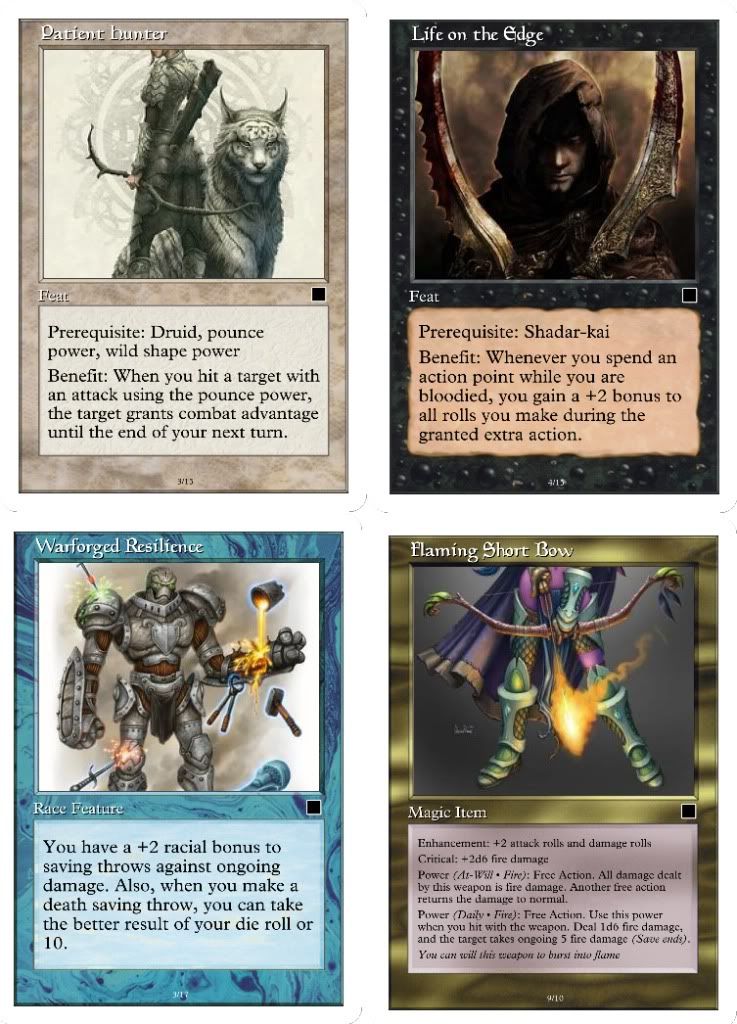
I’ve been using custom-printed cards for my D&D game for almost a year now, and I love them. I have cards for action points, feats, powers, items, gems, quests, handouts, NPCs, initiative, and PC portraits and character quick-sheets, all made using a program called Magic Set Editor. I also got Weem's condition cards, which have been very helpful in combat.
I can’t put up all of the cards I’ve made, because I’ve brazenly stolen all the artwork, but here are some examples of what I’m talking about.
Action Points and Monster Initiative Cards

Feats, Abilities, Items
PC Cards
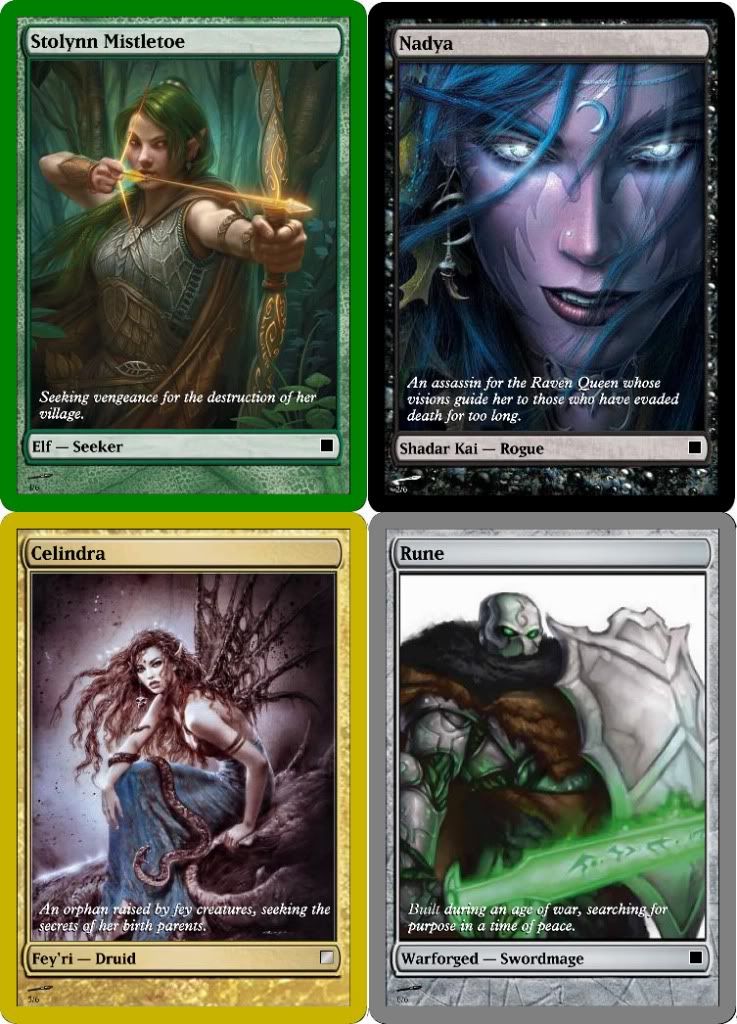
This works very well for our group. D&D 4E is such a complex game for PCs, with so many feats and powers and abilities interacting, that it is often difficult to keep everything straight. And we kept finding bugs in the character builder that kept things from adding up correctly, so we’ve taken to doing it all ourselves. Having the cards to put down to actually “stack” your effects is great. So, yeah, I can see D&D 4E going the way of the Collectible Card Game, and I can see it working pretty well.
Just look at the Castle Ravenloft Board Game for more examples. That game comes with some 200 cards for powers, items, and monsters. There is another game, “Wrath of Ashardalon” being released in about a month that will have more of the same. In fact, there will apparently be some overlap between the two. I wouldn’t be surprised in the slightest to see booster packs, new PC classes, new quests, etc. for the D&D Board Game System being released sometime during the summer or fall. In fact, I would welcome it.
Dungeons and Dragons will continue to lead the way in the RPG industry, as it has for years. Hell, people are still copying the things they published in the Seventies! There will always be people that like things the old-fashioned, original way, and there will always be people who enjoy the next big thing. I'll take the best of both worlds, thank you.
Dungeons and Dragons will continue to lead the way in the RPG industry, as it has for years. Hell, people are still copying the things they published in the Seventies! There will always be people that like things the old-fashioned, original way, and there will always be people who enjoy the next big thing. I'll take the best of both worlds, thank you.
Subscribe to:
Posts (Atom)