As a follow-up to Tuesday's post on Magic-Users learning higher-level spells, it occurred to me that there are no guidelines in M74 Extended for how long it takes a Magic-User to learn new spells. So far in our game, it's been handwaved that a few 1st level spells can be learned in about a day of study. Now that we're getting a little higher in level, it bears researching the precedent in the game.
And it gives me an excuse to flip through my newly-acquired B/X booklets! (Like I really needed an excuse...)
My 1980 Moldvay Basic book had very little to say concerning the learning of new spells, other than the fact that on gaining a level, a magic-user or elf gains an extra spell in their spellbook.
Cook's 1981 Expert Book goes a little deeper, saying that "when player characters gain a level of experience, they will return to their masters and be out of play for one 'game-week' while they are learning their new spells." Interesting. At low levels this is one spell, and after sixth level elves and magic-users get two spells per level.
The Mentzer Companions didn't give me a whole lot to work with in addition to what was already offered, though I did find it quite entertaining that a wizard, after attaining name-level and either building or seizing a tower, is generally expected to build a dungeon nearby, and that monsters would move into the dungeon, and furthermore, adventurers would show up to take the monsters' treasure!
Anyway, I'm going to jump ahead to AD&D 2E (Revised), because that's the next edition of Players' Handbook I have available. There is no mention here of a length of time to learn a new spell. What is interesting, however, is the Intelligence table. It offers several important bits of information for spellcasters, primarily the maximum level of spell they can learn and cast, their chance to learn any given spell they come across, the maximum number of spells they can know per level, and, with superhuman intelligence, what level of Illusion spell they are immune to.
Now, this next observation may sound a bit rules-lawyerly, but nowhere in the Players Handbook does it say that a magic-user must be able to cast a spell to be able to learn it. Maybe it's supposed to be obvious, I don't know. But it seems to me, with the rules as written, that a 2E magic-user could find some high level spells and learn them (if she made her "chance to learn spell" roll) well before she was actually able to cast them. Which is just a bit odd to me. I definitely don't like the static "chance to learn spell" percentage roll, which is supposed to be for any spell of any level. Wouldn't a high level wizard have a pretty easy time learning a low-level spell?
Now, in the 2E Revised DM Guide, it gives a guideline of 2 weeks per spell level for researching new spells, which is quite different from learning an existing spell, which is given on p. 62. "The standard amount of time required to prepare a spell book is one to two days of work per spell level of the spell being entered."
Excellent. That's actually useful. That information probably should have been in the Player's Handbook, but at least I found it!
On to 3E. "The process (of copying a spell into a spellbook) requires 1 day plus 1 additional day per spell level". This information was in the Player's Handbook, and remarkably easy to find.
Easy enough. Similar to the 2E.
And 4th Edition, just for grins. Spells are split between "powers" and "rituals". Wizards automatically gain both powers and rituals as they level up, without needing to find the spells or be taught them. If a 4E wizard wants another ritual beyond what is already handed to him, he can buy it or find it and copy it into his spellbook. This process takes 8 hours for rituals level 1-10, 16 hours for rituals level 11-20, and 24 hours for rituals level 21-30.
Now that's a radical departure if I ever I saw one.
So, what does this mean for our fledgling Microlite74 wizard who just found a mysterious spellbook in a treasure trove? I think we'll ignore Type IV's severely shortened timeframes and go with what was established before. So, here's my houserule for Microlite74 wizards learning new spells.
If the spell is of a level the magic-user would normally be able to cast, she can learn it without a problem. This takes one day per spell level. This time is halved if the magic-user has a higher-level instructor.
If the spell is of a higher level than the magic-user would normally be able to cast, she can attempt to learn it at the risk of misfiring it (see previous post). This takes two days per spell level. This time is halved if the magic-user has a higher-level instructor.
Higher-level magic users will typically request payment of about 100 gold pieces per level of the spell being taught. This is completely up to the DM. Some magic-users have been known to ask for favors, for certain tasks to be completed, of for rare alchemical reagents, either in lieu of or in addition to the gold payment. Most magic-users will be reluctant to teach spells that are a higher level than they believe the student can handle, as the risk of misfire or backfire is often not worth it. The price, in this case, should rise significantly. In this case, some clever teachers will ask for a favor first, often in the form of some dangerous task that could give the student enough experience to rise to the proper level to cast the spell.

New-School Rules, Old-School Style
Showing posts with label Houserules. Show all posts
Showing posts with label Houserules. Show all posts
Thursday, January 19, 2012


Tuesday, January 17, 2012
Can a Magic-User Learn Higher-Level Spells? Sure!
I hate to tell players "no" when they want to try something, and here's a common example. The heroes uncover a treasure trove and inside is a book of magic spells. Upon studying it, the wizard discovers it contains a few spells he already knows, a few he can understand and learn, and a few that are technically a higher level than he can cast.
Can't he try to learn them anyway, and have a chance at figuring them out? Why, sure he can! Here's a simple system to let your Microlite74 magic-user learn and cast spells of a higher level.
Learning a higher level spell: DC=10+level of spell times 2
Magic user rolls d20+level+Mind Bonus
Results greater than or equal to the DC means he has learned the spell and can now cast it. However, until he gains a high enough level to normally be able to cast the spell, it costs twice as many hit points to cast.
Results less than the DC means he cannot learn this spell until he has gained the proper level.
Results of five less than the DC means the spell backfires while he is attempting to learn it (use your favorite backfire/misfire table).
Results of ten less than the DC means the spell backfires catastrophically while he is attempting to learn it (use your favorite backfire/misfire table and the magic-user is unable to cast any spells for a number of days equal to the DC).
Rolling a 1 is an automatic catastrophic failure.
Can't he try to learn them anyway, and have a chance at figuring them out? Why, sure he can! Here's a simple system to let your Microlite74 magic-user learn and cast spells of a higher level.
Learning a higher level spell: DC=10+level of spell times 2
Magic user rolls d20+level+Mind Bonus
Results greater than or equal to the DC means he has learned the spell and can now cast it. However, until he gains a high enough level to normally be able to cast the spell, it costs twice as many hit points to cast.
Results less than the DC means he cannot learn this spell until he has gained the proper level.
Results of five less than the DC means the spell backfires while he is attempting to learn it (use your favorite backfire/misfire table).
Results of ten less than the DC means the spell backfires catastrophically while he is attempting to learn it (use your favorite backfire/misfire table and the magic-user is unable to cast any spells for a number of days equal to the DC).
Rolling a 1 is an automatic catastrophic failure.
Wednesday, January 4, 2012
Microlite74 Druid Modification
My wife really liked her Type IV druid character. In particular, she liked that she could change shape into a wild beast of some sort. She preferred tiger. Needless to say, she was disappointed that this feature of the druid class wasn't available in Microlte74 until the druid reached 7th level.
So I changed it around a bit for her. I knocked the Experience Base up to 30, and changed the shapechange ability to be "once per day per level" instead of "three times per day at level 7".
We haven't playtested it much, but I don't think it'll break the game. She hasn't played with the kids at all, because she's usually trying to keep the 2-year-old from attacking all the minis on the table (poor toddler wants to play D&D SO BAD!).
So I changed it around a bit for her. I knocked the Experience Base up to 30, and changed the shapechange ability to be "once per day per level" instead of "three times per day at level 7".
We haven't playtested it much, but I don't think it'll break the game. She hasn't played with the kids at all, because she's usually trying to keep the 2-year-old from attacking all the minis on the table (poor toddler wants to play D&D SO BAD!).
Saturday, December 31, 2011
Dragonborn for Microlite74
The dragonborn, as a player character race, is typically looked upon with scorn throughout the OSR. It's not a traditional fantasy race and has little if any precedent in the literature the game derives its roots from. I remember my first exposure to a "dragon-man" PC race was in the "Council of Wyrms" campaign setting, which included an optional half-dragon PC race. I own the box set but never had the chance to run it (though that may be a future M74 conversion, who knows), but even reading through it I found the half-dragon concept to be a bit silly and contrived, even in the midst of a campaign setting where players could literally play as dragons.
Regardless of all that, Type-IV D&D includes, in its first Player's Handbook, the Dragonborn as a PC race. The history of the implied setting is filled with references to an ancient Dragonborn Empire called Arkhosia. Even the venerable Forgotten Realms campaign setting managed to find a way to write these Dragonborn into its most recent iteration.
I'm not a huge fan of the Dragonborn by any stretch of the imagination, but my kids think they're awesome. Castle Ravenloft and Wrath of Ashardalon board games each came with a Dragonborn hero to play, so I have a couple miniatures, one wizard and one fighter.
Aside from their draconic appearance, their iconic ability is a breath weapon of some sort. Type IV D&D offers the following options: acid, cold, fire, lightning and poison. This must be selected at character creation and cannot be changed.
I want to avoid any of the once-per-encounter silliness that is part-and-parcel of the Type-IV experience. The way to do this well with Microlite seems to lie with the spending of hit points to use such an ability. I would have to equate this ability to at least a second-level wizard spell.
Dragonborn get +2 to STR. Experience base modifier of +7. Special Abilities: at character generation, choose fire, ice, or lightning as your breath weapon. Fire can strike up to four creatures in a small group within 30 feet for 1d8+level fire damage. Ice can strike up to four creatures within 15 feet of you for 1d8+level cold damage. Lightning can strike up to four creatures in a straight line from you within 30 feet, for 1d8+level lightning damage. Use of this ability requires a ranged attack roll vs AC and costs 3 Hit Points. Dragonborn also recieve a +4 bonus to saving throws against damage/attacks that are similar to their breath weapon type.
Regardless of all that, Type-IV D&D includes, in its first Player's Handbook, the Dragonborn as a PC race. The history of the implied setting is filled with references to an ancient Dragonborn Empire called Arkhosia. Even the venerable Forgotten Realms campaign setting managed to find a way to write these Dragonborn into its most recent iteration.
I'm not a huge fan of the Dragonborn by any stretch of the imagination, but my kids think they're awesome. Castle Ravenloft and Wrath of Ashardalon board games each came with a Dragonborn hero to play, so I have a couple miniatures, one wizard and one fighter.
Aside from their draconic appearance, their iconic ability is a breath weapon of some sort. Type IV D&D offers the following options: acid, cold, fire, lightning and poison. This must be selected at character creation and cannot be changed.
I want to avoid any of the once-per-encounter silliness that is part-and-parcel of the Type-IV experience. The way to do this well with Microlite seems to lie with the spending of hit points to use such an ability. I would have to equate this ability to at least a second-level wizard spell.
Dragonborn get +2 to STR. Experience base modifier of +7. Special Abilities: at character generation, choose fire, ice, or lightning as your breath weapon. Fire can strike up to four creatures in a small group within 30 feet for 1d8+level fire damage. Ice can strike up to four creatures within 15 feet of you for 1d8+level cold damage. Lightning can strike up to four creatures in a straight line from you within 30 feet, for 1d8+level lightning damage. Use of this ability requires a ranged attack roll vs AC and costs 3 Hit Points. Dragonborn also recieve a +4 bonus to saving throws against damage/attacks that are similar to their breath weapon type.
Eladrin for Microlite74
Eladrin, as introduced in Type IV D&D, are elves with stronger ties to the Feywild than "normal" elves. They are more akin to the "High Elves" typical in fantasy literature, while Type IV's Elf race falls more towards the "Wood Elves" or something of that nature.
What sets Eladrin apart in Type IV is their "Fey Step" ability, which is basically a short-range teleportation ability. This is fairly easy to port to Microlite, and I present my mod below.
Eladrin get +1 to DEX and +1 to CHA. Experience Base modifier of +7. Special Abilities: Can use elf-made magic armor and magic weapons even as a magic-user or illusionist. Note secret/hidden doors (D20+Mind bonus; DC 12 if carefully checking, DC 16 if just passing through); spend 2 HP to teleport instantly to a location you can see within 50 feet; speak languages of elves and other fey creatures.
What sets Eladrin apart in Type IV is their "Fey Step" ability, which is basically a short-range teleportation ability. This is fairly easy to port to Microlite, and I present my mod below.
Eladrin get +1 to DEX and +1 to CHA. Experience Base modifier of +7. Special Abilities: Can use elf-made magic armor and magic weapons even as a magic-user or illusionist. Note secret/hidden doors (D20+Mind bonus; DC 12 if carefully checking, DC 16 if just passing through); spend 2 HP to teleport instantly to a location you can see within 50 feet; speak languages of elves and other fey creatures.
Tuesday, October 11, 2011
Microlite74, Sully's Houserules
Microlite74 Extended Edition, Sully's Houserules
The following Houserules will be in effect for my upcoming Microlite74 Play-By-Blog game, which is still recruiting players. If you are interested in joining this game, email me at sully33 at gmail dawt com.
Races: all the races offered seem pretty well true to the source material. One thing, however, immediately jumped out at me, and that was Gnomes getting a +1 to both Strength and Dexterity. Dexterity I agree with, as they are a small and nimble people, but Strength just doesn't make a lick of sense to me, so we'll change that to a +1 to the Mind attribute instead.
I may also cook up a few of the 4E races, such as Tieflings and Dragonborn, down the line.
Classes: all the classes are solid, but I will only be allowing the "Standard" classes to start (Fighter, Ranger, Paladin, Thief, Cleric, Druid, Magic-User, Illusionist), while the "Optional" classes (Assassin, Barbarian, Bard, Monk, Mystic, Sorcerer and Warlord) will have to be "unlocked" through the course of player exploration in the campaign.
Alignment: The Microlite74 alignment system is pretty vague: Light, Dark, or Neutral. I prefer more colorful terms to express a characters alignment, such as "Neutral Hedonistic" or "Chaotic Ugly". Alignment is really more just guidelines for role-playing anyway. Any magic item that has alignment requirements will be adjudicated on the fly based on an individual character's history in the campaign to date.
Virtues and Vices: I think this is a nice little role-playing tool to go along with alignment. I crossed out the line containing "Determined" and "Hidebound" and then numbered the chart down from 1-20 so it could easily be rolled on with a D20 for randomness, if desired.
The different Battle Stances just won't get used, except for "Full Defense", which will be an option as an action in combat. It grants a bonus to Armor Class in exchange for not attacking that round.
Special Combat Situations: the only thing that jumped off the page as ripe for abuse here is the "Knockout Blow", which as written allows a character to make an attack that stuns the target for a number of rounds equal to how much the AC was beaten by (and more for Thieves!). This is something that I think should be included in with Combat Tricks and Stunts, so that's where it will go. Alternatively, I'm the kind of DM that will allow players to knockout an opponent instead of killing them outright when HP are dropped to zero (except in the case of a critical hit).
Next up we'll tackle the Microlite74 Companion, as there are some optional rules there that I would like to include in our game.
The following Houserules will be in effect for my upcoming Microlite74 Play-By-Blog game, which is still recruiting players. If you are interested in joining this game, email me at sully33 at gmail dawt com.
Races: all the races offered seem pretty well true to the source material. One thing, however, immediately jumped out at me, and that was Gnomes getting a +1 to both Strength and Dexterity. Dexterity I agree with, as they are a small and nimble people, but Strength just doesn't make a lick of sense to me, so we'll change that to a +1 to the Mind attribute instead.
I may also cook up a few of the 4E races, such as Tieflings and Dragonborn, down the line.
Classes: all the classes are solid, but I will only be allowing the "Standard" classes to start (Fighter, Ranger, Paladin, Thief, Cleric, Druid, Magic-User, Illusionist), while the "Optional" classes (Assassin, Barbarian, Bard, Monk, Mystic, Sorcerer and Warlord) will have to be "unlocked" through the course of player exploration in the campaign.
Alignment: The Microlite74 alignment system is pretty vague: Light, Dark, or Neutral. I prefer more colorful terms to express a characters alignment, such as "Neutral Hedonistic" or "Chaotic Ugly". Alignment is really more just guidelines for role-playing anyway. Any magic item that has alignment requirements will be adjudicated on the fly based on an individual character's history in the campaign to date.
Virtues and Vices: I think this is a nice little role-playing tool to go along with alignment. I crossed out the line containing "Determined" and "Hidebound" and then numbered the chart down from 1-20 so it could easily be rolled on with a D20 for randomness, if desired.
The different Battle Stances just won't get used, except for "Full Defense", which will be an option as an action in combat. It grants a bonus to Armor Class in exchange for not attacking that round.
Special Combat Situations: the only thing that jumped off the page as ripe for abuse here is the "Knockout Blow", which as written allows a character to make an attack that stuns the target for a number of rounds equal to how much the AC was beaten by (and more for Thieves!). This is something that I think should be included in with Combat Tricks and Stunts, so that's where it will go. Alternatively, I'm the kind of DM that will allow players to knockout an opponent instead of killing them outright when HP are dropped to zero (except in the case of a critical hit).
Next up we'll tackle the Microlite74 Companion, as there are some optional rules there that I would like to include in our game.
Monday, July 18, 2011
Random Background Generation Charts for 4E D&D
Random Background Generation Charts for 4E D&D. This is by no means an exhaustive listing of all possible professions and backgrounds that a character could have in a fantasy role-playing game. This is more to help players give their character a bit more depth, to have an idea of where they came from, and maybe even help the DM flesh out the game world a bit more.
Many of these backgrounds give characters benefits above and beyond the boons generally offered by WotC's published "backgrounds" in the character builder. The charts skew towards a minimal bonus, but big bonuses are possible. The bonuses are meant to be used with an old-school style character generation method; that is, rolling for your stats instead of using a standard array. My preferred method is 4d6, dropping the lowest die, and adding the remaining 3 together, down the line. This will generally not give you a character with attributes that match 4E's standard array. However, between the possibilities on this background generation chart and my upcoming random bogey chart for chargen should offer enough little bonuses to make the game a bit more interesting, in spite of having lower average ability scores.
I'm also open to adding more possibilities to these charts, and including more boons for different backgrounds. If you have any ideas, feel free to drop them in the comments below!
Roll 2d10 and add the numbers
2-3 roll on Wealthy Chart
4-5 roll on Works with Words, Potions n Such Chart
6-8 roll on Smithy Chart
9-11 roll on Farmers and Outdoorsmen Chart
12-14 roll on Labourers Chart
15-16 roll on Craftsmen Chart
17-18 roll on Merchants Chart
19 roll on Adventurers 1 Chart
20 roll on Adventurers 2 Chart
Wealthy Chart (roll 1d10) Starting Gold value is instead of standard 100 gp
1 Minor Lord. Starting Gold: 200
2 Bag of gold fell out of the sky. Starting Gold: 250
3 Married into wealth and suddenly widow(er)ed. Starting Gold: 300
4 Literally struck gold on a claim of land and sold it off to be mined. Starting Gold: 400
5 Politically powerful, entrenched family wants to send their "black sheep" on his merry way. Starting Gold: 500
6 Incredibly successful merchant. Starting Gold: 750
7 Long-lost wealthy relative left everything to you! Starting Gold: 1000
8 The town wizard died and left everything in his tower to you. Starting Gold: 1500 (access to potions, alchemical items, and minor magic items at DM discretion)
9 You are a bastard child of the king, and you've been paid off to keep quiet about it. Starting Gold: 2000
10 Royalty, but with a few older brothers first in line for the throne. Starting Gold: 5000
Works with Words, Potions, n Such Chart (roll 1d12), any items and skills in parentheses after background are in addition to starting gold and class skills. All characters with one of these backgrounds begin with 200 instead of 100 gp.
1 Scribe (+2 History)
2 Sage (gain training in one of the following: History, Religion, Arcana)
3 Minstrel (gain training in either Perception or Bluff)
4 Interpreter (You may take 1 additional language, +2 Perception)
5 Herald
6 Clerk
7 Bookbinder
8 Barrister (+2 History, +2 Bluff, +2 Perception)
9 Astrologer (3 1st-level ritual scrolls, +2 Arcana)
10 Architect (gain training Dungeoneering)
11 Herbalist (3 potions of healing)
12 Apothecary (alchemy kit and 3 alchemical items levels 1-5)
Smithy Chart (roll d10) items in parentheses after background are in addition to starting gold
1 Nailsmith
2 Goldsmith
3 Gemcutter (+1 Magic Orb)
4 Engraver
5 Coppersmith
6 Brazier
7 Bladesmith (Masterwork Longsword)
8 Blacksmith
9 Arrowsmith (20 +1 arrows)
10 Armorer (Masterwork Armor of choice)
Farmers and Outdoorsmen Chart (roll d10) (starts with normal gp)
1 Farmer
2 Fisherman
3 Shepherd
4 Swineherd
5 Butcher
6 Groom
7 Trapper (gain training in Nature)
8 Gardener (gain training in Nature)
9 Forester (gain training in Nature)
10 Hunter (gain training in Nature)
Labourers Chart (roll d6) (starts with normal gp) (all characters of this background gain +2 to Strength or Constitution)
1 Teamster
2 Waterleader
3 Quarrier
4 Porter
5 Ploughman
6 Miner
Craftsmen Chart (roll d12) all Craftsmen start with 150 gp and possible item in parentheses.
1 Tanner
2 Weaver
3 Tinker
4 Tailor
5 Mason
6 Hatter
7 Glassblower
8 Bowyer/Fletcher (Masterwork Bow)
9 Embroiderer
10 Clockmaker (Pocketwatch)
11 Carpenter
12 Brewer
Merchant Chart (roll d12) all Merchants start with 200 gp and possible item in parentheses.
1 Poulterer
2 Mercer
3 Ironmonger
4 Haberdasher
5 Grocer
6 Fishmonger
7 Draper
8 Hosteler
9 Knife-grinder (Masterwork Dagger)
10 Cobbler
11 Barber
12 Baker
Adventurers 1 Chart (roll d10) Starts with 100 gp and an appropriate magical item of level 1-5 (work with your DM!)
1 Pirate
2 Smuggler
3 Explorer
4 Mariner
5 Outlaw
6 Rider
7 Scout
8 Soldier
9 Thug
10 Acbrobat
Adventurers 2 Chart (roll d10) Starts with 200 gp and an appropriate magical item of level 1-10 (work with your DM!)
1 Assassin
2 Weapon Master
3 Sharpshooter
4 Peasant Hero
5 Spy
6 Swashbuckler
7 Mystic
8 Amazon
9 Shaman
10 Gladiator
Many of these backgrounds give characters benefits above and beyond the boons generally offered by WotC's published "backgrounds" in the character builder. The charts skew towards a minimal bonus, but big bonuses are possible. The bonuses are meant to be used with an old-school style character generation method; that is, rolling for your stats instead of using a standard array. My preferred method is 4d6, dropping the lowest die, and adding the remaining 3 together, down the line. This will generally not give you a character with attributes that match 4E's standard array. However, between the possibilities on this background generation chart and my upcoming random bogey chart for chargen should offer enough little bonuses to make the game a bit more interesting, in spite of having lower average ability scores.
I'm also open to adding more possibilities to these charts, and including more boons for different backgrounds. If you have any ideas, feel free to drop them in the comments below!
Roll 2d10 and add the numbers
2-3 roll on Wealthy Chart
4-5 roll on Works with Words, Potions n Such Chart
6-8 roll on Smithy Chart
9-11 roll on Farmers and Outdoorsmen Chart
12-14 roll on Labourers Chart
15-16 roll on Craftsmen Chart
17-18 roll on Merchants Chart
19 roll on Adventurers 1 Chart
20 roll on Adventurers 2 Chart
Wealthy Chart (roll 1d10) Starting Gold value is instead of standard 100 gp
1 Minor Lord. Starting Gold: 200
2 Bag of gold fell out of the sky. Starting Gold: 250
3 Married into wealth and suddenly widow(er)ed. Starting Gold: 300
4 Literally struck gold on a claim of land and sold it off to be mined. Starting Gold: 400
5 Politically powerful, entrenched family wants to send their "black sheep" on his merry way. Starting Gold: 500
6 Incredibly successful merchant. Starting Gold: 750
7 Long-lost wealthy relative left everything to you! Starting Gold: 1000
8 The town wizard died and left everything in his tower to you. Starting Gold: 1500 (access to potions, alchemical items, and minor magic items at DM discretion)
9 You are a bastard child of the king, and you've been paid off to keep quiet about it. Starting Gold: 2000
10 Royalty, but with a few older brothers first in line for the throne. Starting Gold: 5000
Works with Words, Potions, n Such Chart (roll 1d12), any items and skills in parentheses after background are in addition to starting gold and class skills. All characters with one of these backgrounds begin with 200 instead of 100 gp.
1 Scribe (+2 History)
2 Sage (gain training in one of the following: History, Religion, Arcana)
3 Minstrel (gain training in either Perception or Bluff)
4 Interpreter (You may take 1 additional language, +2 Perception)
5 Herald
6 Clerk
7 Bookbinder
8 Barrister (+2 History, +2 Bluff, +2 Perception)
9 Astrologer (3 1st-level ritual scrolls, +2 Arcana)
10 Architect (gain training Dungeoneering)
11 Herbalist (3 potions of healing)
12 Apothecary (alchemy kit and 3 alchemical items levels 1-5)
Smithy Chart (roll d10) items in parentheses after background are in addition to starting gold
1 Nailsmith
2 Goldsmith
3 Gemcutter (+1 Magic Orb)
4 Engraver
5 Coppersmith
6 Brazier
7 Bladesmith (Masterwork Longsword)
8 Blacksmith
9 Arrowsmith (20 +1 arrows)
10 Armorer (Masterwork Armor of choice)
Farmers and Outdoorsmen Chart (roll d10) (starts with normal gp)
1 Farmer
2 Fisherman
3 Shepherd
4 Swineherd
5 Butcher
6 Groom
7 Trapper (gain training in Nature)
8 Gardener (gain training in Nature)
9 Forester (gain training in Nature)
10 Hunter (gain training in Nature)
Labourers Chart (roll d6) (starts with normal gp) (all characters of this background gain +2 to Strength or Constitution)
1 Teamster
2 Waterleader
3 Quarrier
4 Porter
5 Ploughman
6 Miner
Craftsmen Chart (roll d12) all Craftsmen start with 150 gp and possible item in parentheses.
1 Tanner
2 Weaver
3 Tinker
4 Tailor
5 Mason
6 Hatter
7 Glassblower
8 Bowyer/Fletcher (Masterwork Bow)
9 Embroiderer
10 Clockmaker (Pocketwatch)
11 Carpenter
12 Brewer
Merchant Chart (roll d12) all Merchants start with 200 gp and possible item in parentheses.
1 Poulterer
2 Mercer
3 Ironmonger
4 Haberdasher
5 Grocer
6 Fishmonger
7 Draper
8 Hosteler
9 Knife-grinder (Masterwork Dagger)
10 Cobbler
11 Barber
12 Baker
Adventurers 1 Chart (roll d10) Starts with 100 gp and an appropriate magical item of level 1-5 (work with your DM!)
1 Pirate
2 Smuggler
3 Explorer
4 Mariner
5 Outlaw
6 Rider
7 Scout
8 Soldier
9 Thug
10 Acbrobat
Adventurers 2 Chart (roll d10) Starts with 200 gp and an appropriate magical item of level 1-10 (work with your DM!)
1 Assassin
2 Weapon Master
3 Sharpshooter
4 Peasant Hero
5 Spy
6 Swashbuckler
7 Mystic
8 Amazon
9 Shaman
10 Gladiator
Wednesday, July 13, 2011
Old-School CharGen for 4E?
Old School CharGen for 4E
When 3E was introduced, one of the first things I noticed was the point-buy system for stats, instead of rolling 3d6 for them. The designers made this change for the sake of balance. The natural progression from point-buy stats is the standard array, which is what we wound up with in 4E. Every character is balanced against each other in this way right from the get-go (and nevermind the perfectly balanced races and classes as well).
Yawn.
One of the best things from my DragonQuest days was the character generation system. I'm pretty sure it was our DM's set of houserules, as I only ever saw it on sheets that were printed off a computer, but the gist of it was roll a percentile to determine how many points you get to distribute and what your maximum score could be, and roll percentiles for everything after that on several charts. Background and family, race (!), money, hair, height, weight, eye color.
The best part, though, was the bogey chart. If you didn't qualify for any race besides human, at least you got four rolls on the bogey table, which were mostly helpful but sometimes not. Everything from bonuses to ability scores, to cheaper prices for ranks in certain skills, to access to psionics was an option. Sometimes, with the right rolls, you could get a pretty powerful character right from the get-go. Of course, the flip side of that coin is that with the right rolls, even the most powerful of characters could suffer a career-or-life-ending grevious injury.
So it was all kind of balanced in that way. And a whole lot of fun. There were still plenty of options to sift through at chargen, but the randomness of the possibilities made for a whole lot of fun.
So, in that vein, I'm thinking of writing up an old-school chargen guide for 4e, with some modifications to races, and a full-on bogey chart. Anybody out there interested? I think it might work really well in a FourthCore style setting. I'm thinking we ought to go back to rolling for attributes, and rebalance through different possible random bonuses. Sounds more fun than just paging through the books to optimize your character.
On a not-so-random note, critical hits in 4e should have at least the remote possibility of instant kill. Or at least causing a Save-or-Die situation. Any thoughts?
When 3E was introduced, one of the first things I noticed was the point-buy system for stats, instead of rolling 3d6 for them. The designers made this change for the sake of balance. The natural progression from point-buy stats is the standard array, which is what we wound up with in 4E. Every character is balanced against each other in this way right from the get-go (and nevermind the perfectly balanced races and classes as well).
Yawn.
One of the best things from my DragonQuest days was the character generation system. I'm pretty sure it was our DM's set of houserules, as I only ever saw it on sheets that were printed off a computer, but the gist of it was roll a percentile to determine how many points you get to distribute and what your maximum score could be, and roll percentiles for everything after that on several charts. Background and family, race (!), money, hair, height, weight, eye color.
The best part, though, was the bogey chart. If you didn't qualify for any race besides human, at least you got four rolls on the bogey table, which were mostly helpful but sometimes not. Everything from bonuses to ability scores, to cheaper prices for ranks in certain skills, to access to psionics was an option. Sometimes, with the right rolls, you could get a pretty powerful character right from the get-go. Of course, the flip side of that coin is that with the right rolls, even the most powerful of characters could suffer a career-or-life-ending grevious injury.
So it was all kind of balanced in that way. And a whole lot of fun. There were still plenty of options to sift through at chargen, but the randomness of the possibilities made for a whole lot of fun.
So, in that vein, I'm thinking of writing up an old-school chargen guide for 4e, with some modifications to races, and a full-on bogey chart. Anybody out there interested? I think it might work really well in a FourthCore style setting. I'm thinking we ought to go back to rolling for attributes, and rebalance through different possible random bonuses. Sounds more fun than just paging through the books to optimize your character.
On a not-so-random note, critical hits in 4e should have at least the remote possibility of instant kill. Or at least causing a Save-or-Die situation. Any thoughts?
Sunday, May 8, 2011
Islands in the Sky, Session 4: Expedition to Castle Ravenloft, or how to use the Castle Ravenloft board game in your D&D 4E game.
First of all, apologies to everyone for the slow week posting here. Real life is busy, blah blah blah.
Love Stinks
We held our fourth D&D session last night. In attendance were myself, my wife Gabby, Kevin and Curtis. Lisa and Joey were unable to make it, and we don't anticipate seeing Joey again, as he and Lisa had a nasty break-up during the week. Bah. Drama. Lame.
Recap
Anyways, in Session 3, the Heroes foiled an Arkhosian plot and recovered a magical item, a large crystal ball that was the focus of the Dragonborn spell. The ritual would have caused dragons within a certain radius to become enraged and come attack the island. Fortunately, the heroes disrupted the casting of the ritual and no dragons came to Verys Hiladian.
So, just what is this large crystal ball? It is adorned with an ornate brass dragon circling it again and again, the feet of which come down for the ball to stand upon. No one knows. They informed the village council and the Princess about the dragonborn attack, and there immediately began a debate about whether to evacuate the island or fortify defenses.
To Barovia!
However, there was a more pressing matter for the heroes to attend to: the return of the human bodies and rescued prisoners to their home island of Barovia. Khaledra, Tarak, Avenger, and the Ice Queen accompanied the airship; Ember, the genasi swordmage formerly played by Joey, remained on Verys Hiladian to help fortify defenses for the impending Dragonborn invasion. After three uneventful days of travel, the heroes arrived at the mist-shrouded Shadowmote of Barovia. During travel, one of the rescued prisoners, a young widow named Jennalynn, develops a strong infatuation with Tarak, our half-orc ranger. She tells him the story of how her husband disappeared, probably killed by monsters, shortly after their wedding. He has not been seen since. Some think he succumbed to the shadow madness and leapt off the island; others believe he was taken by Count Strahd into Castle Ravenloft for crimes unknown.
Barovia is a small island, just a couple square miles. It is dominated by Castle Ravenloft on one end, atop a large hill, that overlooks the village below. The people here are all human! They are poor, hardscrabble folk who barely survive, and there are just a few hundred of them.
The Mists part and allow them to enter Barovia, land on the island, and begin unloading the bodies, but it is not long at all before the Mists gather again and a messenger comes forth. The ship's crew and the villagers all suddenly fall asleep, all except the heroes. The messenger informs the heroes that their presence has been requested at Castle Ravenloft; Count Strahd wishes to meet them himself. With that, the messenger disappears and the Mists part, showing the heroes the path to the Castle. They follow the path up the hill, all the while feeling like they're being watched. The Castle's drawbridge lowers for them, and they enter.
Into Castle Ravenloft
Here's where the fun begins. Instead of mapping out the monster-infested lower level of the Castle, I took some inspiration (and tiles) from the Castle Ravenloft and Wrath of Ashardalon board games. I built a randomized stack of dungeon tiles from the board game and laid tiles out as the heroes moved deeper into the dungeon. They were searching for the Secret Staircase to allow access to the upper levels of the Castle, and presumably to find Strahd.
This entire dungeon level counted as a single encounter, no resting. I printed out a custom-made "Encounter" deck which consisted of several monsters and a number of Events (such as traps, alarms, ghostly sightings, etc). Each monster dropped treasure, which was rolled for randomly. A strict adherence to initiative was kept, and on each player's turn (for the most part), a card was drawn off the Encounter deck and applied to the board as I saw fit. If a monster was drawn, they were simply added to the initiative stack before the hero whose turn it was. The cards for the monsters had their full stat-blocks printed on them, so there was absolutely no need to flip through the Monster Manual or Open Grave books.
This wound up all working very well. It didn't at all adhere to published encounter standards, but we don't keep track of experience points anyway. Tarak was the only hero who made it to the stairway without being Bloodied. Overall, there was definitely tension at the table as they explored and never knew what was coming around the next corner.
Final Tally
By the end of it all, the heroes took out a swarm of crawling claws, three deathjump spiders, several zombie and skeleton minions, a flaming skeleton, three very hungry ghouls, a couple dire rats and a brain in a broken jar.
Final tally on treasure: 190 gold pieces, vial of Beastbane, 5 potions of healing, 5 random ritual scrolls (to be determined as yet), 5 potions of recovery (homebrewed potion which allows a character to regain the use of a spent encounter or daily power), Hero's Armor +2, Alfsair Spear +2, and a Blooddrinker Axe +2.
It was a long, drawn-out combat encounter, yes, but it was constantly changing and so it didn't get boring. The exploration and combat together worked very well, as did the randomization of the dungeon itself with the board game tiles and the Encounter deck I built. I will be more than happy to make a PDF of the Deck available for download. It contains all the monsters, magical item treasure, randomness charts, events, and character cards for a few NPCs, one of which being Count Strahd. If people are really interested in how I went about putting it all together, I'll be more than happy to do a full blog post on how it works.
Love Stinks
We held our fourth D&D session last night. In attendance were myself, my wife Gabby, Kevin and Curtis. Lisa and Joey were unable to make it, and we don't anticipate seeing Joey again, as he and Lisa had a nasty break-up during the week. Bah. Drama. Lame.
Recap
Anyways, in Session 3, the Heroes foiled an Arkhosian plot and recovered a magical item, a large crystal ball that was the focus of the Dragonborn spell. The ritual would have caused dragons within a certain radius to become enraged and come attack the island. Fortunately, the heroes disrupted the casting of the ritual and no dragons came to Verys Hiladian.
So, just what is this large crystal ball? It is adorned with an ornate brass dragon circling it again and again, the feet of which come down for the ball to stand upon. No one knows. They informed the village council and the Princess about the dragonborn attack, and there immediately began a debate about whether to evacuate the island or fortify defenses.
To Barovia!
However, there was a more pressing matter for the heroes to attend to: the return of the human bodies and rescued prisoners to their home island of Barovia. Khaledra, Tarak, Avenger, and the Ice Queen accompanied the airship; Ember, the genasi swordmage formerly played by Joey, remained on Verys Hiladian to help fortify defenses for the impending Dragonborn invasion. After three uneventful days of travel, the heroes arrived at the mist-shrouded Shadowmote of Barovia. During travel, one of the rescued prisoners, a young widow named Jennalynn, develops a strong infatuation with Tarak, our half-orc ranger. She tells him the story of how her husband disappeared, probably killed by monsters, shortly after their wedding. He has not been seen since. Some think he succumbed to the shadow madness and leapt off the island; others believe he was taken by Count Strahd into Castle Ravenloft for crimes unknown.
Barovia is a small island, just a couple square miles. It is dominated by Castle Ravenloft on one end, atop a large hill, that overlooks the village below. The people here are all human! They are poor, hardscrabble folk who barely survive, and there are just a few hundred of them.
The Mists part and allow them to enter Barovia, land on the island, and begin unloading the bodies, but it is not long at all before the Mists gather again and a messenger comes forth. The ship's crew and the villagers all suddenly fall asleep, all except the heroes. The messenger informs the heroes that their presence has been requested at Castle Ravenloft; Count Strahd wishes to meet them himself. With that, the messenger disappears and the Mists part, showing the heroes the path to the Castle. They follow the path up the hill, all the while feeling like they're being watched. The Castle's drawbridge lowers for them, and they enter.
Into Castle Ravenloft
Here's where the fun begins. Instead of mapping out the monster-infested lower level of the Castle, I took some inspiration (and tiles) from the Castle Ravenloft and Wrath of Ashardalon board games. I built a randomized stack of dungeon tiles from the board game and laid tiles out as the heroes moved deeper into the dungeon. They were searching for the Secret Staircase to allow access to the upper levels of the Castle, and presumably to find Strahd.
This entire dungeon level counted as a single encounter, no resting. I printed out a custom-made "Encounter" deck which consisted of several monsters and a number of Events (such as traps, alarms, ghostly sightings, etc). Each monster dropped treasure, which was rolled for randomly. A strict adherence to initiative was kept, and on each player's turn (for the most part), a card was drawn off the Encounter deck and applied to the board as I saw fit. If a monster was drawn, they were simply added to the initiative stack before the hero whose turn it was. The cards for the monsters had their full stat-blocks printed on them, so there was absolutely no need to flip through the Monster Manual or Open Grave books.
This wound up all working very well. It didn't at all adhere to published encounter standards, but we don't keep track of experience points anyway. Tarak was the only hero who made it to the stairway without being Bloodied. Overall, there was definitely tension at the table as they explored and never knew what was coming around the next corner.
Final Tally
By the end of it all, the heroes took out a swarm of crawling claws, three deathjump spiders, several zombie and skeleton minions, a flaming skeleton, three very hungry ghouls, a couple dire rats and a brain in a broken jar.
Final tally on treasure: 190 gold pieces, vial of Beastbane, 5 potions of healing, 5 random ritual scrolls (to be determined as yet), 5 potions of recovery (homebrewed potion which allows a character to regain the use of a spent encounter or daily power), Hero's Armor +2, Alfsair Spear +2, and a Blooddrinker Axe +2.
It was a long, drawn-out combat encounter, yes, but it was constantly changing and so it didn't get boring. The exploration and combat together worked very well, as did the randomization of the dungeon itself with the board game tiles and the Encounter deck I built. I will be more than happy to make a PDF of the Deck available for download. It contains all the monsters, magical item treasure, randomness charts, events, and character cards for a few NPCs, one of which being Count Strahd. If people are really interested in how I went about putting it all together, I'll be more than happy to do a full blog post on how it works.
Wednesday, April 27, 2011
Return of the Ritual
http://www.wizards.com/dnd/Article.aspx?x=dnd/dra/201104rituals
This may be the most useful thing WotC has published on its website to date. It will probably get very little use by most groups, because the word on the street is that people just don't use ritual spells these days. It is a complete compilation of all rituals published to date by WotC in its various books, modules, and interweb magazines. It sorts them by type and also lists them by different uses at the end.
Apparently, rituals are a very underused resource in typical 4e D&D games. This is probably because, the Rules As Written demand you give up some of your hard-earned gold for a one-time (possible) benefit. Player understanding of rituals is also a big time-sink. The players have a lot to think about at the table already, keeping track of powers and feats and status ailments and such. Getting the hang of the ritual system requires a LOT of reading and perusing texts and asking questions, when they've already done a whole lot of that. Nevermind the fact that the rituals are spread out over some twenty different sources. They are all easily accessible via the online Compendium, but that's still a whole lot of reading and processing to do.
So, how am I planning to get my players more invested in ritual use? Well thank you for asking.
First, screw paying for them. I treat ritual components like ammo and encumberance: we're not keeping track of it.
Second, start including ritual scrolls in treasure parcels. Well, actually, I don't worry a whole lot about parcels and such. We don't don't worry about experience points either. Everyone levels up when I say they do. If we tried to follow the Rules as Written, it would take forever to advance out of the Heroic tier. I mean, really, the campaign world is all about floating islands in the freakin sky, so I think verisimilitude isn't all that terribly important. It's more about creating an epic story and having fun. Where was I? Oh yeah. Give the players ritual scrolls. Can't hurt. They'll either use them or lose them in the bag of holding.
Yeah, this game is run fast and loose. Story, combat, role-playing, all good. It's not Dark Sun. The world won't kill the players if they don't have enough water. It's an epic tale. You never see Luke Skywalker worried about where his next meal might come from, after all.
This may be the most useful thing WotC has published on its website to date. It will probably get very little use by most groups, because the word on the street is that people just don't use ritual spells these days. It is a complete compilation of all rituals published to date by WotC in its various books, modules, and interweb magazines. It sorts them by type and also lists them by different uses at the end.
Apparently, rituals are a very underused resource in typical 4e D&D games. This is probably because, the Rules As Written demand you give up some of your hard-earned gold for a one-time (possible) benefit. Player understanding of rituals is also a big time-sink. The players have a lot to think about at the table already, keeping track of powers and feats and status ailments and such. Getting the hang of the ritual system requires a LOT of reading and perusing texts and asking questions, when they've already done a whole lot of that. Nevermind the fact that the rituals are spread out over some twenty different sources. They are all easily accessible via the online Compendium, but that's still a whole lot of reading and processing to do.
So, how am I planning to get my players more invested in ritual use? Well thank you for asking.
First, screw paying for them. I treat ritual components like ammo and encumberance: we're not keeping track of it.
Second, start including ritual scrolls in treasure parcels. Well, actually, I don't worry a whole lot about parcels and such. We don't don't worry about experience points either. Everyone levels up when I say they do. If we tried to follow the Rules as Written, it would take forever to advance out of the Heroic tier. I mean, really, the campaign world is all about floating islands in the freakin sky, so I think verisimilitude isn't all that terribly important. It's more about creating an epic story and having fun. Where was I? Oh yeah. Give the players ritual scrolls. Can't hurt. They'll either use them or lose them in the bag of holding.
Yeah, this game is run fast and loose. Story, combat, role-playing, all good. It's not Dark Sun. The world won't kill the players if they don't have enough water. It's an epic tale. You never see Luke Skywalker worried about where his next meal might come from, after all.
Friday, April 8, 2011
Game Night: Success!
So we actually played some D&D! Wha? Only a month and a half after I had hoped to start the Islands in the Sky campaign, but hey, its started! Five players and myself running the game: Kevin, a Revenant Avenger of the Raven Queen who was a Shadar-Kai in his past life; Curtis, a half-Orc Ranger Scout (Essentials build); Lisa and Joey, playing pre-gens I took from the WotC website, a Tiefling Invoker and a Warforged Warden; and my beautiful wife Gabby and her Eladrin Druid.
Kevin's Revenant Avenger we stole outright from the WotC message boards Character Optimization Forum. And he kicked ass. He likes a lot of story and plot mixed in, and took a little bit of time trying to figure out his motivation for helping everyone else, but it was definitely all good.
I honestly wasn't impressed with WotC's convention builds. A warforged warden? I'm sorry, I just have a hard time connecting a mechanical/magical construct with the primal power source. And there are better ways to build an Invoker. That being said, Lisa and Joey are real champs for sticking with it and being ready to come back for more. I'll be searching for proper builds for them over the next couple of weeks, before our next game, so they can also kick some major ass.
But yeah, it looks like we might have a team of (mostly) strikers by the time I'm done printing character sheets.
A couple more things before we get into the play report. We played with a couple of supplements, to make things even more confusing for the noobs: D&D Fortune Cards (which I handed out to the players) and Paizo's Plot Twist Cards. The Fortune Cards only got used a couple times, but I think there are two reasons for this. First, the party pretty much cake-walked through the encounters. Second, nobody yet has a great grasp of the rules and terminology. I'm the only one with the books or the DDI subscription. So the Fortune Cards will probably see more use as players get the hang of the mechanics of the system. All the players were drawing from my one deck (I only ever picked up four or five booster packs), so I think a lot of them got cards that were kinda useless.
The Plot Twist Cards were definitely better, helped move the game along and kept me on my toes, but in a very good way. I loved what they added to the game. More on this in the Actual Play run-down.
Another thing that was a big help was having little pop-up monster info cards. 3x5 index cards, folded in half, with monster defenses written on both sides. I set them out at the beginning of combat and it definitely cut down a lot on me having to look through books and sheets during combat. Some might argue that players shouldn't know all that info right off the bat; I don't really care. It helped speed up the game and it helped players make decisions. All numbers in the game are purely meta knowledge anyway, so we might as well lay it all out on the table.
I also didn't use a DM Screen, probably for the first time. All rolls were out in the open, no fudging at all. I found this extremely liberating.
All in all, the players had fun, I had fun, the game ran well and everyone is coming back for more! The next post will be a proper report of what all went down.
Kevin's Revenant Avenger we stole outright from the WotC message boards Character Optimization Forum. And he kicked ass. He likes a lot of story and plot mixed in, and took a little bit of time trying to figure out his motivation for helping everyone else, but it was definitely all good.
I honestly wasn't impressed with WotC's convention builds. A warforged warden? I'm sorry, I just have a hard time connecting a mechanical/magical construct with the primal power source. And there are better ways to build an Invoker. That being said, Lisa and Joey are real champs for sticking with it and being ready to come back for more. I'll be searching for proper builds for them over the next couple of weeks, before our next game, so they can also kick some major ass.
But yeah, it looks like we might have a team of (mostly) strikers by the time I'm done printing character sheets.
A couple more things before we get into the play report. We played with a couple of supplements, to make things even more confusing for the noobs: D&D Fortune Cards (which I handed out to the players) and Paizo's Plot Twist Cards. The Fortune Cards only got used a couple times, but I think there are two reasons for this. First, the party pretty much cake-walked through the encounters. Second, nobody yet has a great grasp of the rules and terminology. I'm the only one with the books or the DDI subscription. So the Fortune Cards will probably see more use as players get the hang of the mechanics of the system. All the players were drawing from my one deck (I only ever picked up four or five booster packs), so I think a lot of them got cards that were kinda useless.
The Plot Twist Cards were definitely better, helped move the game along and kept me on my toes, but in a very good way. I loved what they added to the game. More on this in the Actual Play run-down.
Another thing that was a big help was having little pop-up monster info cards. 3x5 index cards, folded in half, with monster defenses written on both sides. I set them out at the beginning of combat and it definitely cut down a lot on me having to look through books and sheets during combat. Some might argue that players shouldn't know all that info right off the bat; I don't really care. It helped speed up the game and it helped players make decisions. All numbers in the game are purely meta knowledge anyway, so we might as well lay it all out on the table.
I also didn't use a DM Screen, probably for the first time. All rolls were out in the open, no fudging at all. I found this extremely liberating.
All in all, the players had fun, I had fun, the game ran well and everyone is coming back for more! The next post will be a proper report of what all went down.
Thursday, April 7, 2011
Return of the Saving Throw
Older editions of D&D had a plethora of saving throws required in different circumstances. Save vs Breath Weapon, Save vs Wand, etc etc. Different classes had different charts for how their saving throws improved as they gained levels.
In 4th Edition, the Saving Throw has all but disappeared. There are some effects that require a saving throw to brush off, but it is a flat "roll 10 or higher" across the board. How boring! But whatever. I'm not advocating the elimination of that mechanic, nor am I calling for a return to cumbersome charts. My solution is much simpler and is already part of the ruleset.
Whenever an attack targets a PC's reflex, fortitude or willpower defenses, we will assume it will be successful, unless the PC saves vs the attack. All this requires is having the player make the monster's attack roll! By rolling under the target number, she effectively saves vs that attack. Just a simple way to put some of that old-school feel back into a decidedly new-school ruleset. Probably dangerous, as I can no longer fudge those things behind the screen! We're getting our game on this evening, so we will see how it goes.
In 4th Edition, the Saving Throw has all but disappeared. There are some effects that require a saving throw to brush off, but it is a flat "roll 10 or higher" across the board. How boring! But whatever. I'm not advocating the elimination of that mechanic, nor am I calling for a return to cumbersome charts. My solution is much simpler and is already part of the ruleset.
Whenever an attack targets a PC's reflex, fortitude or willpower defenses, we will assume it will be successful, unless the PC saves vs the attack. All this requires is having the player make the monster's attack roll! By rolling under the target number, she effectively saves vs that attack. Just a simple way to put some of that old-school feel back into a decidedly new-school ruleset. Probably dangerous, as I can no longer fudge those things behind the screen! We're getting our game on this evening, so we will see how it goes.
Thursday, March 31, 2011
Making Magic Magical Again
So I just acquired a copy of Adventurer's Vault 2 (a completely redundant buy, considering all the items are in the DDI online Compendium, but still...) and as I peruse its contents, and that of the first Adventurer's Vault, and the magic items in the various Player's Handbooks and supplements, I find myself completely underwhelmed.
I blame the statblocks.
I recall being 12 years old and having this amazing sense of wonder as I paged through the back of my AD&D Dungeon Master's Guide, having found the magic items. Simple, one or two paragraph descriptions was all that was needed to inspire my imagination. So much was left to be a judgment call on the part of the DM, and the items were ripe for customization. Hell, even the finding of a magical item or weapon was cause for cheering from the players.
In 4th Edition, magical items are an integral part of the game, and are key to maintaining balance between the PCs and the encounters they face as they level up. Items all have specific levels, prices, and stat-blocks. Magic items, weapons, armor, everything are so common that several are found in every adventure. This definitely has the effect of causing magical items to become mundane.
So the question becomes how to keep the game balanced while making magical items the wondrous, rare items (I feel) they should be. It's tricky. The DMG 2 has guidelines for using boons to boost PC stats in place of magic items, but a DM has to be crafty to provide in-game story reasons for why these boons exist in the first place. Ideally, what we need are better guidelines for where the bonuses need to be applied as characters level, and then they can be house-ruled into the existing leveling scheme. I have been unable to find such guidelines. Anyone got any pointers here? I was contemplating replacing the 1/2 Level mechanic with a straight 1Level mechanic, but I worry it will become too overpowered, especially at higher levels. Maybe I'm worrying too much about balance. Not sure. Any tips out there in the interwebs?
I blame the statblocks.
I recall being 12 years old and having this amazing sense of wonder as I paged through the back of my AD&D Dungeon Master's Guide, having found the magic items. Simple, one or two paragraph descriptions was all that was needed to inspire my imagination. So much was left to be a judgment call on the part of the DM, and the items were ripe for customization. Hell, even the finding of a magical item or weapon was cause for cheering from the players.
In 4th Edition, magical items are an integral part of the game, and are key to maintaining balance between the PCs and the encounters they face as they level up. Items all have specific levels, prices, and stat-blocks. Magic items, weapons, armor, everything are so common that several are found in every adventure. This definitely has the effect of causing magical items to become mundane.
So the question becomes how to keep the game balanced while making magical items the wondrous, rare items (I feel) they should be. It's tricky. The DMG 2 has guidelines for using boons to boost PC stats in place of magic items, but a DM has to be crafty to provide in-game story reasons for why these boons exist in the first place. Ideally, what we need are better guidelines for where the bonuses need to be applied as characters level, and then they can be house-ruled into the existing leveling scheme. I have been unable to find such guidelines. Anyone got any pointers here? I was contemplating replacing the 1/2 Level mechanic with a straight 1Level mechanic, but I worry it will become too overpowered, especially at higher levels. Maybe I'm worrying too much about balance. Not sure. Any tips out there in the interwebs?
Sunday, March 27, 2011
Ravenloft-Ashardalon Mash-Up
In my last post, I talked about some of the mechanics behind Monster deck construction for homebrewed adventures with the D&D Adventure System Games, Castle Ravenloft and Wrath of Ashardalon. Today, we’re going to look a little closer at just what our options are.
As I said before, you want 12 1xp monsters, 12 2xp, and 6 3xp, for a grand total of 30 cards in your deck. There are three of each monster in the decks that come with each game, so you really have 4 1xp monsters, 4 2xp, and 2 3xp.
Castle Ravenloft Monsters
Kobold Skirmisher, 1xp (Reptile)
Zombie, 1xp (Undead)
Wolf, 1xp (Animal)
Rat Swarm, 1xp (Animal)
Spider, 2xp (Vermin)
Blazing Skeleton, 2xp (Undead)
Skeleton, 2xp (Undead)
Ghoul, 2xp (Undead)
Wraith, 3xp (Undead)
Gargoyle, 3xp (Elemental)
Wrath of Ashardalon Monsters
Human Cultist, 1xp (Human)
Orc Archer, 1xp (Orc)
Kobold Dragonshield, 1xp (Reptile, Sentry)
Snake, 1xp (Reptile)
Orc Smasher, 2xp (Orc)
Cave Bear, 2xp (Animal)
Duergar Guard, 2xp (Devil, Dwarf, Sentry)
Grell, 2xp (Aberrant)
Gibbering Mouther, 3xp (Aberrant)
Legion Devil, 3xp (Devil)
So we have 20 monsters to fill 10 spots in the deck. The first and most obvious cross-platform scenario that jumps out at me is something involving Kobolds, and I would construct the deck like so: Kobold Skirmisher, Kobold Dragonshield, Orc Archer, Snake, Spider, Orc Smasher, Cave Bear, Grell, Gibbering Mouther, and Gargoyle. This combination of monsters provides more of a feel of an abandoned mine-complex that has been taken over by some feuding Kobolds and Orcs.
I would use the Ashardalon Encounter and Treasure decks.
The goal of the scenario could be as simple as killing a certain number of monsters, or getting deep enough in to find a boss (possibilities from the official material include: Klak Kobold Sorcerer, Kraash Orc Storm Shaman, Meerak Kobold Dragonlord, the Rage Drake, and the Beholder Gauth. There’s no reason deeper role-playing elements couldn’t be used, such as a negotiation of some sort between the Orc and Kobold factions (although the Rules as Written don’t provide much support for anything like that; we’d have to come up with something based off the 4e ruleset... Skill Challenges for the D&D Adventure System, anyone?).
For the more undead feel, Ravenloft plays quite nicely with a couple substitutions from Ashardalon. Trade in the WoA Human Cultists for the CR Kobolds, the Duergar for the Spiders, and the Legion Devils for the Gargoyle.
I’m pondering a variant ruleset that would feature a Dungeon Master to run the monsters and support more role-playing and puzzle-solving elements for the games. I’ll have a post on that up in the next few days. I’ve been painting minis, too, so I should have some pics up of my work pretty soon. I’m no expert (actually, I’m colorblind with shaky hands, so I’m starting at a handicap) and haven’t painted minis since I was 10 and got a little crazy with my Heroquest set. The ones I’ve done so far look good enough to use at the table, though, that’s for sure.
As I said before, you want 12 1xp monsters, 12 2xp, and 6 3xp, for a grand total of 30 cards in your deck. There are three of each monster in the decks that come with each game, so you really have 4 1xp monsters, 4 2xp, and 2 3xp.
Castle Ravenloft Monsters
Kobold Skirmisher, 1xp (Reptile)
Zombie, 1xp (Undead)
Wolf, 1xp (Animal)
Rat Swarm, 1xp (Animal)
Spider, 2xp (Vermin)
Blazing Skeleton, 2xp (Undead)
Skeleton, 2xp (Undead)
Ghoul, 2xp (Undead)
Wraith, 3xp (Undead)
Gargoyle, 3xp (Elemental)
Wrath of Ashardalon Monsters
Human Cultist, 1xp (Human)
Orc Archer, 1xp (Orc)
Kobold Dragonshield, 1xp (Reptile, Sentry)
Snake, 1xp (Reptile)
Orc Smasher, 2xp (Orc)
Cave Bear, 2xp (Animal)
Duergar Guard, 2xp (Devil, Dwarf, Sentry)
Grell, 2xp (Aberrant)
Gibbering Mouther, 3xp (Aberrant)
Legion Devil, 3xp (Devil)
So we have 20 monsters to fill 10 spots in the deck. The first and most obvious cross-platform scenario that jumps out at me is something involving Kobolds, and I would construct the deck like so: Kobold Skirmisher, Kobold Dragonshield, Orc Archer, Snake, Spider, Orc Smasher, Cave Bear, Grell, Gibbering Mouther, and Gargoyle. This combination of monsters provides more of a feel of an abandoned mine-complex that has been taken over by some feuding Kobolds and Orcs.
I would use the Ashardalon Encounter and Treasure decks.
The goal of the scenario could be as simple as killing a certain number of monsters, or getting deep enough in to find a boss (possibilities from the official material include: Klak Kobold Sorcerer, Kraash Orc Storm Shaman, Meerak Kobold Dragonlord, the Rage Drake, and the Beholder Gauth. There’s no reason deeper role-playing elements couldn’t be used, such as a negotiation of some sort between the Orc and Kobold factions (although the Rules as Written don’t provide much support for anything like that; we’d have to come up with something based off the 4e ruleset... Skill Challenges for the D&D Adventure System, anyone?).
For the more undead feel, Ravenloft plays quite nicely with a couple substitutions from Ashardalon. Trade in the WoA Human Cultists for the CR Kobolds, the Duergar for the Spiders, and the Legion Devils for the Gargoyle.
I’m pondering a variant ruleset that would feature a Dungeon Master to run the monsters and support more role-playing and puzzle-solving elements for the games. I’ll have a post on that up in the next few days. I’ve been painting minis, too, so I should have some pics up of my work pretty soon. I’m no expert (actually, I’m colorblind with shaky hands, so I’m starting at a handicap) and haven’t painted minis since I was 10 and got a little crazy with my Heroquest set. The ones I’ve done so far look good enough to use at the table, though, that’s for sure.
Thursday, March 24, 2011
D&D Adventure System Customization!
So, this blog has apparently been getting a number of visitors who found me on google while searching for content related to the Wrath of Ashardalon and Castle Ravenloft D&D Adventure System board games. Cool! What people seem to be looking for are ways to put the two games together into a singular experience, either through mixing the games together for a single delve, or through a longer, tied-together campaign. I'm going to start working on some custom homebrewed adventures using both games together, but in the mean-time, I offer up some guidelines for crafting your own.
First, start over at boardgamegeek.com. The forums there for Wrath and Ravenloft have a lot of custom goodness, from adventures and heroes to additional cards and guidelines for campaign-play. Wrath of Ashardalon, out of the box, does support "mini campaigns", which allow you to keep treasure and boons between adventures, but the heroes are still limited to 2nd level. There are a couple different offerings on the boardgamegeek.com forums on how to handle leveling up past 2nd level without breaking the game.
When mixing the games for a new experience, one thing to remember is to not just shuffle the monster decks all together and see what happens. The 30 card monster deck is key to the feel of an individual adventure. Construct your monster deck with 12 1xp monsters, 12 2xp monsters, and 6 3xp monsters. I would select one or the other of the encounter decks to use.
The treasure deck can be a little tricky. Wrath of Ashardalon treasures have prices on them, while Castle Ravenloft treasures do not. Ninjadorg (http://ratdorg.blogspot.com) has a list of suggested prices for Ravenloft treasures, which I would just go ahead and write directly onto the Ravenloft treasure cards.
One of my players biggest complaints about the D&D Adventure System games versus full-on 4e play was that he "missed the talking." The games are not designed with role-playing in mind. However, next time I'll take a look at how to add some more role-playing elements to the games, along with campaign play and leveling past 2.
First, start over at boardgamegeek.com. The forums there for Wrath and Ravenloft have a lot of custom goodness, from adventures and heroes to additional cards and guidelines for campaign-play. Wrath of Ashardalon, out of the box, does support "mini campaigns", which allow you to keep treasure and boons between adventures, but the heroes are still limited to 2nd level. There are a couple different offerings on the boardgamegeek.com forums on how to handle leveling up past 2nd level without breaking the game.
When mixing the games for a new experience, one thing to remember is to not just shuffle the monster decks all together and see what happens. The 30 card monster deck is key to the feel of an individual adventure. Construct your monster deck with 12 1xp monsters, 12 2xp monsters, and 6 3xp monsters. I would select one or the other of the encounter decks to use.
The treasure deck can be a little tricky. Wrath of Ashardalon treasures have prices on them, while Castle Ravenloft treasures do not. Ninjadorg (http://ratdorg.blogspot.com) has a list of suggested prices for Ravenloft treasures, which I would just go ahead and write directly onto the Ravenloft treasure cards.
One of my players biggest complaints about the D&D Adventure System games versus full-on 4e play was that he "missed the talking." The games are not designed with role-playing in mind. However, next time I'll take a look at how to add some more role-playing elements to the games, along with campaign play and leveling past 2.
Thursday, February 3, 2011
Old School Inspiration
So I started looking through my old AD&D 2e books today, just for kicks, and one of the things I came across that I had always thought was cool was the Character Kits from the Skills and Powers book. Now, I know the Player's Option books are pretty much universally derided as being too prone to power-gamer min/max abuse, but I don't really care. I was always more interested in the story possibilities inherent in each of the kits, and I think they can be exploited to good effect in 4e.
In Dark Sun, we were introduced to the concept of Character Themes, and the Skills and Powers Kits fit the bill quite well for more homebrewed Themes. Obviously, themes should be appropriate for the world they come from. For instance, in my Islands in the Sky campaign, the first theme I would want to introduce would be something concerning the airships. Just looking at the Players Option list, this opens up the following: Mariner, Pirate, Smuggler and Swashbuckler. These kits all speak to possibilities inherent in the nature of airships.
A lot of the kits seem like they could very easily fit into any campaign. Things like Merchant, Peasant Hero, Rider, Outlaw, and Spy would be common character types.
A number of these kits have become their own class in 4e! Assassin and Barbarian are the most obvious. The Cavalier is an Essentials Paladin build. Gladiator is already a theme in Dark Sun. Sharpshooter is basically a ranger build, and Animal Master is basically the Essentials Druid Sentinel.
Now to start coming up with Encounter powers for these new themes... The original kits only gave players a bunch of suggestive fluff for their character, a benefit and a hindrance. I guess the idea was that the kits, if allowed in a game, would balance themselves out by having a benefit and a hindrance. Regardless, it's going to take some creative thinking in a lot of cases to come up with some encounter powers to give these themes!
In Dark Sun, we were introduced to the concept of Character Themes, and the Skills and Powers Kits fit the bill quite well for more homebrewed Themes. Obviously, themes should be appropriate for the world they come from. For instance, in my Islands in the Sky campaign, the first theme I would want to introduce would be something concerning the airships. Just looking at the Players Option list, this opens up the following: Mariner, Pirate, Smuggler and Swashbuckler. These kits all speak to possibilities inherent in the nature of airships.
A lot of the kits seem like they could very easily fit into any campaign. Things like Merchant, Peasant Hero, Rider, Outlaw, and Spy would be common character types.
A number of these kits have become their own class in 4e! Assassin and Barbarian are the most obvious. The Cavalier is an Essentials Paladin build. Gladiator is already a theme in Dark Sun. Sharpshooter is basically a ranger build, and Animal Master is basically the Essentials Druid Sentinel.
Now to start coming up with Encounter powers for these new themes... The original kits only gave players a bunch of suggestive fluff for their character, a benefit and a hindrance. I guess the idea was that the kits, if allowed in a game, would balance themselves out by having a benefit and a hindrance. Regardless, it's going to take some creative thinking in a lot of cases to come up with some encounter powers to give these themes!
Saturday, January 22, 2011
D&D the CCG: Progress!
I have decided to fully embrace the potential for making D&D a fully card-based game. So this morning I fired up my Magic Set Editor and began to make Essentials feat cards.
Since I'm throwing in a healthy serving of Dragonquest into the mix, with static hit points and trading experience points for ranks in skills, it's going to be an interesting process. The math is certainly something I'm going to have a hell of a time wrapping my brain around, but I'm pretty sure I can do it.
First off, Weapons. Weapon Proficiencies, Expertise, and Focus will be by weapon group, ie light blades, heavy blades, axes, bows, etc. Proficiency grants your character the proficiency bonus listed on the weapons chart. Weapon Focus gives you a +1 to hit and to damage for that weapon group, which you must be proficient in. Weapon Focus can be purchased repeatedly for the same weapon group. Weapon Expertise gives you a +1 to hit and another bonus, and requires Proficiency and Focus in the weapon group.
Next, Armor. Armor proficiencies graduate from one another, so you must first get leather, then hide, then chain, then scale, and finally plate. There are also shield proficiencies. There are also feats that can be purchased that allow you to ignore the armor penalties to skills and movements.
I left Toughness in. It gives you 5 extra hit points. You can buy it multiple times. It's going to be expensive.
There are feats that can be bought to upgrade your Fortitude, Reflex and Will defenses.
There are currently 5 different feats that give you Combat Advantage in certain situations.
Similar to Weapon Proficiencies are Implement Proficiencies, with corresponding Expertise and Focus feats, although I still need Expertise in Orbs, Totems, and Rods.
Languages. First you must learn to speak a language, then you can learn to read and write. That's a lot more basic than it could be (Dragonquest has 10 ranks each in Read/Write and Speak, with corresponding levels of literacy/understanding and vocabulary), but I think it will function.
Skills. There's a Skill Training card for each skill, and a generic Skill Focus card. Skill Training grants +5 to a roll on a skill. Skill Focus can only be added on a skill once you have training, and adds +3. You can buy it multiple times.
In Essentials there are a number of "Disciple of..." Feats, which typically have a minimum ability score you must meet, and have wildly different bonuses associated with them.
There are also some random ones thrown in, such as two-weapon fighting, blindfighting, fire and cold resistance. Whenever a feat has a bonus that increases at paragon and epic tier, I made a 2nd and 3rd rank for it that can be purchased.
I did assign Experience Point costs, but did so in a rather arbitrary way as I put things in. Those costs are all up for revision and most likely everything will change between now and the finished project. But for the sake of reference, to start with I'm thinking that killing a monster will generally be worth 15-30 experience points, defeating a boss monster would be from 100-250, accomplishing a side quest 300-500, and completing an adventure nets you 1200. Dragonquest had a system whereby once you had gained X ranks in Y skills and abilities, you started earning more for completed adventures. I'm not sure if that would work for this system. It worked well for Dragonquest because every skill, ability, class, what-have-you had its own chart for experience costs per rank, and the costs grew quite a bit as you ranked up. This system, as yet, being entirely card-based, does not. I want the rules to be concise (about the size of a Magic-the Gathering rulebook, that slips inside a deck), and avoid any charts at all. Everything about your character should be right in front of you on the cards you have earned.
If anyone wants to take a look, I can put the cards up as a PDF file for download.
Since I'm throwing in a healthy serving of Dragonquest into the mix, with static hit points and trading experience points for ranks in skills, it's going to be an interesting process. The math is certainly something I'm going to have a hell of a time wrapping my brain around, but I'm pretty sure I can do it.
First off, Weapons. Weapon Proficiencies, Expertise, and Focus will be by weapon group, ie light blades, heavy blades, axes, bows, etc. Proficiency grants your character the proficiency bonus listed on the weapons chart. Weapon Focus gives you a +1 to hit and to damage for that weapon group, which you must be proficient in. Weapon Focus can be purchased repeatedly for the same weapon group. Weapon Expertise gives you a +1 to hit and another bonus, and requires Proficiency and Focus in the weapon group.
Next, Armor. Armor proficiencies graduate from one another, so you must first get leather, then hide, then chain, then scale, and finally plate. There are also shield proficiencies. There are also feats that can be purchased that allow you to ignore the armor penalties to skills and movements.
I left Toughness in. It gives you 5 extra hit points. You can buy it multiple times. It's going to be expensive.
There are feats that can be bought to upgrade your Fortitude, Reflex and Will defenses.
There are currently 5 different feats that give you Combat Advantage in certain situations.
Similar to Weapon Proficiencies are Implement Proficiencies, with corresponding Expertise and Focus feats, although I still need Expertise in Orbs, Totems, and Rods.
Languages. First you must learn to speak a language, then you can learn to read and write. That's a lot more basic than it could be (Dragonquest has 10 ranks each in Read/Write and Speak, with corresponding levels of literacy/understanding and vocabulary), but I think it will function.
Skills. There's a Skill Training card for each skill, and a generic Skill Focus card. Skill Training grants +5 to a roll on a skill. Skill Focus can only be added on a skill once you have training, and adds +3. You can buy it multiple times.
In Essentials there are a number of "Disciple of..." Feats, which typically have a minimum ability score you must meet, and have wildly different bonuses associated with them.
There are also some random ones thrown in, such as two-weapon fighting, blindfighting, fire and cold resistance. Whenever a feat has a bonus that increases at paragon and epic tier, I made a 2nd and 3rd rank for it that can be purchased.
I did assign Experience Point costs, but did so in a rather arbitrary way as I put things in. Those costs are all up for revision and most likely everything will change between now and the finished project. But for the sake of reference, to start with I'm thinking that killing a monster will generally be worth 15-30 experience points, defeating a boss monster would be from 100-250, accomplishing a side quest 300-500, and completing an adventure nets you 1200. Dragonquest had a system whereby once you had gained X ranks in Y skills and abilities, you started earning more for completed adventures. I'm not sure if that would work for this system. It worked well for Dragonquest because every skill, ability, class, what-have-you had its own chart for experience costs per rank, and the costs grew quite a bit as you ranked up. This system, as yet, being entirely card-based, does not. I want the rules to be concise (about the size of a Magic-the Gathering rulebook, that slips inside a deck), and avoid any charts at all. Everything about your character should be right in front of you on the cards you have earned.
If anyone wants to take a look, I can put the cards up as a PDF file for download.
Tuesday, January 18, 2011
Legend of Zelda 4E Great Deku Tree Monsters
Let us say that, when fighting monsters, Link and Zelda must do ten points of damage in a single hit to deplete a monster's heart point. To start, that is their average damage. Less than ten points results in a stun but no loss of a heart.
Which means that easy monsters should have 1 heart, tougher monsters should have 2 or 3, and the mini-boss should have 5 or 6. (We’ll talk about dungeon bosses later)
Let’s take a look at the Great Deku Tree from Ocarina of Time as inspiration for our first dungeon adventure. I picked four different monsters to populate this (very basic and beginner) dungeon: Keese, Skulltulla, Deku Baba, and Baby Gohma.
The monster’s name is across the top. Their number of hearts is at the top right. Just beneath the picture is a list of defenses. In the text box is movement, their attack, and any special notes. Please note that these cards are for the DM side of the screen only.


The mini-boss for the first dungeon’s item room will probably be a couple Skulltullas and a whole mess of Baby Gohmas and Keese. Up next will be a dungeon map and write up for the Boss! And maybe a little discussion on the potential plotline.
Any thoughts, critiques, suggestions out there? All comments are most welcome!
Monday, January 17, 2011
Legend of Zelda 4E Starting Powers
Here's my starting powers for Link and Zelda in my stripped-down D&D4E system for my kids.


Now, you may ask, what is a Courage Power Attack and a Wisdom Power Spell, you may ask? And why do they have numbers in the upper right corners of the cards (where the Magic: the Gathering casting cost would be?) They're not Legend of Zelda-specific Action Points. During the course of play, Link can accrue Courage points, and Zelda gathers Wisdom points. They can spend those points to use their "Power" attacks and spells. While they each only have one "Power" ability, they will learn more throughout the campaign.
Link and Zelda starting powers


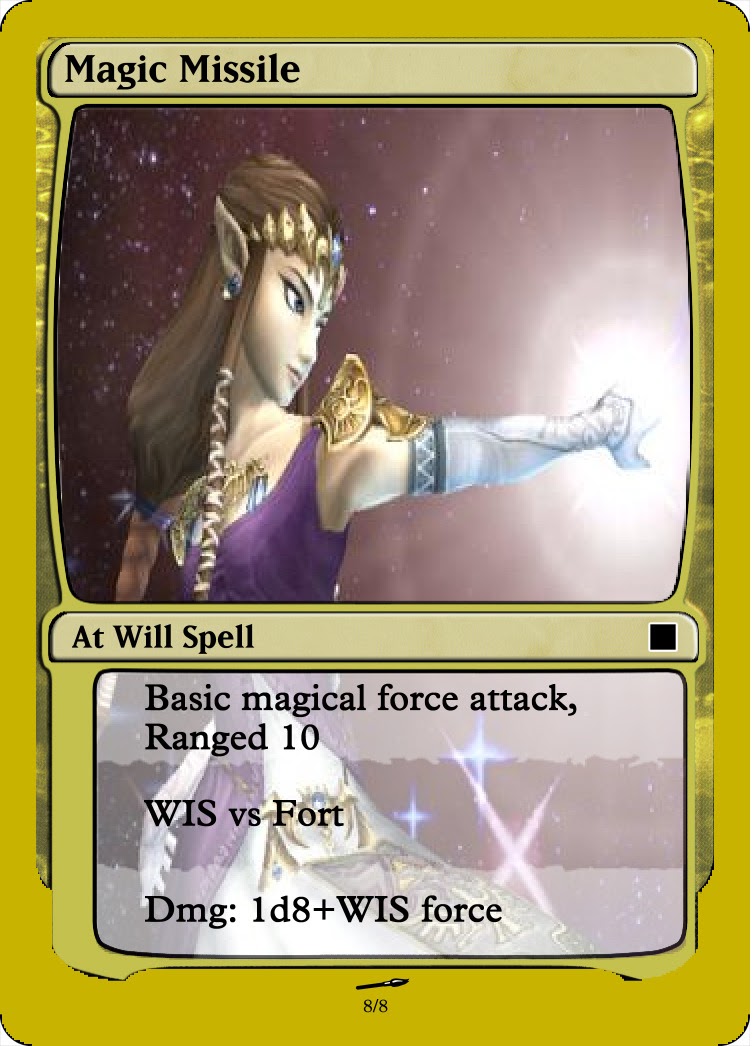


Now, you may ask, what is a Courage Power Attack and a Wisdom Power Spell, you may ask? And why do they have numbers in the upper right corners of the cards (where the Magic: the Gathering casting cost would be?) They're not Legend of Zelda-specific Action Points. During the course of play, Link can accrue Courage points, and Zelda gathers Wisdom points. They can spend those points to use their "Power" attacks and spells. While they each only have one "Power" ability, they will learn more throughout the campaign.
So, with the "Number of Hearts" mechanic replacing "1/2 Level", and the unlocking of new powers by learning them in-game, we've pretty much done away with "levels" as we knew them in D&D, but still have a way for Link and Zelda to grow more powerful.
We also no longer have to worry about experience points. Now, how do Link and Zelda gain Courage and Wisdom points? I'm thinking that an at-will attack that hits and does damage is worth 1 point. Slaying different creatures will be worth between 1 and 5 points. I think they will also be found in breakable jars and crates and skulls throughout dungeons (though they will probably be pretty rare).
Next up in this series: some monsters for the first area and the first dungeon, and probably some discussion on what the plot should be.
Sunday, January 16, 2011
4e Movement Issues
In D&D 4E, characters and monsters can move up to their speed in any direction, regardless of whether that direction is a rank, file, or diagonal. This makes no sense whatsoever.
A square on a combat grid in D&D 4E is considered to be a five foot by five foot square. So a character with a movement of six can move up to thirty feet along a rank or file. However, corner to corner length of a five foot square is just over seven feet. This means that a character with a movement of six moving completely along a diagonal line on the grid can move a distance of forty-two feet.
That’s twelve extra feet of movement. Or, two and a half squares, along a rank or file.
This bugs me considerably. This is probably the only area in the game that bugs me for its lack of verisimilitude. I could care less about realism in combat, except this thing just rubs me the wrong way. Considering how much they dropped and changed from previous editions of the game, I just don’t understand why D&D designers decided to stay with the square grid for combat, when there are better, more realistic options available.
The first option is a hex map. The drawback to hexmaps is that you often end up with half-hexes if you draw straight lines, because most rooms and corridors are built along ninety degree angles. This causes problems when drawing out combat on your chessex map. Can a character move into a half-hex? Why or why not? It’s really more difficult than its worth.
The second option, that I like a lot more, is simply using a ruler, and good old-fashioned inches. If a character is within a half-inch they’re considered adjacent. This is assuming you’re using circular monster tokens (squares can make things a little more confusing on that front, though not impossible). If this idea gets some traction or requests, I’ll happily come up with some printable templates for powers that use blasts, cones, circles, etc. The only problem with this approach, really, is if you have a rowdy group that tends to knock the combat board around a lot, it’ll be easier for them to cheat when they put the pieces back where they “belong”.
Subscribe to:
Posts (Atom)