Labels

Showing posts with label Castle Ravenloft. Show all posts

Sunday, December 18, 2011

Microlite74/Castle Ravenloft Mash-Up Progress

In my last post I identified a number of things I wanted to accomplish to make the M74 Castle Ravenloft game run more smoothly. These were:

Random Event Chart in lieu of drawing Castle Ravenloft "Encounter" cards.
New chart for "What's in the Newly Explored Tile".
New Random Monster Chart including stats and possible treasure.
A chart for determining traps on a tile, separate from the Random Event Chart.

I present my progress below.

Random Dungeon Event Chart (my first D30 table! I don't even own a D30, sacrilege I know, but I've totally got an app for that...)


D30 Dungeon Events Table

Using the “Countdown Dice” mechanic: DM has a dWhatever that starts on a 1. Player rolls same size dice. If player’s roll is greater, nothing happens, and DM’s countdown die increases by 1 for the next player’s turn, who will also roll same size die. If a player’s roll is equal to or less than the number of the DM’s countdown die, roll on this chart. (Note: some of this flavor text I took right off the Encounter cards from the board game, so I apologize to WotC for any copyright infringement)
1. Crippling Miasma: a horrid stench of decay fills the air. Each Hero’s speed is reduced by 1. Fortitude save ends.
2. Howl of the Wolf: from somewhere deeper in the crypts, a wolf howls. 1 monster makes an immediate attack.
3. Choking Fog: acrid, yellow smoke fills the crypt, causing you to choke and cough. Reflex save to hold breath or take 1d6 damage.
4. Gray Ooze: a puddle of gray ooze forms at your feet and attacks! Plus 6, 1d6 dmg, Poisoned (Fortitude save ends).
5. Reinforcements: 1d4 monsters arrive from the nearest unexplored edge and attack!
6. Howling Ghost: a shrieking banshee emerges from the shadows; its howl causes you to recoil in agony. 1d6 dmg to all heroes on tile (Presence save halves)
7. Treasure Chest: you find an ancient chest with a rusty lock.
8. Hands of the Dead: several crawling claws attack all the heroes on the tile. Plus 6, 1d4 dmg and Slowed (Presence save ends)
9. Bat Swarm: a horde of bats fills the chambers for 1d6 rounds. All heroes must make Reflex saves to attack.
10. Blood Frenzy: All monsters make an attack.
11. Strahd’s Minions: Strahd appears and teleports hero to a far-away tile. Add two monsters to the destination tile.
12. Adventurer’s Past: a ghost of a long-dead adventurer appears. Presence save or run towards closest unexplored edge and explore.
13: Strahd Attacks: Strahd appears out of the shadows and tosses a fireball at you! Plus 6, 1d8 dmg, Reflex save halves. Strahd disappears into the darkness.
14. Prowling Spirits: Cold, spectral hands grasp at you. Reflex save or lose an item.
15: King Tomescu’s Portal: You stumble into an unseen portal, and disappear until your next turn, when you reappear elsewhere on the board. While gone, you are attacked three times at plus 6 1d6 dmg.
16. Strahd’s Hunger: Strahd appears! His gaze overwhelms you. Will save or 1d6 dmg.
17. Deadly Shadows: voices in the darkness whisper corrupting lies about your friends. Will save or attack the closest one!
18. Strahd’s Whispers: Strahd’s voice compels you to attack your closest friend if you fail a Will save.
19. Corner of Your Eye: You investigate something moving in the darkness.  Explore the closest unexplored edge. You have initiative against any monster you find there. You also gain 1d6 HP.
20. Haunted Mists: Undead monsters gain plus 2 to hit and to damage for 1d6 turns.
21. Spider Webs: hundreds of tiny spiders drop a web on you from above! Reflex save or Immobilized (Fort save ends)
22. Green Slime: a blob falls from the ceiling and attacks every hero on the tile. Plus 6 1d6 dmg, and then slithers through a crack in the floor.
23: Cackling Skull: a phantasmal skull floats through the crypts, laughing hideously. Presence or Will save to avoid being Dazed (Will save ends)
24: Mists of Terror: a whispered chant echoes through the crypts, and a white mist flows past you. Reflex save or be Immobilized in terror (Presence save ends)
25: Overwhelming Terror: shrieks and howls can be heard somewhere in the crypts. Presence save or run three tiles towards the entrance.
26. Patrina Velikovna: The ghostly image of an elf maiden appears before you. She smiles for a moment, before unleashing a blood-curdling shriek. Shriek plus 7, 1d6 dmg, all monsters move closer to the heroes.
27.The Ghost of Prince Aurel: a ghost appears in the corridor ahead of you; its ghastly features freeze you in terror. Presence save or Immobilized (Will save ends).
28. Music of the Damned: the haunting sounds of an organ fill the tombs, chilling you to the bone. All monsters gain plus 2 to hit and to damage for 1d6 rounds.
29. Blood Fog: a dark red fog rolls through the area, filling monsters and heroes alike with a bloodlust. All attack rolls of 18 or higher result in critical hits.
30. Summoning Circle: a misstep disturbs a strange magic rune, and a monster materializes next to you!


What's In the Newly Explored Tile? 1d12 (Dungeon Events produced from this chart do NOT reset the DM's countdown die)
1. Nothing
2. Nothing
3. Monster
4. Monster
5. Monster
6. Monster and Dungeon Event
7. 2 Monsters 
8. 2 Monsters
9. 2 Monsters
10. 2 Monsters and Dungeon Event
11. 3 Monsters
12. Treasure
Every tile has a 1-in-6 chance of being trapped. 


Hey, there's a trap on that tile! What is it? Roll a d8!
1. Circle of Death: All Undead gain 1d6 HP when triggered. 
2. Alarm: 1d6 new monsters appear each round for 1d6 rounds or until the Alarm is deactivated. 
3. Net: A huge net falls on all heroes in the tile (+6, Slowed on a hit, Reflex save ends). 
4. Poison Darts: +4, Poisoned on a hit, Fort save ends)
5. Crossbow Turret: Bolts fire out of holes in the far wall, +7, 1d6 dmg
6. Fire Trap: Jets of fire from walls and ceiling, +8, 1d8 dmg
7. Teleport Glyph: Reflex save or teleport to random/dangerous spot in dungeon. 
8. Spear Gauntlet spiking up out of the floor: +6, 1d8 dmg

Hey, you killed a monster! I bet it dropped some treasure. What did it have in its little horde? 
This is a series of charts. First roll 2d6 here:
2. White: Weapons
3. Red: Potions
4. Green: Rings n Stuff
5. Fortune
6. Gold
7. Gold
8. Gold
9. Fortune
10. Green: Rings n Stuff
11. Red: Potions
12. Black: Magic

You found Gold! Roll 2d10 to see how many pieces of gold you found!
2. 100
3. 75
4. 60
5. 50
6. 40
7.30
8. 25
9. 20
10. 15
11. 10
12. 15
13. 20
14. 25
15. 30
16. 40
17. 50
18. 60
19. 75
20. 100

How Fortunate! You've gotten a Fortune of some sort. Roll a d10. 
1. Breath of Life: Regain 1d8 HP
2. Shake it Off: Choose a hero and end any one condition that a Save could end
3. Intimidate: Move a monster up to 2 squares away
4. Burst of Speed: Move up to your speed
5. Heroic Stand: Gain +2 to hit and to damage for the next 1d6 turns
6. Run!: Gain +2 to speed for 1d6 rounds
7. Guided Strikes: All heroes gain +2 to hit until your next turn
8. Harrowed Experience: Gain 1 Experience Point
9. Action Surge: Make an extra move or attack right now!
10. Moment’s Respite: The DM sets his Dungeon Event Die back to 1. 

Looks like you found a magical ring or something. Roll 2d10. 
2. Ring of Wisdom: +2 to Will saves
3. Ring of Courage: +2 to Presence saves
4. Ring of Toughness: +2 to Fortitude saves
5. Ring of Quickness: +2 to Reflex saves
6. Ring of Accuracy: +1 to ranged attacks
7. Boots of Striding: +1 to Speed
8. Polymorph Wand: Choose a monster within 10 squares. Roll for a new monster and replace the old one if it fails its saving throw. Wand has 1d6 charges
9. Amulet of Protection: Gain +1 bonus to all saving throws
10. Lucky Charm: Reroll any die roll, and discard
11. Lucky Charm: Reroll any die roll, and discard
12. Gauntlets of Ogre Power: +2 to damage with melee weapons
13. Blessed Shield: +1 to AC
14. Wand of Teleportation: Teleport any monster on your tile up to 3 tiles away. 1d6 charges
15. Bracers of Defense: +1 to AC
16. Ring of Shooting Stars: +5 to hit, 1d6+3 dmg, range 10
17. Ring of Wisdom: +2 to Will saves
18. Ring of Courage: +2 to Presence saves
19. Ring of Toughness: +2 to Fortitude saves
20. Ring of Quickness: +2 to Reflex saves

Ooooh, it's a potion! Roll 2d8. 
2. Dragon’s Breath Elixir: Attack each monster on your tile at +6, for 1d8 dmg
3. Potion of Animal Control: Control a single animal for 1d6 turns
4. Potion of Undead Control: Control 1d6 undead for 1d6 turns
5. Potion of Invisibility: Lasts 1d6 turns, or until you make an attack
6.Potion of Strength: +1d4 dmg on melee attacks for 1d6 turns
7. Potion of Healing: Regain d8 HP
8. Antidote: End a Poisoned condition
9. Potion of Speed: Move twice your speed for 1d4 turns. 
10. Potion of Recovery: End any one condition that a Save could end
11. Potion of Extra-Healing: Regain 2d8 HP
12. Holy Water: A vial of Holy Water does 1d6 damage against undead. 
13. Potion of Animal Control: Control a single animal for 1d6 turns
14. Potion of Fire Resistance: Lasts for 1d6 turns
15. Potion of Undead Control: Control 1d6 undead for 1d6 turns
16. Dragon’s Breath Elixir: Attack each monster on your tile at +6, for 1d8 dmg

Cool, some magical item, roll 2d6
2. Crystal Ball: Explore any unexplored edge from anywhere on the board.
3. Wand of Magic Missiles: 3d6 charges, 1d6 damage each. 
4. Glyph of Warding: Place the glyph on any tile. The first monster to enter that tile takes 2d8 damage.
5.Wand of Fireballs: 2d6 charges; 2d6 dmg to everyone on a single tile, save halves
6. Staff of the Elements: +2 to damage with spells
7. Thieves’ Tools: +4 to thievery checks
8. Wand of Magic Missiles: 3d6 charges, 1d6 damage each. 
9. Thunderstrike Staff: Cast lightning bolt at will (+4 to hit; range 10; 1d10 dmg)
10. Wand of Frost: 2d6 charges; freeze a creature in place, save ends
11. Necklace of Fireballs: Attack each monster on a tile within 5 squares. Ranged attack +3, 2d8 damage. 1d6 fireballs on the necklace
12. Tome of Experience: Gain a level between quests. 

A magic weapon? Awesome! Roll 2d6!
2. Holy Avenger: Longsword +2, +5 vs Undead
3. Vorpal Sword: +2 to hit and to damage, Critical damage on a natural 18 or higher
4. Elven Shortbow +1 (+3 if wielded by an elf)
5. Blessed Mace +1 (+3 if wielded by a cleric)
6. Longsword +1
7. Morningstar +1
8. Hoopak (Staff w/sling at top) +1 (+3 if wielded by a halfing)
9. Dwarven Battleaxe +1 (+3 if wielded by a dwarf)
10. Vampiric Dagger +1 (regain 1d6 HP on a critical hit)
11. Dragontooth Spear +2 (+5 to hit and damage vs Dragons)
12. Vengeful Battleaxe +2 to hit (+4 if target has hurt you)


As far as the monsters are concerned, I have gone through and made stats for all the monsters I plan to use in the game, and will be printing out cards from Magic Set Editor. I think I've accomplished my goals and then some. We'll be playtesting, hopefully, later this week. 

Saturday, December 17, 2011

Microlite74/Castle Ravenloft Mash-Up, First Playtest

Castle Ravenloft/Microlite 74 MashUp

So last night I ran the minions through a playtest of the Castle Ravenloft board game, using mostly Microlite74 rules. Due to a dead battery in the family minivan that needed to be removed and recharged at the auto parts store, I didn't have quite as much time to prepare as I would have liked, so I wound up winging a lot more of it than I would have liked.

Everybody still had a blast though. They're at the age that (mostly) mindless hack n slash is a lot of fun, and I gave them that in spades. The basic scenario was that they are all residents of Barovia. A werewolf recently attacked the town and they followed it into the crypts below Castle Ravenloft, and set about exploring these crypts to find it and slay it.

We went around the table, with each hero taking a turn to move and take an action of some sort. I had a d12 set to count upwards, ticking up on every player's turn. On their turn, I had the player roll their own d12. Rolling at or below the number on my set d12 resulted in drawing an "Encounter" card.

I used the Castle Ravenloft "Encounter" deck right out of the box, and this is something I will change for the future. Quite simply, many of the encounters don't translate very well between the board game and Microlite, so I will be going through them all and making a randomized list for next time, instead of drawing cards.

Every time they explored into a new tile, I had them roll a d10 and I consulted the following list.

When exploring a new tile:
1 Nothing
2 Nothing
3 Nothing
4 Draw Encounter
5 Monster
6 Monster
7 Draw Encounter
8 2 Monsters
9 2 Monsters
10 3 Monsters!

This worked fairly well, although I will probably change a roll of 3 from "Nothing" to "Monster". There were a couple moments when it seemed they were almost overwhelmed by numerous monsters on the board. This happened when they split up and started exploring without communicating with each other or having any kind of plan.

Monsters were determined according to a random list. 2d20, with each result getting crossed off after it was rolled and the rest of the list moving closer to the middle. This was, I believe, too many. Next time I will trim down the list (although most monsters appeared 2 or 3 times), and have full stats printed on the list. My lack of prep time meant I was running it using the list I had typed out on my phone, which was not ideal.

This brings up another point which I was foolish to overlook: I constructed the list from what minis I had, mostly from the Castle Ravenloft board game, and a few others. Unfortunately, not all of these monsters appear in the Microlite74 monster list. So I had to wing a lot of that, and I think the monsters could have been a lot more interesting than what they wound up being. Grells and Gibbering Mouthers, for example, do not have a counterpart in the M74 monster list.

Monsters acted after the hero who discovered them. This I would change to a die roll to see if the monster wins initiative, which could be as simple as an "evens or odds" roll (or even a quick paper-rock-scissors against the player!). I also tried to keep track of which monsters appeared on which player's turn, and have them act in that initiative order. In the future, they'll be acting when the turn order comes around the table to me.

OR...

We'll make a complete switch and do it as a group thing. That might make a lot more sense. Actually... Yes. We'll get rid of the round-the-table turn thing and force them all to work together and decide what to do as a team.

Another thing I'll add is more treasure. I didn't give out very much, mostly because they didn't fight many monsters that would really necessarily drop treasure. Granted, the kids never asked to search any of the monsters for treasure either, but... it'll be more fun if they do find more treasure.

All in all, the kids had a good time. One of the best things you can do for kids when playing D&D is have them roll lots of dice, even if they don't really do anything on their turn, and this system did that, which kept them engaged and focused. I definitely have a nice big list of things to do now, which I'll be posting up here as I accomplish them. Once I have a nice tight package, I'll put it all together in a PDF.

To Do:
Random Event Chart in lieu of drawing CR "Encounter" cards.
New list for "What's in the Newly Explored Tile".
New random monster chart. This must include monster stats and possible treasure.
Chart for determining if a tile has a trap in it, and what kind of trap (this should be separate from the Random Event Chart).

Friday, December 16, 2011

The Minions are Getting Restless

The minions are really excited and pumped to play Castle Ravenloft using the Microlite rules. And by really excited, I mean it was all they were talking about after I asked them about it. Furthermore, the two oldest children, as chance would have it, each have a friend spending the night tonight, and those friends will undoubtedly want to play. 

So much for taking my time and preparing. Here's to winging it! 

My plan is to have children start rolling their new 1st level characters as soon as I get home. They all already know what they want to be: a tiefling thief, a half-elf druid, a human cleric, and an elf fighter. The elf paladin is subject to a dozen mind-changes over the course of the day, but at the moment, elf paladin it is. The other visiting children will play fighters of some sort, as they have never played any type of D&D before. 

I did have one thought concerning the Encounter cards. In the Rules as Written for the board game, an Encounter card is drawn whenever a new tile is placed that has a black triangle, or when a player does not explore a new tile on their turn. My gut instinct is to tone this down for the Microlite rules, and make it more random. So, I will have a special D12 set aside. On the first player's turn, it will be set to 1, and I will roll another D12. If I roll a 1, an Encounter card will be drawn. Otherwise, no Encounter card. On the next player's turn, the special D12 turns up to 2, and I roll. On a 1 or a 2, we draw an Encounter card. And so on and so forth. Whenever an Encounter card is drawn, the special D12 goes back to 1. We'll see how it goes. I can always make the dice smaller. 

I'm still going to have to adjudicate the card drawn on the fly. There's not really any way around that at this point. But no matter what, it'll still be good D&D fun. 

Thursday, December 15, 2011

Thoughts on Running Castle Ravenloft with Microlite74

So, the kids have been itching to play Castle Ravenloft and Wrath of Ashardalon. This has generally been an exercise in frustration, as the two youngest are six and eight years old, and they don't quite grasp the strategic elements of which powers to use. Generally, its a lot of the same difficulties I ran into running 4E with them. 

However, as my recent blog posts attest, they have been very much enjoying playing with the Microlite rules, so my brain naturally started cooking up ideas for how to play the CR/WoA games with Microlite rules. 

There are some parts of the board games that will be easy to convert. Building the dungeon as they go, for instance, is a no-brainer. The monster AI as written on the cards won't be necessary, as I'll be the DM. 

I really like the Monster Deck mechanic, but I don't particularly want to make up a ton of new cards with M74 monster stats (though I started just such a project in Magic Set Editor). I'm thinking instead of a random wandering monster chart to possibly roll on whenever they explore a new tile. I'm thinking a 2dWhatever chart, with the weaker monsters in the middle (at the height of the bell curve) and the stronger monsters on the ends. Monsters would get crossed off as they are encountered, with the rest of the chart moving up or down closer to the middle, so the dungeon randomly gets more dangerous the deeper they get. 

I think that's a good start. Next up, we've got the Encounter Deck, which comprises traps and other events that alter play (moody music playing somewhere, drawing a wandering monster, chamber fills with blood mist, a ghost comes through, an earthquake rattles everything, etc). I'm going to need to take a bit to actually look through the cards again, but my gut feeling is that I may be able to use the cards as written, perhaps changing instances of "1 damage" to "1d6 damage". 

There are four "Conditions" that appear in the board games that were ported over from 4E. These appear often on the "Encounter" cards, so I will need a standard way to adjudicate these. They are: Slowed, Immobilized, Dazed and Poisoned. M74 has four saving throws: Fortitude, Reflex, Will, and Presence. I don't think, however, that it would be a good idea to match each saving throw to a particular condition. Rather, it would be on a case-by-case basis, and then I would have to record each instance so that precedents can be maintained. 

Anyways, I'll be taking a closer look at everything in the box this evening and should have some better ideas on how to make it work. Since we seem to have an extra night a week to play in addition to our now regularly scheduled game with their grandfather, I may just have them roll up new characters for a Castle Ravenloft mini-campaign. 

Monday, May 9, 2011

Castle Ravenloft Encounter: In Depth

In depth: Using the D&D Adventure System components in your 4E game. 

The Dungeons and Dragons Adventure System Board Games, Castle Ravenloft and Wrath of Ashardalon, feature what is basically a very stripped down version of the D&D 4th Edition Core Ruleset. Gameplay mechanics allow a group of players to delve into a dungeon crawl scenario without needing a Dungeon Master to control monsters or spring traps. The games come with 40 unpainted D&D miniatures, numerous tokens, and tiles that serve as the play area, which are interlinkable; the dungeon builds itself as players explore it, and is never the same twice. 

Tiles, monsters, treasure, and events are randomized through shuffled decks of cards. 

In preparing for my 4e game's journey into Castle Ravenloft, I was able to adopt a lot of the mechanics from the board games for the dungeon. The last thing I wanted was another boring delve with preplanned encounters, and this worked surprisingly well. 

The Set-Up

I went through all the tiles for Ravenloft and Ashardalon and made a single stack, primarily consisting of tiles with doors and hallways. I left out a lot of the tiles that were full rooms. I found the Secret Stairway tile and put it in the stack about 20 tiles down. Once a character stepped on a tile, I would place any adjacent tiles in a way that made sense. 

My players are currently fifth level, so I started scouring the Monster Vault and MM3 for beasties that would fit the general undead theme, between levels 3 and 7, and found several that worked. I pared down the list to about 15 or 20. 

Then I opened up Magic Set Editor and got to work. This was the time-consuming part, but it was made easy by having the WotC D&D Compendium open. Copy and paste and a little formatting, and pretty soon I had a deck full of monsters. 

I went through the Encounters decks for both Ravenloft and Ashardalon and started taking notes for some traps and events to spring on the heroes, and made individual cards for those as well. 

I got into Adventurer's Vault 2 and picked out a dozen magic items to drop in, and made cards for those (I do that for all magic items found in-game, though), copy and pasting from the Compendium. 

Treasure drops were random, based on d12 rolls, and the amount varied with the different creatures. I placed the number of rolls on the treasure chart as the monster's "casting cost" in the upper right corner. I made cards with the random charts on them to have right in front of me. 

Print out the cards on decent cardstock paper, cut out and shuffle into a deck (leaving out the individual magic item cards, hand those out when they come up on a roll for treasure). Draw a card on every character's turn as they move through the dungeon. I admit I tended to skip the draw a few times if they were getting swamped, but as soon as they took out a couple monsters, I started drawing again. 

You'll want to have figures or tokens set aside for all possible monsters to avoid bringing the game to a halt while you search for them. Other than that, using a little common sense while you implement the results of the card draws goes a long way. Spread the monsters out around the board if you can. And don't draw yourself into a corner with your tile placement!

Sunday, May 8, 2011

Islands in the Sky, Session 4: Expedition to Castle Ravenloft, or how to use the Castle Ravenloft board game in your D&D 4E game.

First of all, apologies to everyone for the slow week posting here. Real life is busy, blah blah blah.


Love Stinks

We held our fourth D&D session last night. In attendance were myself, my wife Gabby, Kevin and Curtis. Lisa and Joey were unable to make it, and we don't anticipate seeing Joey again, as he and Lisa had a nasty break-up during the week. Bah. Drama. Lame.

Recap

Anyways, in Session 3, the Heroes foiled an Arkhosian plot and recovered a magical item, a large crystal ball that was the focus of the Dragonborn spell. The ritual would have caused dragons within a certain radius to become enraged and come attack the island. Fortunately, the heroes disrupted the casting of the ritual and no dragons came to Verys Hiladian.

So, just what is this large crystal ball? It is adorned with an ornate brass dragon circling it again and again, the feet of which come down for the ball to stand upon. No one knows. They informed the village council and the Princess about the dragonborn attack, and there immediately began a debate about whether to evacuate the island or fortify defenses.

To Barovia!

However, there was a more pressing matter for the heroes to attend to: the return of the human bodies and rescued prisoners to their home island of Barovia. Khaledra, Tarak, Avenger, and the Ice Queen accompanied the airship; Ember, the genasi swordmage formerly played by Joey, remained on Verys Hiladian to help fortify defenses for the impending Dragonborn invasion. After three uneventful days of travel, the heroes arrived at the mist-shrouded Shadowmote of Barovia. During travel, one of the rescued prisoners, a young widow named Jennalynn, develops a strong infatuation with Tarak, our half-orc ranger. She tells him the story of how her husband disappeared, probably killed by monsters, shortly after their wedding. He has not been seen since. Some think he succumbed to the shadow madness and leapt off the island; others believe he was taken by Count Strahd into Castle Ravenloft for crimes unknown.

Barovia is a small island, just a couple square miles. It is dominated by Castle Ravenloft on one end, atop a large hill, that overlooks the village below. The people here are all human! They are poor, hardscrabble folk who barely survive, and there are just a few hundred of them.

The Mists part and allow them to enter Barovia, land on the island, and begin unloading the bodies, but it is not long at all before the Mists gather again and a messenger comes forth. The ship's crew and the villagers all suddenly fall asleep, all except the heroes. The messenger informs the heroes that their presence has been requested at Castle Ravenloft; Count Strahd wishes to meet them himself. With that, the messenger disappears and the Mists part, showing the heroes the path to the Castle. They follow the path up the hill, all the while feeling like they're being watched. The Castle's drawbridge lowers for them, and they enter.

Into Castle Ravenloft

Here's where the fun begins. Instead of mapping out the monster-infested lower level of the Castle, I took some inspiration (and tiles) from the Castle Ravenloft and Wrath of Ashardalon board games. I built a randomized stack of dungeon tiles from the board game and laid tiles out as the heroes moved deeper into the dungeon. They were searching for the Secret Staircase to allow access to the upper levels of the Castle, and presumably to find Strahd.

This entire dungeon level counted as a single encounter, no resting. I printed out a custom-made "Encounter" deck which consisted of several monsters and a number of Events (such as traps, alarms, ghostly sightings, etc). Each monster dropped treasure, which was rolled for randomly. A strict adherence to initiative was kept, and on each player's turn (for the most part), a card was drawn off the Encounter deck and applied to the board as I saw fit. If a monster was drawn, they were simply added to the initiative stack before the hero whose turn it was. The cards for the monsters had their full stat-blocks printed on them, so there was absolutely no need to flip through the Monster Manual or Open Grave books.

This wound up all working very well. It didn't at all adhere to published encounter standards, but we don't keep track of experience points anyway. Tarak was the only hero who made it to the stairway without being Bloodied. Overall, there was definitely tension at the table as they explored and never knew what was coming around the next corner.

Final Tally

By the end of it all, the heroes took out a swarm of crawling claws, three deathjump spiders, several zombie and skeleton minions, a flaming skeleton, three very hungry ghouls, a couple dire rats and a brain in a broken jar.

Final tally on treasure: 190 gold pieces, vial of Beastbane, 5 potions of healing, 5 random ritual scrolls (to be determined as yet), 5 potions of recovery (homebrewed potion which allows a character to regain the use of a spent encounter or daily power), Hero's Armor +2, Alfsair Spear +2, and a Blooddrinker Axe +2.

It was a long, drawn-out combat encounter, yes, but it was constantly changing and so it didn't get boring. The exploration and combat together worked very well, as did the randomization of the dungeon itself with the board game tiles and the Encounter deck I built. I will be more than happy to make a PDF of the Deck available for download. It contains all the monsters, magical item treasure, randomness charts, events, and character cards for a few NPCs, one of which being Count Strahd. If people are really interested in how I went about putting it all together, I'll be more than happy to do a full blog post on how it works.

Sunday, April 24, 2011

Orcish Horde!

So it was probably a few weeks ago that this was released...

http://www.wizards.com/DnD/Article.aspx?x=dnd/duad/20110408

But we finally got a chance to run it with the minions and my father-in-law this Easter afternoon. In case you didn't click on the link, it goes to an official WotC mini-campaign for the D&D Adventure System that combines monsters, encounters, and treasure from both the Castle Ravenloft and Wrath of Ashardalon board games. 

Once again we played with four kids and my father-in-law, and I took care of running the monsters. Dragonborn Wizard, Eladrin Wizard, Dragonborn Fighter, Human Rogue and Human Ranger. They would have won the scenario if the kids had a better grasp of class roles and strategery. As it was, I kept reminding the wizards that they didn't have to get right next to the monsters to attack them with their spells. Hopefully, the more we all play, the more of the strategy and tactics they'll figure out. I don't want to tell them how to play their characters, of course, but it's difficult sometimes when they're completely missing very clear and obvious courses of action. 

However, the more I think about it, the more I see how well-suited these games are for introducing new players to full-on D&D 4E. So, once the minions are consistenty kicking Ravenloft and Ashardalon's butts, we'll start introducing more and more concepts from D&D into the games until they are ready to take on a regular game. That's the plan anyway! 

Regardless, the new adventures/mini-campaign combining the two games are solid entries in the franchise. The chosen monsters and encounters definitely give these adventures a unique feel apart from the two games they're take from. We played the first scenario, in which the goal is to save the kidnapped villagers from the orcish horde. 

It would have been an easy win if the kids had any tactical sense about them whatsoever. As it was, the tile that flipped over that had the villagers was 2 tiles away from the Start tile, which was the escape route for the kidnapped villagers. By that time, the heroes were pretty well beat up and started needing to use healing surges pretty quick, and within a full turn around the table, the game was over with a downed hero. 

Maybe next time we'll do some combat and tactics gameplay theory, but I'm not sure it'll hold their attention. We'll see. 

Friday, April 22, 2011

Get the Gauth!

Get the Gauth! 

Last Sunday night we got to play some D&D Adventure System Wrath of Ashardalon with the minions and my father-in-law. We played the adventure that introduces the Door rules (4 or 5?), and ends with finding the Horrid Chamber and the Beholder Gauth and crew inside. 

Since all four of my reading-age children wanted to play, and my father-in-law, I opted to simply control the monsters on each player's turn. Whenever I play with the kids I usually have to interpret monster actions from the cards for them anyway, so I figured this would speed up gameplay quite a bit. I had hoped that would be the case, anyway. Like in standard 4e D&D, players taking their time choosing their actions in combat can be a big time-suck in the D&D Adventure System. Having five players can also cause things to drag on. I think three players might be ideal. Regardless, the kids love it. I did eventually wind up taking over for the 6-year-old, because he was getting tired (it was almost 9pm by the time we finished). 

Anyways, we were (just barely) triumphant over the beholder, though this may be because we stopped drawing Encounter cards once the beholder was placed on the board. That was more an effort to speed up gameplay, as it was getting to be time to get on home. 

We wound up playing with Heroes from both Ravenloft and Ashardalon, and they all worked just fine. I cannot recommend these games enough. The box may say ages 12+, but all my children are younger than that and it plays just fine. It'll probably take them several more sessions before they start to grasp more the more strategic elements of cooperative gameplay, but we all had fun. It definitely gave me some food for though regarding a rules hack to allow for a Dungeon Master, Campaign Play, and more Roleplaying elements, but that's all fodder for another post. The Castle Ravenloft game has given me plenty of ideas for how to play out my 4e group's foray into Barovia in their next session as well, but I'll have to keep those details under wraps until after the session plays out. 

Wednesday, April 6, 2011

Wrath of Gravestorm!

So, me and my 7-year-old stepdaughter went for an expedition into Castle Ravenloft last night. We attempted to find and slay the Dracolich "Gravestorm". We found him all right. Sadly, we failed to slay him, even after destroying his phylactery (which, by the way, my stepdaughter was able to pronounce perfectly!). She played the elven paladin from Wrath of Ashardalon. I played a homebrewed character, Ninjadorg's samurai. Things were pretty smooth sailing to begin. A lot of 1xp monsters came our way, and they were largely easy pickings. My samurai leveled up on a natural 20 early on. We got some good treasure, too. 

Things were going well. A little too well...

Everything went downhill as soon as we found Gravestorm. A spear trap activated. Followed by an alarm, which immediately started summoning monsters. I had the Thieves' Kit, and got the alarm deactivated, but not before it had summoned a 3xp Gargoyle. My daughter made it across the board to destory the phylactery, but when she made it back to fight the Dracolich we were very quickly surrounded by the Gargoyle, a Ghoul, and two blazing skeletons, all creatures that do damage even when they miss. We did manage to get Gravestorm down to his last three hit points, but we were out of healing surges and fell quickly. We're fixing to try again with a different set of characters. 

I liked playing the homebrewed Samurai (go see ratdorg.blogspot.com). The paladin, who is from Wrath of Ashardalon, definitely held her own. We probably could have won, had the monster cards come out in a different order. Regardless, we had fun, with lots of tense moments there at the end, and my stepdaughter really wants to play again. Hopefully the rest of the children won't be bogged down with too much schoolwork and will be able to join us next time. It would have been better if there were more heroes on the board. 

Sunday, March 27, 2011

Ravenloft-Ashardalon Mash-Up

In my last post, I talked about some of the mechanics behind Monster deck construction for homebrewed adventures with the D&D Adventure System Games, Castle Ravenloft and Wrath of Ashardalon. Today, we’re going to look a little closer at just what our options are.

As I said before, you want 12 1xp monsters, 12 2xp, and 6 3xp, for a grand total of 30 cards in your deck.  There are three of each monster in the decks that come with each game, so you really have 4 1xp monsters, 4 2xp, and 2 3xp.  

Castle Ravenloft Monsters
Kobold Skirmisher, 1xp (Reptile)
Zombie, 1xp (Undead)
Wolf, 1xp (Animal)
Rat Swarm, 1xp (Animal)
Spider, 2xp (Vermin)
Blazing Skeleton, 2xp (Undead)
Skeleton, 2xp (Undead)
Ghoul, 2xp (Undead)
Wraith, 3xp (Undead)
Gargoyle, 3xp (Elemental)

Wrath of Ashardalon Monsters
Human Cultist, 1xp (Human)
Orc Archer, 1xp (Orc)
Kobold Dragonshield, 1xp (Reptile, Sentry)
Snake, 1xp (Reptile)
Orc Smasher, 2xp (Orc)
Cave Bear, 2xp (Animal)
Duergar Guard, 2xp (Devil, Dwarf, Sentry)
Grell, 2xp (Aberrant)
Gibbering Mouther, 3xp (Aberrant)
Legion Devil, 3xp (Devil)

So we have 20 monsters to fill 10 spots in the deck.  The first and most obvious cross-platform scenario that jumps out at me is something involving Kobolds, and I would construct the deck like so: Kobold Skirmisher, Kobold Dragonshield, Orc Archer, Snake, Spider, Orc Smasher, Cave Bear, Grell, Gibbering Mouther, and Gargoyle. This combination of monsters provides more of a feel of an abandoned mine-complex that has been taken over by some feuding Kobolds and Orcs.  

I would use the Ashardalon Encounter and Treasure decks.  

The goal of the scenario could be as simple as killing a certain number of monsters, or getting deep enough in to find a boss (possibilities from the official material include: Klak Kobold Sorcerer, Kraash Orc Storm Shaman, Meerak Kobold Dragonlord, the Rage Drake, and the Beholder Gauth.  There’s no reason deeper role-playing elements couldn’t be used, such as a negotiation of some sort between the Orc and Kobold factions (although the Rules as Written don’t provide much support for anything like that; we’d have to come up with something based off the 4e ruleset... Skill Challenges for the D&D Adventure System, anyone?).

For the more undead feel, Ravenloft plays quite nicely with a couple substitutions from Ashardalon.  Trade in the WoA Human Cultists for the CR Kobolds, the Duergar for the Spiders, and the Legion Devils for the Gargoyle.

I’m pondering a variant ruleset that would feature a Dungeon Master to run the monsters and support more role-playing and puzzle-solving elements for the games. I’ll have a post on that up in the next few days.  I’ve been painting minis, too, so I should have some pics up of my work pretty soon.  I’m no expert (actually, I’m colorblind with shaky hands, so I’m starting at a handicap) and haven’t painted minis since I was 10 and got a little crazy with my Heroquest set.  The ones I’ve done so far look good enough to use at the table, though, that’s for sure.  

Thursday, March 24, 2011

D&D Adventure System Customization!

So, this blog has apparently been getting a number of visitors who found me on google while searching for content related to the Wrath of Ashardalon and Castle Ravenloft D&D Adventure System board games. Cool! What people seem to be looking for are ways to put the two games together into a singular experience, either through mixing the games together for a single delve, or through a longer, tied-together campaign. I'm going to start working on some custom homebrewed adventures using both games together, but in the mean-time, I offer up some guidelines for crafting your own. 

First, start over at boardgamegeek.com. The forums there for Wrath and Ravenloft have a lot of custom goodness, from adventures and heroes to additional cards and guidelines for campaign-play. Wrath of Ashardalon, out of the box, does support "mini campaigns", which allow you to keep treasure and boons between adventures, but the heroes are still limited to 2nd level. There are a couple different offerings on the boardgamegeek.com forums on how to handle leveling up past 2nd level without breaking the game. 

When mixing the games for a new experience, one thing to remember is to not just shuffle the monster decks all together and see what happens. The 30 card monster deck is key to the feel of an individual adventure. Construct your monster deck with 12 1xp monsters, 12 2xp monsters, and 6 3xp monsters. I would select one or the other of the encounter decks to use. 

The treasure deck can be a little tricky. Wrath of Ashardalon treasures have prices on them, while Castle Ravenloft treasures do not. Ninjadorg (http://ratdorg.blogspot.com) has a list of suggested prices for Ravenloft treasures, which I would just go ahead and write directly onto the Ravenloft treasure cards. 

One of my players biggest complaints about the D&D Adventure System games versus full-on 4e play was that he "missed the talking." The games are not designed with role-playing in mind. However, next time I'll take a look at how to add some more role-playing elements to the games, along with campaign play and leveling past 2. 

Sunday, March 20, 2011

Wrath of Ravenloft... Erm, I mean, Castle Ashardalon

We finally gathered a couple friends for some expeditions into Castle Ravenloft on Saturday night, and we had a pretty damn good time. We played the adventure with the kobold sorcerer Klak, who is an obnoxious, cowardly villain, as he regularly explores more of the board, which spawns more and more monsters to get in our way. We did eventually defeat him and his chaos-inducing artifact, though. 

The second adventure we played was the revenge of the Night Hag, and we managed to handle that one pretty well. Good rolls helped a lot. It was definitely an interesting one, as each of the players start play at each of four corners of a five-by-five tile grid, and often got teleported around the board by the Night Hag. 

In the morning, we played a Wrath of Ashardalon adventure with our two boys, aged 6 and 9. The goal was to sneak into Ashardalon's lair, recover a certain treasure, and then escape with it. We had to use three healing surges, but it worked out at the last second, as Gabby found the treasure and we escaped by the skin of our teeth. It was definitely a tense few moments there, especially as the monsters ganged up on Gabby in the turn before she could escape, and the Rage Drake, the Cave Bear, and Ashardalon himself ALL missed! Whew!

On another note, my friend Kevin, who joined us for Ravenloft last night, came bearing a gift: the World of Warcraft board game. He apparently got it on sale over a year ago, at half-price, played it once, found it to be entirely too complicated, and never did much with it since. So he brought it over and gave it to us! While it is definitely a complicated game, with a lot of moving parts and stuff to keep track of, it does come with a SHIT-TON of miniatures! Good God! Over a hundred monsters and a dozen heroes and villains! Some are perfect fits for custom homebrewed Heroes and Monsters for the D&D Adventure System games, and most of them will get extensive use in our regular 4th Edition game, whenever the hell we actually get to play again. There's like 18 Gnolls, so I'm thrilled, not to mention great figures for elementals, wraiths, sahuagin, demons, younger dragons and drakes, werewolves, human bandits/warriors... The heroes and villains are also all very nice, and I think several of them will find use in Castle Ravenloft and the Wrath of Ashardalon. I used one of them for the Ranger in the game this morning with the kids! The wife and I are fixing to start painting a lot of the figures this week, and I'll be posting up photos of the final products as we finish them. 

Wednesday, March 16, 2011

Good Stuff

I know, I know, posting has slowed down of late. This is primarily due to working overtime and children's activities keeping me pretty busy.  So, this will be short, but hopefully sweet.

First, I found what seems to be a pretty helpful site for 4E Dungeon Masters: Adventuringkit.com allows you to do three things: build custom monsters, build encounters, and string those encounters into full-on adventures. The monster builder seems pretty robust and easy to use.  The encounter builder allows you to use those monsters and create a (very basic) map. Building adventures seems mostly limited to a few text boxes and links to the aforementioned encounters.  If you have an Android phone, this guy has built a free app that pulls up monster stat blocks from the DDI Compendium (assuming you have a subscription, of course!), which is called KMonster.  I would assume that KMonster and AdventuringKit work together pretty well, but I have yet to test that theory, as I do not have any Android devices.  However, I will be throwing together some encounters and monsters using this software and I will post them up here when I have them completed.

Secondly, I found some really awesome stuff for the D&D Adventure System board games, Castle Ravenloft and Wrath of Ashardlon. These are Dungeons & Dragons games, and like every iteration of D&D, beg for houserules and customization.  What is really awesome about these games is that it is incredibly easy to maintain game balance, once you've played the game a few times, while introducing new, custom, homebrewed goodness.  Here is an article by Ninjadorg on the merits of solo play with these games, but really I'm pointing you to this article because of all the linkage to an abundance of additional material that is very easy to use with these games.  In my opinion, a lot of the suggestions fix some things I didn't like about the games (such as monsters always winning initiative). Ravenloft and Ashardalon have been filling my D&D void lately, and I have been very excited to see so much homebrew stuff for these games, especially so much stuff that looks as good as the official WotC product.

Saturday, January 15, 2011

First Impressions: Castle Ravenloft Board Game

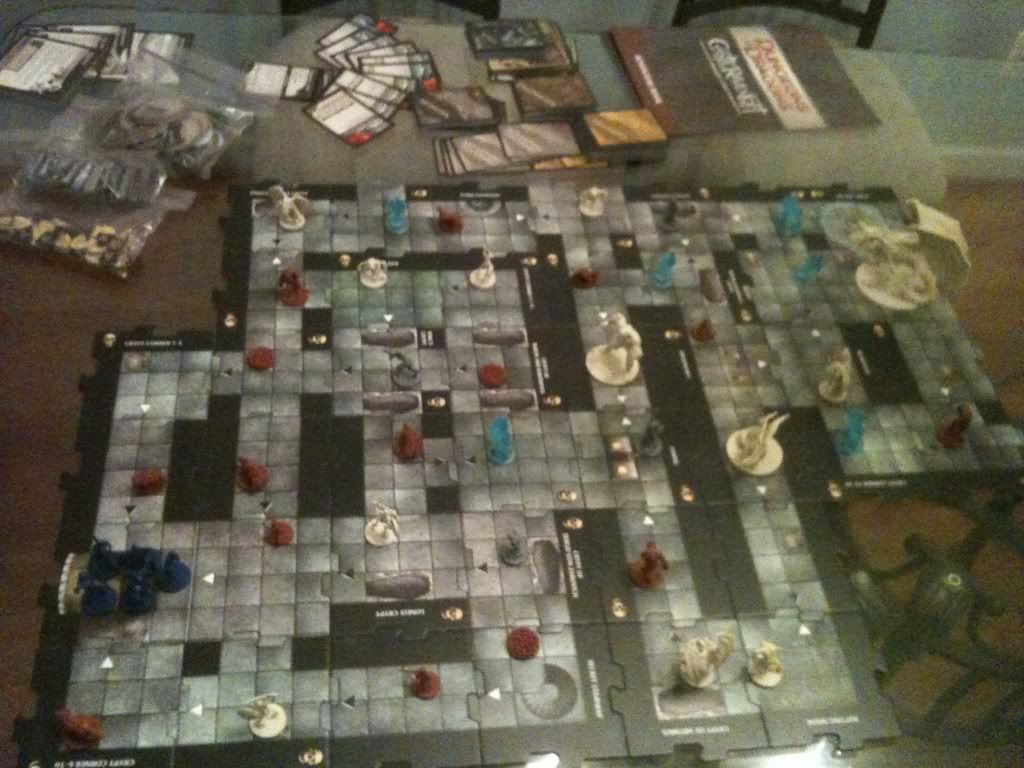
All the pieces on the board...


Since I mentioned it in my last post, I thought this would probably be the best thing to review next. 

Just like the Monster Vault, this box comes with a whole lot of stuff, and requires a certain amount of organizational capability to get the most out of it.  There are so many different pieces of heavy cardstock that get used in the game, from Hit Point counters to Dungeon Tiles, item markers and Player Character cards, if you can’t keep them organized you’ll have a hell of a time getting the game to run smoothly. Plastic baggies worked pretty well for me. 

There are forty plastic minis, 35 monster and 5 heroes, including a big nasty Dracolich.  I’m probably more looking forward to using these minis in my actual D&D 4E game than with Castle Ravenloft..

Same goes with the tiles that make up the dungeon as well.  They could very easily be used for a proper D&D game. 

You also get a d20 with the game.  Woohoo!

It is very much a simplified D&D 4E.  So simplified, that it’s kind of confusing.  There is no Dungeon Master, for starters!  The monsters are controlled by the individual player that encounters each monster, and the monster’s actions are dictated by what their little playing card says they’ll do.  Oh, and did I mention that the monster always wins initiative?  Pretty much every time a monster is discovered, it gets to make the first attack, usually against the hero that finds it.  It was definitely an exercise in frustration to roll for the hero to attack and miss, and then roll for the monster to attack and have it hit, almost every time, which was what happened to my eight-year-old son.  His wizard was the first to run out of hit points are require a healing surge (of which there are 2, to be shared by the whole team).  I’m surprised he still wants to play again. 

For its faults, the system still seems to work pretty well.  It is not an easy game to win, certainly, but it’s not too terribly difficult either.  Like any D&D game, a string of bad rolls can really cause some damage. 

I would have preferred to have some kind of Dungeon Master running the monsters, with a little more freedom to choose what they do.  Maybe that would make this game a little too much like “HeroQuest” but I think it would give it more of a D&D feel.  My plan is to work up some houserules to incorporate a DM into the game, and find a happier medium between this system and the 4E rules as written. 

Hell, I may just teach the kids 4E and be done with it, and use the pieces and adventures of Castle Ravenloft for our D&D game instead!