Labels

Showing posts with label Legend of Zelda. Show all posts

Monday, September 17, 2012

Hyrulian Adventures: Session 1


I was a little stressed out leading up to getting started yesterday; I haven’t run a D&D game in several months, and running a game for the kids can always be a challenge. On top of that, I didn't have as much prepared as I would have liked, and knew I would be winging some of the session. We started with character generation. We had five characters fully done up within an hour and a half. Microlite characters are pretty straightforward, of course, and most of the time was taken up buying supplies.

I explained it in an earlier post, but I’ll recap here. PCs start basically as level-0 townsfolk with three stats: Strength, Dexterity, and Mind. Stats are calculated using 12d6, dropping the three lowest rolls, and assembling three scores with what remains and assigning as the player sees fit. Ability modifiers are calculated by taking the score, minus ten, and divided by 2, rounded down. They all get 12 HP plus a Strength bonus. They all rolled on my Character (Family) Background Generator, which gave us the children of a barber, a forester, a farmer, an arrowsmith, and explorers. There are no levels. Character improvement happens through acquiring items in-game, training with NPCs, and success with certain tasks in the field. I’m still ironing out some of the details, but I have plenty of time and some good ideas, I think.

Regardless, things got off to a start with some combat. I’ve learned that with the kids, they need some action to start things off. So I explained the situation, plopped down a battle map, and we got to rolling dice.
They nearly died.

It was fantastic.

So, having successfully fended off the bokoblin attack and defended their fellow villagers and the refugees, they set off to help the town by acquiring more weapons and armor. They upgraded their “weapons” (really just hunting tools) by having the town blacksmith do a little work on some of the swords that were dropped by the bokoblins from the attack in town.

They have a general map of the area (which belongs to the daughter of the explorers), and they were faced with a few options. First, Lon Lon Ranch is some five or six miles from Kakariko Village, and there was some concern if the ranch would be okay. Also, Ordon Village, some twenty miles to the south, could also be in need of assistance. Finally, there was an area on the map clearly marked “Ruins” to the Northwest (the remains of the original Hyrule Castle, perhaps…?). They eventually settled on heading to the Ranch.

A random encounter happened first. Currently, as it is always dark and Hyrule is crawling with monsters, I’m rolling for every mile travelled. I roll 2d6, and if either face pops up a 1, bam, random encounter. Snake Eyes would be the discovery of something fairly major.

They came across a ruined tower, though it still had a second floor at least. It also had a pair of bokoblins guarding the entrance. An ambush took the guards out and they set up to move in. My father-in-law directed their movements, and they made quick progress with good cover, and the encounter with another four or five bokoblins inside didn’t last very long.

They did, however, fail to investigate upstairs. Not sure why, as bokoblins were coming at them from upstairs, but I wasn’t about to remind them. The tower’s not going anywhere, and whatever was up there will still be there, right? Maybe? Who knows.

They made it the rest of the way to Lon Lon Ranch, where they met Malon and her father Talon. Malon is the twelve year old girl who really runs the Ranch, and Talon does what he can to help out. When they come up, she is armed with a shortbow and certainly not thrilled to have strangers, but is willing to let them stay the night in the barn if they help out repairing the ranch.

Oh, and there’s a cave nearby where all these monsters seem to keep coming from, and little Malon just hasn’t been able to get over there and clear it out. Could you guys investigate?

In they went. Numerous encounters with Deku Baba plants later (the little bastards kept popping back up out of the ground after they killed them, wonder why...) and they were face to face with some robed evil dudes creating bokoblins in some kind of foul ritual involving rupees. The robed guys went down fairly quickly, but not before one of them toasted our heroes pretty good with a fireball attack of some sort.

Of course, the two youngest adventurers took the bait of the evil-looking daggers dropped by the robed fellows. And as they were trying to leave the dungeon, fighting their way through the Deku Baba plants that had grown back, one of the plants grabbed the boy as he tried to stab it with said evil dagger and chewed him up good. The rest of the group took the plants out and hauled the boy out, but he would need a few days to recover, and that only with the aid of some famous Lon-Lon Milk. Needless to say, they’re not really sure what to do with those daggers now…

And that’s where we left things. The plan is for some of the adventurers to borrow horses from Lon-Lon Ranch, leaving the injured boy there for a few days while they head back to Kakariko to deliver some of the weapons they’ve acquired, and then head back to Lon-Lon and then down to Ordon Village. We’ll see how things go, of course.

Overall, a good first session for the campaign, I think. If there’s anything that’s going to kill the kids, though, it’s greed. They all suffer from “Gimme Gimme” syndrome; they all want the shiniest new thing to show up, and it’s always a competition amongst all of them to see who can get it. They were going after fallen rupees in the middle of combat. Seriously. It nearly killed a couple of them on a couple of occasions. Once that nonsense started, any thoughts of taking it easy on them vanished. Not that I was fudging any die rolls (everything gets rolled right out in front of God and everyone), but I certainly wasn’t going to bring my B-game as far as tactics with the monsters was concerned. After all, they had been warned before the game started that their characters were fragile and could easily be killed if they weren't careful...

The kids had a good time, though. There was certainly some frustrations from every seat at the table at some point, be it from a string of poor die rolls or lamenting bad decisions, but all their characters (barely) survived to see another session, so we’ll continue on!

Sunday, September 16, 2012

Hyrulian Adventures Begin


Hyrule has known peace for a thousand years at least, under the strong but caring leadership of the Royal Family.

All that changed last Thursday morning, when the earthquakes began. While rare, earthquakes are perfectly natural events, and certainly no cause for alarm. Until they continued. For three days. Much of Kakariko lay in ruins, only the sturdiest buildings surviving.

The next day, a boy, carrying a shield and a sword and wearing a green tunic, rode into town, and sought out the elder Sahasrahla. Within a couple hours, he was gone again. Apparently, he was the “Hero of Legend”, but you had never heard of this legend before.

Then the monsters came.

And then the darkness followed. The sun has not been seen in days. You can hear the howling of the monsters in the wilds.

A few hours ago, refugees arrived from Hyrule Castle Town. Hundreds of people, many of them injured, all of them terrified of what they had seen at the castle. Monsters had descended upon the town, undead rising up from the cobblestones, and the castle torn up from the very ground itself, and by some magic remains suspended there, transformed into a twisted, evil, Forbidden Fortress.

The refugees and other survivors have been gathered in the village temple. There are a few soldiers with them, and their primary concern is building up defenses for the village and its people. No one knows what has happened to the Royal Family. None of the survivors knows anything about the “Hero of Legend”. The Elder Sahasrahla pulls the five of you aside. He fears the worst; the Hero has fallen, and the Triforce of Courage is shattered and scattered across Hyrule. This evil, these monsters, can only come from someone wielding the Triforce of Power, and if what the refugees say is true, there is a good chance that someone has taken captive Princess Zelda, the bearer of the Triforce of Wisdom.

The Triforce of Courage must be recovered, reassembled, and wielded by someone pure of heart if there is any hope at all of returning the light to Hyrule! 

But first, Kakariko Village must be defended from attack...

Friday, February 24, 2012

Hyrulian Adventures: Some Monsters

Hyrulian Monsters and other DM notes

Hyrule is not normally filled with monsters. The demons currently plaguing the countryside are not of this world. They are sorcerous creations sent to wreak havok and plunge Hyrule into chaos. The foul ritual that creates them uses some of Hyrule's essence, be it gems from the earth, other pieces of nature (Deku sticks and nuts, for example), or the strength of its peoples. Because they are not natural, when monsters are destroyed, they disappear, sometimes leaving behind rupees, a heart, or some other item. Rupees can be collected and spent later by PCs. Hearts, when found, must be used then to recover 1d4 hit points. If a PC grabs a heart while they have maximum hit points, they gain nothing. 

And some monsters: 

Bokoblins are vile little humanoid creatures, about four feet tall, with a toothy maw and green or blue skin. They typically carry crude spears or swords (1d8 damage) and are rarely encountered alone, typically marauding in a band of 3d4 of the creatures, with one Leader. They have a love of bloodshed and causing mayhem. Their weapons are shoddily made, and automatically break on a natural attack roll of 5 or less. Unarmed bokoblins attack with their clawed hands for 1d6 damage. 

Bokoblin: HD 1d8, AC 12, +1 attack, 1d8 (armed) or 1d6 (claws) damage, save 18 
2 in 6 chance of dropping either heart (1-3) or single rupee (4-6)

Bokoblin Leader: HD 1d8+2, AC 13, +1 attack, 1d8+1 damage (armed) or 1d6+1 (claws), save 17. Leaders carry better weapons (usually longsword, which only break on an attack roll of 1) and a wooden shield. Always drop either heart or a 5-rupee piece. 

Photobucket Pictures, Images and Photos
Moblins are big and mean. Eight feet tall with a pig-like face and furry red skin, these are elite soldiers. They are usually armed with a large morningstar (1d10 damage, STR 15 to wield) and armored (Banded mail, though it is too large for a PC to wear). 

Moblin: HD 3d8, AC 16, +3 attack, 1d10 damage, save 15. They always drop 2d6 5-rupee pieces and a single heart. 


Keese are dark winged rodents that are often found in dungeons. They have a wingspan of 1 foot and are more nuisance than threat. There is a fiery version as well. 

Keese: HD 1d4, AC 18, +4 attack, 1 damage, Save 20. 1 in 6 chance of dropping either single rupee or heart. 

Flaming Keese: HD 1d4, AC 18, +4 attack, 1 fire damage and victim must make Reflex save or take 1 additional fire damage next round; Save 20. 1 in 6 chance of dropping a single rupee or heart. 

Photobucket Pictures, Images and Photos
Deku Baba is a monstrous plant. It has a large, bulbous head that opens to reveal rows of sharp teeth. It is rooted in place by a five foot long stalk, but can attack anything that gets close enough. 

Deku Baba HD 2d8, AC 15, +3 attack, 1d6 damage, victim must make reflex save or be grabbed in Deku Baba's mouth. Deku Baba does 1d6 more damage each round until victim makes fortitude save to break out. Save 17. The Deku Baba's weak spot is its stalk, which has an AC of 18, but a blow with a bladed weapon automatically severs it from the ground, destroying it. Deku Baba grow back in 10 minutes unless root is dug out and burned. Always drops either Deku Stick or Deku Nuts. The root, when burned, leaves behind a single 10 rupee piece. 

Thursday, February 23, 2012

Hyrulian Adventures: Character Generation

Character Generation

These rules are based on Microlite and as such are Open Game Content.

PCs are human and hail from either Kakariko Village or Hyrule Castle Town. 

Roll 3d6 in order to determine your PC's Strength, Dexterity, and Mind ability scores. You may switch one score with another. Ability modifiers are as follows: Score minus 10, divided by 2, round down. 

There are no classes, nor do PCs gain levels. PCs can use any weapon and wear any armor, as long as they meet the minimum Strength requirement. 

A PC's starting Hit Points equal their Strength score plus 1d8. 

Armor Class equals 10 + Dexterity modifier + Armor Bonus. 

There are three different attacks a PC can make: Melee, Ranged, and Magical. Add Strength modifier to Melee Attacks, Dexterity modifier to Ranged Attacks, and Mind modifier to Magical Attacks. PCs do not start with any Magical Attack they can perform, but there are items they can find in-game which will allow them to. 

There are three saving throws: Fortitude, Reflex, and Willpower. PCs begin with a +4 modifier to each saving throw, plus ability score modifiers: Strength modifier to Fortitude, Dexterity modifier to Reflex, and Mind modifier to Willpower. When a saving throw is called for, a PC must roll a d20 and add their appropriate saving throw bonus. A total of 20 or more means they saved. 

Players start with 3d6 times 3 rupees, and a backpack and small money bag. 

PCs can carry a number of items up to their Strength score, including weapons and armor. 

Now, obviously, because they have no levels or bonuses from their classes, these starting characters are not quite as strong as standard Microlite characters. That is the idea; they are basically 0-level mooks to start. If they survive their first foray into the monster-infested wilderness, it won't be long before they find items to grow stronger and more powerful. Dungeons are filled with these types of treasures; they also abound in secret, hidden places in the wilderness, and can be bestowed on a PC by an NPC. 

The PCs begin knowing very little about the world. They know the area they are from, and the locations of other human settlements and the major landmarks of Hyrule (Death Mountain, Lake Hylia, etc). They know that beastly monsters have been seen in the wilderness, that Hyrule Castle Town is overrun with monsters, and that Hyrule Castle itself has been transformed into an evil fortress. They know the world has gone dark. Visibility outside is approximately 50 feet. 

The few soldiers that escaped with the refugees from Hyrule Castle Town are tasked with the defense of Kakariko. They have begun the process of forging weapons and armor and training able-bodied men and women to defend the town. 

At the beginning of the game, heavy weapons and armor are not yet available for sale in Kakariko Village, and won't be until the town is armed for defense to the liking of the soldiers. This process will take one month, unless the PCs help by taking weapons from monsters and donating them to the town. For every five weapons the PCs donate, the town becomes one day closer to being properly armed. 

The following items for adventuring can be found at the General Store:

Lantern (holds 1 pint of oil, visibility 20 ft): 10 rupees
Oil: 5 rupees per pint (pint lasts 4 hours)
Torch (burns 1 hour, visibility 20 ft): 1 rupee
Waterskin: 3 rupees
Rope 50 ft: 5 rupees
Grappling Hook: 10 rupees
Ten-foot pole: 1 rupee
Backpack: 5 rupees
Small Money bag (holds 50 individual rupees): 5 rupees
Flint and Steel: 5 rupees
Tent: 5 rupees
(Bug-Catching) Net: 5 rupees (use DEX bonus to catch something in the Net)
Bottle: 10 rupees

Armor:
Leather AC +2  10 rupees
Studded Leather AC +3  30 rupees
Wooden Shield  AC +1 (Min STR 13) 10 rupees

Weapons:
Hand axe 1d6  10 rupees
Hunting knife 1d4  5 rupees
Staff 1d4  5 rupees
Bow and arrows 1d6 (Min STR 13) 20 rupees
Sling 1d4 (Monster must make a saving throw or be dazed for a round if attack scores a Critical hit)

Hyrule Historia

It is apparently Zelda week here at the Pack of Gnolls. This post outlines a bit more of my design philosophy for Hyrulian Adventures. Later today I will post the promised Character Generation guidelines.


The Legend of Zelda video game series has continued on for more than 25 years. Personally, I've played most of the games, but have only actually conquered two: Wind Waker and Twilight Princess. When you get down to it, I'm just not all that great at video games. 

One thing about the Legend of Zelda series that I personally find simultaneously interesting and inane, is the long-term debate over the Zelda Timeline(s). If you thought D&D edition wars were bad, check out the debates that rage every time a new Zelda game is released and throws the various timeline theories into chaos with new information. 

In December 2011, Nintendo released a book called the Hyrule Historia, which purports to be an "official" timeline of the video game series. It was only published in Japanese, so I'm relying on this Zelda wiki article

http://www.zeldawiki.org/Timeline

to get the gist of it all. While there are a couple of inconsistencies, overall it makes sense, I suppose. As the publisher's "official" word on the subject, I guess we have to accept it, but I personally think it's a load of bull. Nintendo has consistently pursued gameplay first in game development, and handled storyline after the fact. Certainly, some titles reference events in other games, and some are obviously direct sequels to what came before. There was never a grand design for a timeline for the games. I wouldn't be surprised when the debate is renewed again after the next game is published, and numerous details throw the entire thing once again into question (unless of course they include, in the instruction manual, exactly when amongst all titles and branching timelines this next game falls). 

Personally, I prefer to think of the games as "but one of the legends of which people speak", as stated at the beginning of The Wind Waker. This is my design philosophy as I develop my Microlite-based Legend of Zelda RPG. 

Each individual Zelda game is but a different version of the Triforce story: evil Ganon seeks the power of the Triforce, and the Hero, Link, must undertake an adventure to defeat Ganon and save Hyrule. In this table-top game, the Hero of Legend is defeated and it is up to the people of Hyrule (the PCs) to stop Ganon. 

I will be drawing inspiration from many of the different video game titles as I develop my Hyrule for my players to explore. This rendition does not fall into any place within the canonical timelines. It is Hyrule, it is plagued by evil, and it must be saved. 

Wednesday, February 22, 2012

Hyrulian Adventures: Basic Premise

Hyrule has known an age of peace and prosperity. All this changes quickly, however. First came three days of earthquakes, which have altered the landscape dramatically. Next came sightings of monsters in the wilderness. People began talking of ancient legends, and then a young man in green appeared, the Hero of Legend. He spent a few hours in Kakariko Village and then disappeared into the wilderness. 

Three days later, the land of Hyrule was plunged into an unnatural darkness. The sun is yet to rise. Refugees from Hyrule Castle Town have arrived in Kakariko Village, telling stories of demons stalking the streets and the overnight change of the Castle itself into a terrifying fortress, and no one knows what is become of the Royal Family. 

The village sage fears the worst: Ganondorf has returned, seeking the ancient power of the Triforce, and the Hero of Legend has fallen. Legend says that if the Hero falls, the Triforce of Courage will be broken into nine pieces and scattered across the land. These pieces must be recovered before Ganon finds them! 

Hyrulian Adventures: Initial Thoughts

Translating the Legend of Zelda video games to a tabletop D&D RPG has, thus far, been an interesting thought experiment. There are numerous conventions within the video game series that strain credulity within a D&D context. Here are a couple examples I am contending with as I build "my" Hyrule. 

Artificial barriers in the maps. In the NES Legend of Zelda, bushes and rocks were often used to block Link's progress or separate parts of the map. Obviously, these types of barriers make little sense in D&D, as clever players can easily get around them. These include the common convention, ever since Link to the Past, of requiring certain items to open up new parts of the map, such as the mallet or the power bracelet. 

Bottles. Why are there only three or four bottles Link can use to carry things in, but endless supplies of ceramic jars to break? Why can't Link just buy a simple glass bottle in a store? 

Obviously, these things serve a certain purpose within the video games that are probably unnecessary in a table-top game. The trick is identifying which tropes exist purely as a limiting factor in-game, and twist them in such a way that they still serve a purpose in the table-top world and are fun and rewarding for the players to find. 

One of the coolest things about the original NES Legend of Zelda was that a clever player could get all the way to the final battle with Ganon without ever getting a sword. You weren't funnelled along from Dungeon A to B to C. You could go take on several different dungeons, right from the beginning, if you could find them. Very little was blocked off, in the sense that it required an item key of some sort to access. That alone speaks volumes about how much the original game relied on player exploration, skill and ingenuity. I don't want to force my players along a certain, predetermined path to get to the end. I want to give them a world to explore, secrets to uncover, problems to solve, and great rewards for doing so. 

Tomorrow: Character Generation

Friday: Monster theory and samples

Tuesday, February 21, 2012

Zeldaspiration: Hyrulian Adventures

The Legend of Zelda video games have always served as great inspiration for me, and my wheels have really been turning lately. I've always wanted to be able to run adventures in Hyrule as a table-top RPG, but I always run into the same problem when I start working on it: the story is always focused on a single character. While this would be okay for one-on-one gaming, it's not really what I'm after. 

Instead, I want to capture the essence of what makes the gameplay fun and interesting and apply it to Microlite-type D&D. 

Puzzles, riddles, secrets: this is a huge part of what makes Zelda games fun, but obviously this aspect will be confined to adventure/dungeon/world design. I want to make this as old-school as possible. Characters won't be making any "search checks".

No levels. All growth in character power is by way of earned items. This is something I love about the games. It doesn't matter how many monsters you kill or rupees you collect, you've still got to earn the Master Sword by solving the riddles to find it. 

Sandbox. The first two Zelda titles on the NES featured big, wide-open sandboxes to explore. There were hidden secrets everywhere, it seemed. Some places were much more dangerous than others, and it was easy to get in over your head. 

I will basically be developing a sandbox setting and a set of Microlite-based rules to go hand-in-hand, specifically for running Hyrule-esque adventures with my kids. They are all in love with the Legend of Zelda video games, and table-top adventuring in this style with all of them should be tons of fun. 

This won't mean the end of our Night Below Underdark adventures on Sunday, however! That game will continue on Sundays. 

Zeldaspiration: Old School Zelda

Photobucket Pictures, Images and Photos

Very interesting article here about the Legend of Zelda series' evolution through the years.

What is really fascinating is how closely the Legend of Zelda's evolution as a video game mirrors the evolution of D&D, from the little brown books to 4E and Essentials. 
 
I actually had a whole post written up analyzing this, but I realized it was probably going to wind up baiting edition warriors and Zelda fanatics, and the last thing I want to deal with here is any kind of flame war. I had a lot of thoughts on it all, but I don't want to come off as demeaning any of the many editions of D&D; I own books from every edition and I find them all useful in running my Microlite games. 

Anyway, if you're interested, it's a fascinating read and I think offers some good advice for D&D game masters, especially those familiar with The Legend of Zelda. 

Wednesday, December 28, 2011

First Impressions of Legend of Zelda: Skyward Sword

I have the greatest wife in the world. As proof, I offer exhibit Z: she got us the newest Legend of Zelda game, Skyward Sword, for Christmas. That's right, while everyone else is obsessing over this "Skyrim" stuff, I'm going old-school and working my way through yet another amazing Legend of Zelda experience. We've been taking turns playing it. I've only gotten through the first dungeon so far, but I humble offer up my first impressions of the game.

Let's get the bad stuff out of the way first.

Argh, why the hell isn't Link left-handed? Like every other Link? Ever! The motion-control wii-mote interface is pretty cool, really. Link swings his sword the way you swing your wii-mote. It works really well. The nunchuck accessory serves as your shield. However, Link in this game is right-handed, and there is no option to make him left-handed. As a lefty, who naturally holds the wii-mote in my left hand and the nunchuck in my right, this makes for a clumsy experience. The sword-swings just don't seem to work the way they ought to if I'm holding the devices in the wrong hands. So I have been forced to play right-handed, as weird as it feels. A couple thoughts on this. First of all, they really should have included some kind of option for playing the game using the Classic Controller. It could have been done if they really wanted to. And they should have given the player the option to be right or left handed. As every other lefty knows, we are part of a persecuted minority. Everything around us is designed for the majority of people in the world who are right-handed. Undoubtedly, one of the reasons I identified so much with Link in these games is that he, like me, is left-handed. Having a lefty Link is a big reason I prefer the Gamecube version of Twilight Princess over the Wii version (if you don't know, go here).

Now that I'm done bitching, on to the good stuff.

First of all, Nintendo stole my "Islands in the Sky" campaign setting. It's okay, Nintendo, I won't sue. Yet. Flying around on your giant bird is pretty fun, and the controls work really well. In fact, all the controls in the game work work pretty darn well (if you're right-handed). There are a lot of different places to explore, and a lot of areas to work through down on the "surface", where the dungeons are.

The sword-and-shield-play aspect of the game is particularly fun, and is a pretty big departure from previous Zelda titles in terms of gameplay. The direction in which you attack with your sword, and the timing of a shield-bash, are quite often key to defeating monsters. Monsters carrying swords will parry your blows. Other monsters have weak spots that must be attacked in a certain direction.

This game includes a companion for Link, this time in the form of Fi, the guardian spirit of the Goddess Sword, which Link pulls from a stone early in the game. Fi is very much a Data or Spock-like character, constantly deducing logical conclusions based on evidence as you uncover it in-game (although, really only the obvious things, she doesn't really help you with the puzzles, thank goodness).

So far, it's a very solid addition to the Legend of Zelda franchise. Like I said, I have yet to get very far, but I'll be slowly working my way through it over the next month or three.

Sunday, July 10, 2011

Zeldaspiration: Bridges

The Legend of Zelda video game for the Nintendo Entertainment System was the first game to introduce a save feature and the ability to explore the game world in any order you wished. It was the first Sandbox, a term that has a different meaning in tabletop pen and paper role playing games than video games. 

Traditionally in Dungeons and Dragons, the sandbox is a large area that the players are free to explore as they see fit, but it is much more than just that. The term is often used as the opposite of the oft-dreaded "railroad" type game. In a railroady-game, the DM often just shuttles the players along from plot point to plot point to tell his or her story, whereas in a sandbox the players are given some points of interest to explore and allowed to do as they please. 

What is special and unique about the Legend of Zelda sandbox is how it grows naturally through the course of the game, with more and more of it becoming available as Link conquers dungeons and acquires magical items that allow him to explore more of the world. 

In A Link to the Past, this often took the form of a physical barrier such as a giant rock blocking a path. These were typically things that any clever D&D player would be able to circumnavigate with little difficulty, and as such, strains the bounds of verisimilitude as well as player credulity. The real world simply does now work that way. 

My personal favorite method of unlocking more and more of the Hyrule Sandbox came in Twilight Princess.

In Twilight Princess, there are several large bridges that, at the beginning of the game, are broken and displaced to other areas of the world by the evil Darkness that has swept over the land, and at several points in the game it is required that a bridge be repaired to move on to the next part of the story. 

Bridges are important to people. Their construction often inspires awe and creates an easily used path where there was only an obstacle before. A bridge enables commerce and communication between peoples on either side. The lack of a bridge causes delays and detours. 

So, my suggestion to DMs out there is to make good use of bridges! Place one in a strategic, important place. Especially during the heroic tier in 4e, when players don't have much in the way of flying capability. Maybe one of the PCs has a relative or ancestor who helped build it. Make sure they use it numerous times by placing various MacGuffins on either side of it. This also helps the players see how the bridge helps the communities on either side of it. Perhaps one side depends on the other for foodstuffs, while the other side requires minerals or other raw materials. 

Then, have your BBEG destroy it, preferably to facilitate an escape, while simultaneously causing all manner of hardship and suffering for the many people who depended on that bridge for commerce. Make it as dramatic as possible. Done right, the violent and deliberate destruction of any important landmark such as a bridge or even a statue can be just as world-changing to the players as the death of a relative or friend, and possibly more so if they have come to have a degree of respect for how important such a landmark is to the population at large. 

Sunday, July 3, 2011

Legend of Zelda-ify your D&D Game!

Here I go, embarking on another series of posts. I will be continuing my FreeRPGDay reviews and giveaways, of course. The first winners have been posted, by the way, right here!

The Legend of Zelda video games are some of the most popular in the world, and I think they are often overlooked when we examine the resurgence of fantasy media in the past decade, in favor of The Lord of the Rings films and the oft-maligned but wildly popular World of Warcraft. Indeed, for many kids in my generation, the Legend of Zelda was their initial gateway to a world of swords and sorcery and monsters and dungeons. It was for me.

Over the years, the games have evolved with the technology level of the system they are played upon, but they have also retained some core qualities throughout, and many of these primary aspects can be quite useful to Dungeon Masters building a campaigns and adventures for their players. For Zelda nit-pickers, we are primarily examining the core console releases: Legend of Zelda, Link to the Past, Ocarina of Time, Wind Waker, and Twilight Princess.

1) Sandbox. Years before Grand Theft Auto, the first Legend of Zelda for the Nintendo Entertainment System pioneered the open sandbox. The game opens with the hero in the middle of the screen, with three directions to go, and a cave to enter. Enter the cave, get your sword, and go thee hence unto the wider world to explore. Certain areas, of course, were accessible only once the proper items were available to open them up.

2) Level-up. The method of growing your hero more powerful in the game has always been the same. You start with three hearts maximum life. At the end of every dungeon is a heart container that adds another heart to your maximum total. You also typically find some type of item that enables you to do more in the game, typically the ability to get to new areas or new weapons to fight smarter. You don't "level up" after aquiring a certain number of experience points, you do so after exploring a complicated area and vanquishing a powerful foe (and also by accomplishing the gathering of certain numbers of "pieces of heart" within the sandbox).

3) Two worlds, light and dark. Starting with "A Link to the Past", the Dark World was introduced, and the idea of two different worlds occupying the same or similar places has stuck around. In Ocarina of Time, it was the present and the future. In Wind Waker it was above and below the sea, and in Twilight Princess it was the shadow that had to be expunged by "Wolf Link".

4) Characters. Link. Zelda. Gannon. And the Triforce, reflecting all of them. These characters have been constant and make up the core of the conflict in the game. They represent each different aspect of the Triforce: Courage, Wisdom, and Power. This is a huge part of the mythology of the land of Hyrule, and is consistent throughout.

The next four posts in this series will examine how these principles can be applied to your D&D game.

Tuesday, February 8, 2011

The Legend of Zelda: A Railroady Sandbox

One of the things that the Legend of Zelda video games have always done very well is create the illusion of the sandbox, while railroading the player along the prescribed storyline. It was the first video game that allowed for open-ended exploration (some twenty years before Grand Theft Auto, I might add) and had a save feature. Basically the idea is that the player has a big area to explore, but can't explore further until the dungeon is conquered and a MacGuffin is acquired, which in turn gives the player the ability to explore new areas and find the next dungeon. 

I know I spent countless hours in every Zelda iteration just running around, trying to get a handle on the world that was available, and the resultant joy in having new areas to explore once I had the mechanical means to do so was always one of the best parts of the game. This is obviously a tradition I want to continue and draw upon for my Legend of Zelda 4e game with my kids, but I think the lessons learned here are applicable to any DM cooking up a homebrewed world. 

Start with an area big enough to explore, and with some minor treasure to pick up, but make sure the players know there is a bigger world out there. Facilitate more exploration by giving them a mechanical means to do so. In LoZ, this meant acquiring bombs or the hookshot to get to new places. In more traditional D&D, this might mean clearing out the gnolls that control the pass through the mountains, or eliminating the necromancer in the old tower deep in the forest that keeps sending undead to kill the lumberjacks. 

One thing that made the exploration so great was that persistence, curiousity, and cleverness was regularly rewarded with tangible benefits. Pieces of heart, bottles, bug-catching net, etc, that either granted additional prowess or opened up new options. This is definitely something that DMs should include in their games, especially as it rewards exploration and role-playing! 

What do you think? Are there any video game tropes you've used to good effect in D&D? 

Tuesday, January 18, 2011

Legend of Zelda 4E Great Deku Tree Monsters

Let us say that, when fighting monsters, Link and Zelda must do ten points of damage in a single hit to deplete a monster's heart point. To start, that is their average damage.  Less than ten points results in a stun but no loss of a heart. 

Which means that easy monsters should have 1 heart, tougher monsters should have 2 or 3, and the mini-boss should have 5 or 6.  (We’ll talk about dungeon bosses later)

Let’s take a look at the Great Deku Tree from Ocarina of Time as inspiration for our first dungeon adventure.  I picked four different monsters to populate this (very basic and beginner) dungeon: Keese, Skulltulla, Deku Baba, and Baby Gohma. 

The monster’s name is across the top.  Their number of hearts is at the top right.  Just beneath the picture is a list of defenses.  In the text box is movement, their attack, and any special notes.  Please note that these cards are for the DM side of the screen only. 


The mini-boss for the first dungeon’s item room will probably be a couple Skulltullas and a whole mess of Baby Gohmas and Keese.  Up next will be a dungeon map and write up for the Boss!  And maybe a little discussion on the potential plotline.  

Any thoughts, critiques, suggestions out there?  All comments are most welcome! 

Monday, January 17, 2011

Legend of Zelda 4E Starting Powers

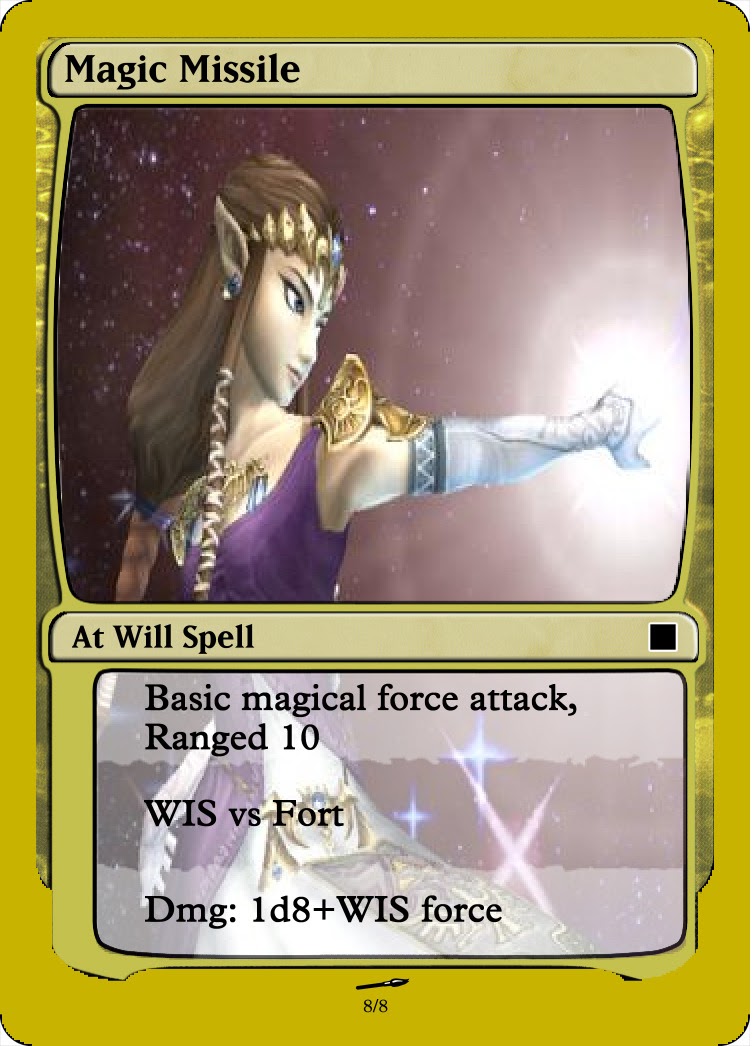
Here's my starting powers for Link and Zelda in my stripped-down D&D4E system for my kids.


Link and Zelda starting powers


Now, you may ask, what is a Courage Power Attack and a Wisdom Power Spell, you may ask?  And why do they have numbers in the upper right corners of the cards (where the Magic: the Gathering casting cost would be?) They're not Legend of Zelda-specific Action Points.  During the course of play, Link can accrue Courage points, and Zelda gathers Wisdom points.  They can spend those points to use their "Power" attacks and spells.  While they each only have one "Power" ability, they will learn more throughout the campaign.

So, with the "Number of Hearts" mechanic replacing "1/2 Level", and the unlocking of new powers by learning them in-game, we've pretty much done away with "levels" as we knew them in D&D, but still have a way for Link and Zelda to grow more powerful.  

We also no longer have to worry about experience points.  Now, how do Link and Zelda gain Courage and Wisdom points?  I'm thinking that an at-will attack that hits and does damage is worth 1 point.  Slaying different creatures will be worth between 1 and 5 points.  I think they will also be found in breakable jars and crates and skulls throughout dungeons (though they will probably be pretty rare).  

Next up in this series: some monsters for the first area and the first dungeon, and probably some discussion on what the plot should be.  

Sunday, January 16, 2011

Legend of Zelda, 4E Style


Dungeons and Dragons 4th Edition, Sullivan Houserules

Overview

I am developing these 4E Houserules as a way to teach my oldest two children, K and A, the game of Dungeons and Dragons without totally overwhelming them with options and rules.  The basics of the game are still here: Ability Scores, Skills, Initiative, Powers for combat, and the Core Mechanic of rolling a D20, adding a modifier and trying to get a certain number. 

Since K and A are a boy and a girl, the two characters in the game are Link and Zelda, Link being a martial hero and Zelda being a magic-user.  Puzzles and combat will go easier if the two of them work together and cooperate, rather than try to do their own thing (which, knowing these two, will probably be a challenge in and of itself!). 

At the bottom of this post is download links for the Link and Zelda basic character sheets.  What follows is a basic explanation of everything on the sheets. 


Hit Points are replaced with Hearts.  Link and Zelda each start with 3 Hearts.  Pieces of Heart can be found by completing small sidequests throughout the game, and also in certain treasure chests in Dungeons.  Full Hearts are dropped by boss monsters at the end of each dungeon. Four Pieces of Heart must be collected to form a full Heart.  Link and Zelda gain Hearts together

Ability Scores
Strength, Constitution, Dexterity, Intelligence, Wisdom and Charisma.  Use the following ability scores 18, 16, 16, 14, 12, 12.  The modifiers are the same as in the Rules Compendium page 63.

½ Level Rule
The ½ Level modifier is replaced by the Number of Hearts the PC has accumulated.

Link and Zelda each have a Speed of 6

Initiative=D20+Dex total

Saves
Armor Class: 10+Dex total
Fortitude: 10+Str or Con total
Reflex: 10+Dex or Int total
Willpower: 10+Wis or Cha total

Skills: Link and Zelda are trained in 5 skills. Skills are modified by the Total Bonus from the skill’s Associated Ability and Training.

Magic Items
Each PC has the following magic item slots: Head, Neck, Arms, Hands, 2 Rings, Waist, and Feet. 

Powers
Link and Zelda each get three at-will combat powers and one recharge power to start.  Further powers must be learned in the course of the play.  There are no “daily” powers. “Recharge” powers require a certain number of successful hits with at-will powers to “charge”. 


Up Next: Link and Zelda’s starting power cards!  

Thursday, January 13, 2011

Why, hello!

Welcome to my blog! This will primarily be focused on Dungeons and Dragons, a game I have been playing in one iteration or another for a good fifteen years, both as a player and DM. I have a few different projects that I am going to post here, including developing campaign settings, adventures, 4E-style Dungeon Delves, characters, ideas, thoughts, and commentary. I'll also link up to the other places on the interwebs that I'm stealing things from for my own campaigns, as well as tools and just about anything else related to Dungeons and Dragons.

The one thing I will not do is get caught up in Edition Wars or any other kind of NerdRage. There are plenty of other blogs out there that do that quite well, and I just don't have the patience for it.

My two oldest children are 10 and 8 years old. They are both very interested in playing D&D, and they (like the other children) love The Legend of Zelda video games. So, currently, my biggest project is adapting The Legend of Zelda video game world to the Dungeons and Dragons 4E system, while also simplifying the system so that it is not too overwhelming for my kids. Trying to find a balance between the 4E style of play and the feel of a Zelda game has been kind of tricky, and I am going to share what I come up with here. Interestingly, I've had an easier time adapting the mechanics than I have coming up with a storyline and dungeons. Regardless, I'll be posting a lot of that here.

Now, to kick off the new blog thing here with something totally not related to the Legend of Zelda, I give you "The Great Tree". I originally posted the kernel for this campaign setting on the WotC D&D forums, and here it is a little more filled out.


The Great Tree

The trunk of the Great Tree is two thousand miles across, with countless kingdoms and lands spread out among its huge branches. The Tree is surrounded by numerous floating earthmotes, where stone is mined for use in the kingdoms of the Great Tree

For directional purposes, North is always towards the Tree.

The huge branches tend to be about 100-200 miles across and thousands of miles long. Civilization tends to stay close to the trunk, generally within a few hundred miles. Past that, that the terrain becomes treacherous and monster-infested.

Typically, each branch is the domain of a single political entity, be it kingdom, democracy, magocracy, etc.

There are a great many carved tunnels throughout the trunk, many of which connect different branches/kingdoms. Many are Underdark-like. There are a number of Dwarven kingdoms in the trunk as well.

No one has ever returned from an expedition to the base of the Great Tree. It cannot be seen from the lowest branch/kingdom, obscured by clouds and mist.

Large, flat areas of branches are typically covered with soil deep enough to sustain some farming. It regularly rains on every level of the tree. Some areas get water from never-ending earthmote waterfalls.

The sun appears to travel around the tree, so that when the sun is behind the tree, relative to your position, it is night-time (ie, it is dark because the tree is providing shade). The sun is never directly overhead, however. High noon is when your shadow is pointed directly at the Great Tree.

Out beyond the earth-motes is sky, forever, and danger. Elementals and dragons rule the skies out there, and skyships rarely stray more than a hundred miles from the Tree.

The Great Tree is the source of all life on the Prime Material Planes. Before the Gods created Faerun, or Krynn, or any other “world”, there was the Great Tree, in the midst of the Heavens. They filled the Great Tree with all manner of creatures, natural, fey, and shadow, living, dead, and undead.

All other worlds have been populated with creatures chosen from the population of the Great Tree. All other worlds are connected to the Great Tree, so much so that the destruction of the Tree would bring an end to life on all Prime Material Planes, for it is from the Great Tree that all life flows.

Of course, the denizens of the Great Tree do not know of the importance of their hometree. Most are unaware of the existence of other planes of existence. The Gods are real and make their homes on their own branches of the Great Tree. Those branches are very well protected, and the gods are not often found there, anyway.

There is one group, however, that does know of the Tree’s history and importance: Melora’s Guardians. They protect both the Tree and its people from threats abyssal and elemental.
The Primordials are jealous of the Gods, and the life-sustaining power of the Great Tree. They seek to tear it down. Those from the Far Realm seek only to corrupt and feed off the Great Tree; they are abominations and must be destroyed.


Well, that is my overview of "The Great Tree" campaign setting. There is definitely a lot of room to expand, and plenty of possibilities for adventure. I'll start filling in the branches as inspiration comes to me.